The investigation into the “No Fuel / No Start” condition has led us deep into the van’s literal nervous system. What we found behind the panels isn’t a factory Ford harness; it’s a dense, custom-engineered web of 1980s surveillance tech.
The Discovery: The Lost Schematic
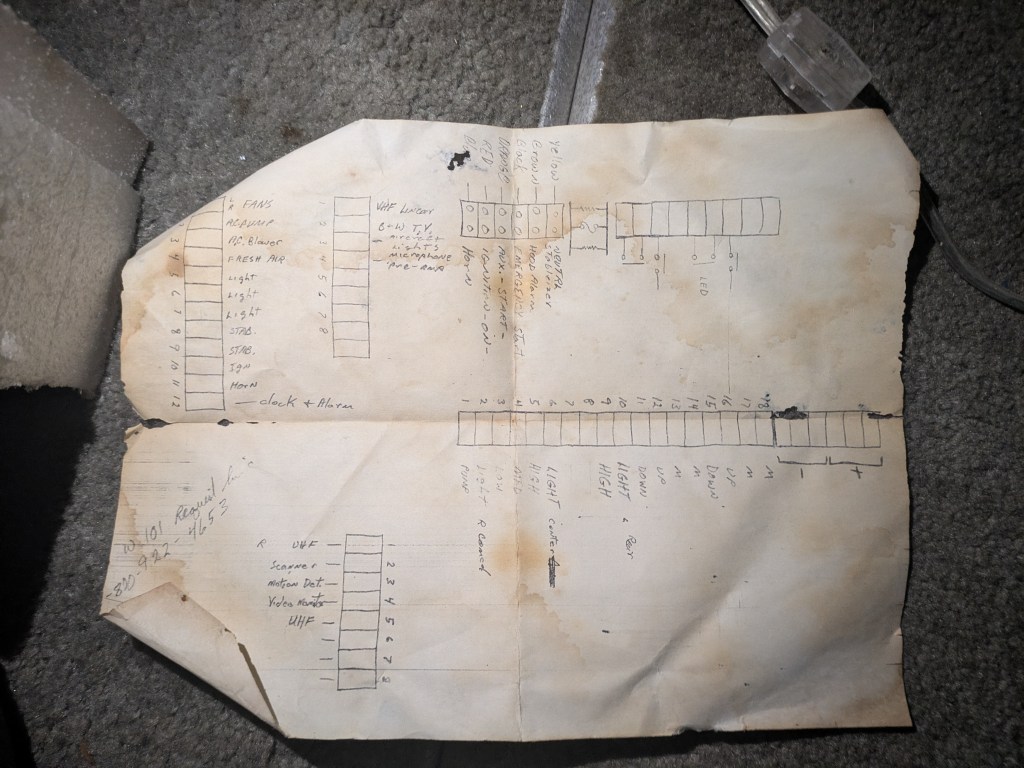
After hours of tracing blind wires, we found it: a hand-drawn, aged schematic folded up and forgotten under a seat.
- The Clue: The diagram confirms the complexity of the Seatron build, showing pinouts for “VHF Linears,” “Aircraft Lights,” and “Motion Detectors”.
- The Breakthrough: Most importantly, it reveals a “Clock + Alarm” circuit and an “Ignition-On” trigger. This is the first paper trail linking the surveillance grid to the Ford’s engine.
The Suspect: The AutoPage 4242 Interlock
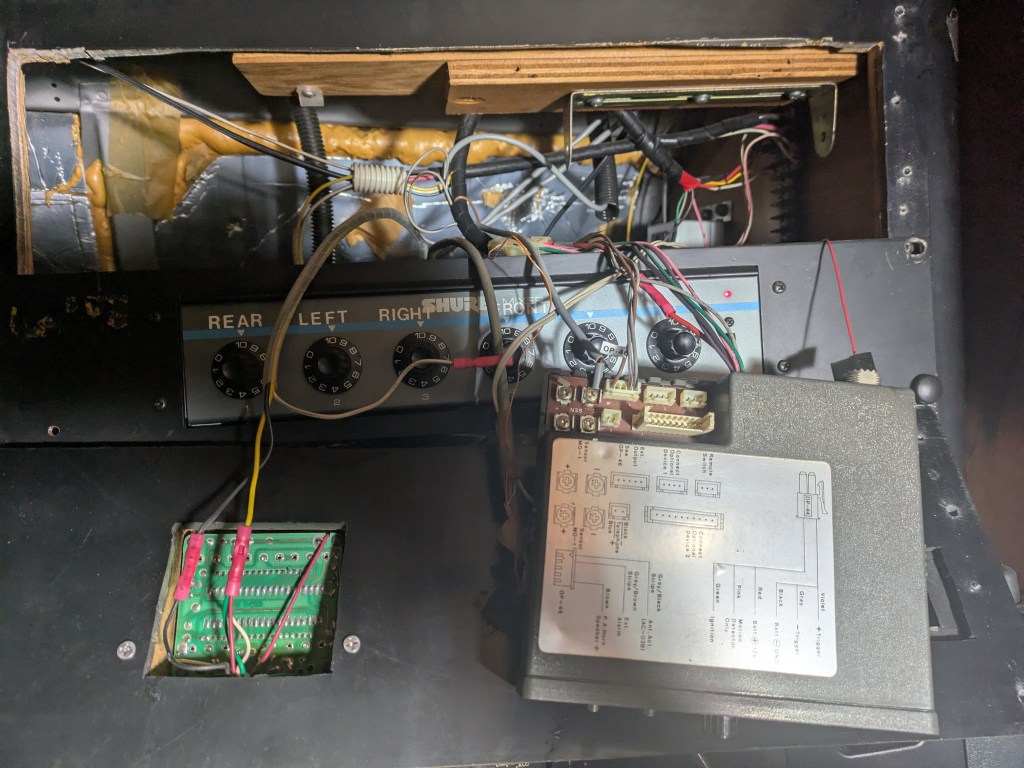
The heart of the “No Start” mystery possibly lies in the AutoPage 4242 alarm module we unearthed.
- The Forensic Detail: The module’s diagram shows a “Green” wire for Ignition and a “Pink” wire for a Motion Detector, amongst others. Additionally, we found a hidden switch behind the driver seat in the cab connected to the alarm system.
- The Theory: In high-stakes surveillance, these alarms weren’t just for sirens; they were often wired as Ignition Kills. If this vintage brain thinks the van is being tampered with—or if a 30-year-old relay has simply fused shut—it will cut power to the fuel pump relay indefinitely.
The Chaos: The Hidden Fuse Block
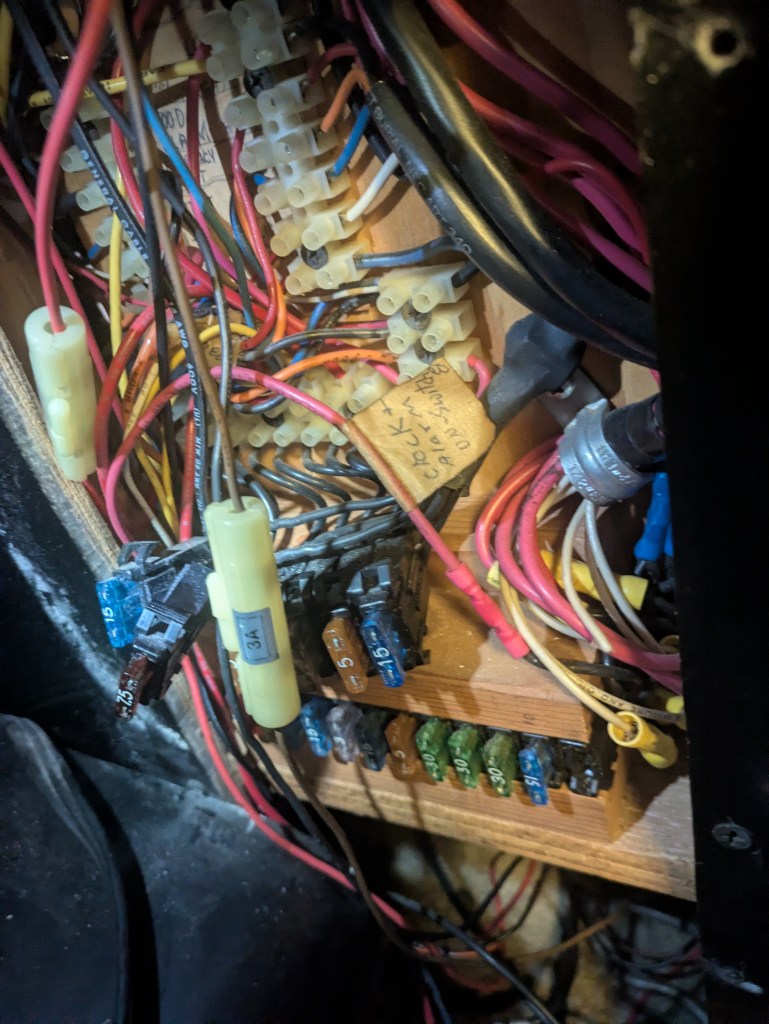
Behind the power center in the back of the van, we discovered a secondary fuse and relay center that can only be described as a “Massive Mess”.
- The Hardware: It’s a dense thicket of unlabeled fuses, terminal strips, resistors, and diodes.
- The Obstacle: One specific wire is hand-labeled “Clock + Alarm UN-Switch”. This confirms that the alarm system has a constant, un-switched power draw.
Technical Triage
We are now moving from “Restoration” to “Forensic Electrical Engineering.”
- Bypassing the Brain: We need to jump the “Ignition” lead on the AutoPage module to see if the fuel pump wakes up. (Spoiler – it didn’t.)
- Testing the Fuses: We tested and found two blown fuses, but replacing them didn’t change anything. We’re not quite sure yet what they are connected to.
- The Fuel Pump: Our next steps here are going to be connecting a meter to the fuel pump harness directly, in order to confirm we’re on the right track before tracing too many more of these wires.
Functional Integrity vs. Historical Preservation
In the world of forensic restoration, we are constantly balancing the scales between historical preservation and operational reliability.
To honor the legacy of Squad 527, the van must do more than just look like a time capsule; it has to function as a dependable machine. This requires a “transparent” approach to restoration: we intend to keep the AutoPage 4242 alarm and the dense web of 1980s relays physically in place to preserve the visual and structural history of the build, even as we move to bypass the aging interlocks that currently hold the fuel system hostage.
Similarly, while we aim to keep the radio stack looking exactly as it did during its peak service years, we may replace internal components or swap non-functional units with era-appropriate models that are legal to operate on modern frequencies.
The goal is a “functional ghost”—a van that looks like it just rolled off a 1989 stakeout, but possesses the modern reliability needed to ensure it actually reaches its destination under its own power.
 The Vice Van: Hillsborough Files
Leave a comment