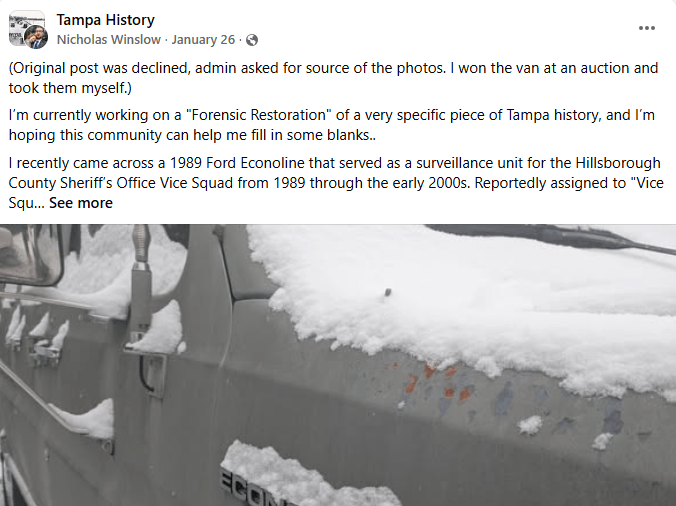
When we first brought the Vice Van home, we launched a digital dragnet, dropping a public post into a local history group to see if anyone recognized the vehicle. Over the course of a few days, that casual inquiry has evolved into an absolute goldmine of actionable data. The ghosts of the Hillsborough County Sheriff’s Office (HCSO) and the targets they tracked have stepped forward to provide concrete operational history.
Unmasking the Cover Stories
Our inventory previously uncovered an “Air Quality Survey Vehicle” magnet lost inside the cabin. The community quickly confirmed that this rig lived a double life under multiple cover stories. According to former fleet operators, the van routinely carried ladders on the roof and utilized magnetic decals, along with matching uniforms and a Twice Daily fleet card to blend seamlessly into local neighborhoods.
When parked on location, the disguise was flawless. Targets would literally lean right against the exterior panels outside of local businesses, completely oblivious to the detectives watching them through the specialized dome window and periscope system mounted on the roof.
The Architecture of the Ice Box
In Case File 026, we started work restoring a makeshift cooling system under the floorboards. The forum put us in touch with an Intelligence Detective from the era. That detective helped confirm the design, noting that back in the late 1980s, the unit was engineered as a covert, ice-filled reservoir. It was built specifically to act as a silent climate control unit, allowing operators to stay cool during long stakeouts without giving away their position with a running engine.

The Technician’s Blueprint
The most significant breakthrough came from a retired Surveillance Technician who moved to the Vice unit in 1997 and took over as the primary operator of The Vice Van. That technician unmasked some mystery controls, including a specific toggle and push-button assembly under the dashboard. It isn’t a kill switch—it’s an emergency Battery Boost. If the primary truck battery died during a long stakeout, the operator could hold that button down to link the house batteries directly to the starter to crank the engine.
That technician moved on to supervise the department’s undercover fleet, and confirmed that this van was one of four similar units at the time. Backed by a massive post-9/11 federal budget, this vehicle along with others served the HCSO supporting joint task force operations involving local police, the DEA, and the FBI, amongst others. It covered everything from local buy-bust operations to major federal targets. That technician even identified an orange box still laying in the floorboard, and asked if his cameras were still in it. The box was in the exact place he left it when the van was retired from service in Hillsborough County.
Views from the Perimeter
The file wouldn’t be complete without a view from the other side of the glass. A local resident, Al Katz, chimed in with a vivid memory of the van parked outside his house while he was “conducting illegal behavior” in the mid-90s. His operations came to an abrupt halt when six large vice detectives suddenly exited the vehicle to arrest him while he was simply walking to his car to pick up a pizza.

We also connected with local residents like Sue Kellogg-Jadzcak, who recounted letting HCSO Vice and the Tampa QUAD Squad use her northwest bedroom as a lookout post to monitor and take down drug houses nearby.
The Verdict
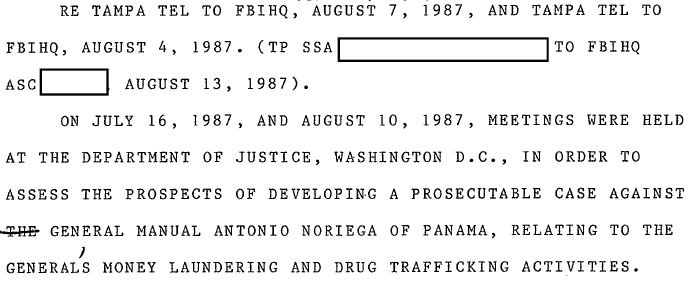
We already knew the Vice Van called Hillsborough County home, but the digital forum has finally unveiled the true depth of its operational lineage. This metal box didn’t just sit on street corners; it was a front-row witness to the shifting landscape of American law enforcement. The surveillance conducted from the HCSO fleet covered everything from street-level buy-busts to underground gambling and prostitution stings. Most incredibly, the intelligence gathered by HCSO Vice over the years fed into a much larger machine—flipping low-level dealers in a domino effect that climbed all the way to the top, ultimately influencing major military action in South America.


Leave a comment