- CASE FILE 032: Preserving More Than the Machine
The persistent summer heat has limited how much work we can reasonably complete inside the Vice Van. Even with the ventilation systems operating, the rear compartment remains a confined space filled with old electronics, wiring, and wood paneling. Rather than force physical progress under poor conditions, we shift our attention toward another part of the restoration: preserving the history surrounding the van.
Mechanical repairs can keep the vehicle operating, but they cannot explain who used it, how it was equipped, or where it fits within the history of the Hillsborough County Sheriff’s Office. That information requires a different kind of investigation.
Contacting USF
Earlier in the project, we contacted Dr. Davide Tanasi, director of the Institute for Digital Exploration at the University of South Florida. USF and HCSO have been working together to preserve and digitize a large collection of historical material from the agency.
We asked whether the collection included information that could help document the Vice Van, including:
- Photographs and documents related to the Vice Squad during the late 1980s and early 1990s.
- Surveillance photographs and other audiovisual records.
- Images of period uniforms and equipment.
- Records involving specialized surveillance vehicles, Seatron equipment, or the van’s original configuration.
Dr. Tanasi responded with useful information about the collection and expressed an interest in the project.
The Collection
At the time of our correspondence, the archival portion of the HCSO collection had been transferred to USF Libraries and was still being curated. It was not yet available for general public research.
The physical artifact collection remained in the custody of the HCSO Training Division and was expected to become part of the HCSO History Center in Ybor City. USF’s Institute for Digital Exploration had already created three-dimensional models of selected artifacts, along with a virtual tour of the History Center.
Dr. Tanasi also clarified an important limitation: the collection does not contain historical radio transmissions. It does, however, contain a substantial number of surveillance photographs. Those images may eventually provide useful context for the equipment, vehicles, clothing, and working environment represented by the Vice Van.
Documenting the Van as Found
During our correspondence, Dr. Tanasi raised the possibility of creating a three-dimensional scan of the van before restoration began. Unfortunately, the distance made that impractical. The van is located approximately 800 miles from USF, and the van was in no condition to travel.
Instead, we documented the van’s condition at the time of purchase to the best of our ability. We took extensive photographs, recorded notes, inventoried the equipment, and traced the original arrangement of the interior before beginning substantial repairs or alterations.
That documentation is not as comprehensive as a professional three-dimensional scan, but it provides a permanent record of how the vehicle appeared when it left government service. It also allows us to distinguish original equipment and construction from the repairs and adaptations made during the restoration.
Following the Paper Trail
Dr. Tanasi also recommended searching historical Tampa newspapers for coverage of HCSO Vice operations. That research has already helped enlighten us to the broader work being performed by the agency during the van’s service life.
We also contacted USF Libraries for information about where the collection will eventually be published, how researchers will be able to access it, and whether a projected release date is available. A collection of this size takes time to process, so there may not be an immediate answer.
The Work Continues
The heat may have slowed work inside the van, but it has not stopped the project. This period has provided an opportunity to organize records, review archival material, and continue contact with people responsible for preserving the same history from the institutional side.
The Vice Van is more than the equipment still mounted in its racks. Its history also exists in photographs, documents, recollections, and agency records that have not yet been (and may never be) fully assembled.
Until conditions improve enough to return to the physical work, the investigation continues outside the garage.

- CASE FILE 031: Environmental Safety & Cover Prep
Restoring a late-1980s surveillance rig means balancing raw period accuracy with real-world functionality. While the cargo bay is designed to look like a freeze-frame from 1989, operating heavy electronics inside a wood-lined enclosure demands modern, reliable safety protocols.
Inside the tight confines of the rear cabin, vintage CRT monitors, retrofitted power grids, and dense wiring runs generate real thermal loads. Fire prevention and physical cover prep took priority in this phase of the build.
Replacing Legacy Sensors
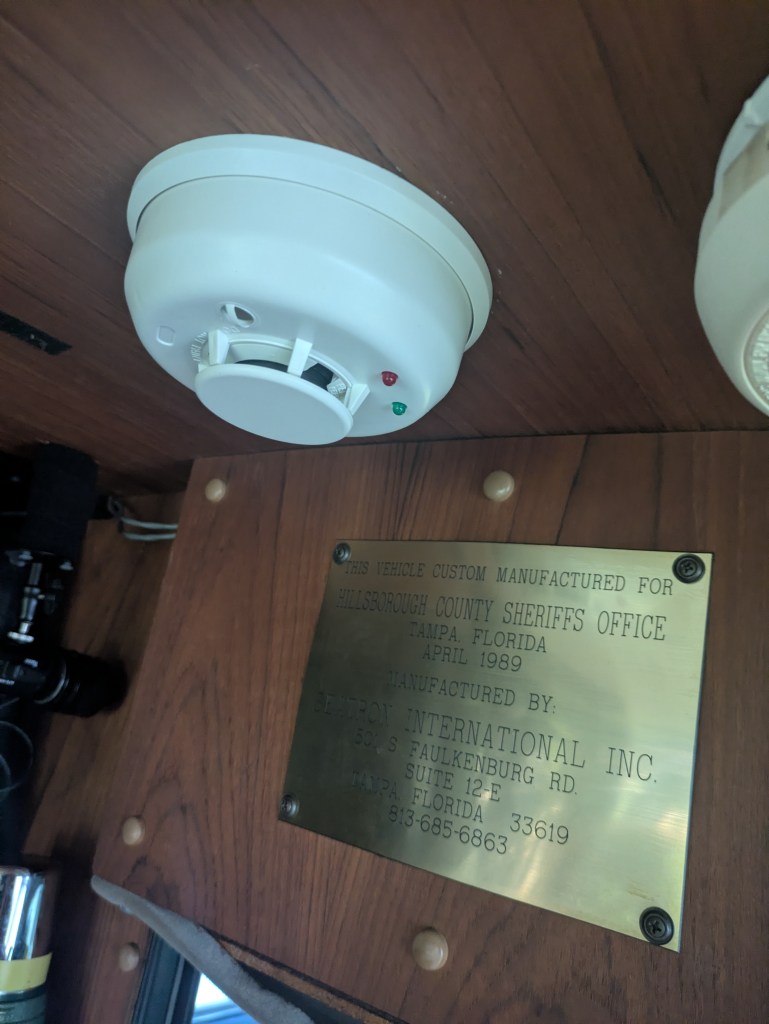
Mounted on the overhead wood paneling directly above the original brass Seatron International manufacturing plate were the original 1980s environmental alarms: a yellowed unit labeled “SMOKE” and an old carbon monoxide detector labeled “CO2.” Decades of heat exposure and age had rendered the original internal components useless.
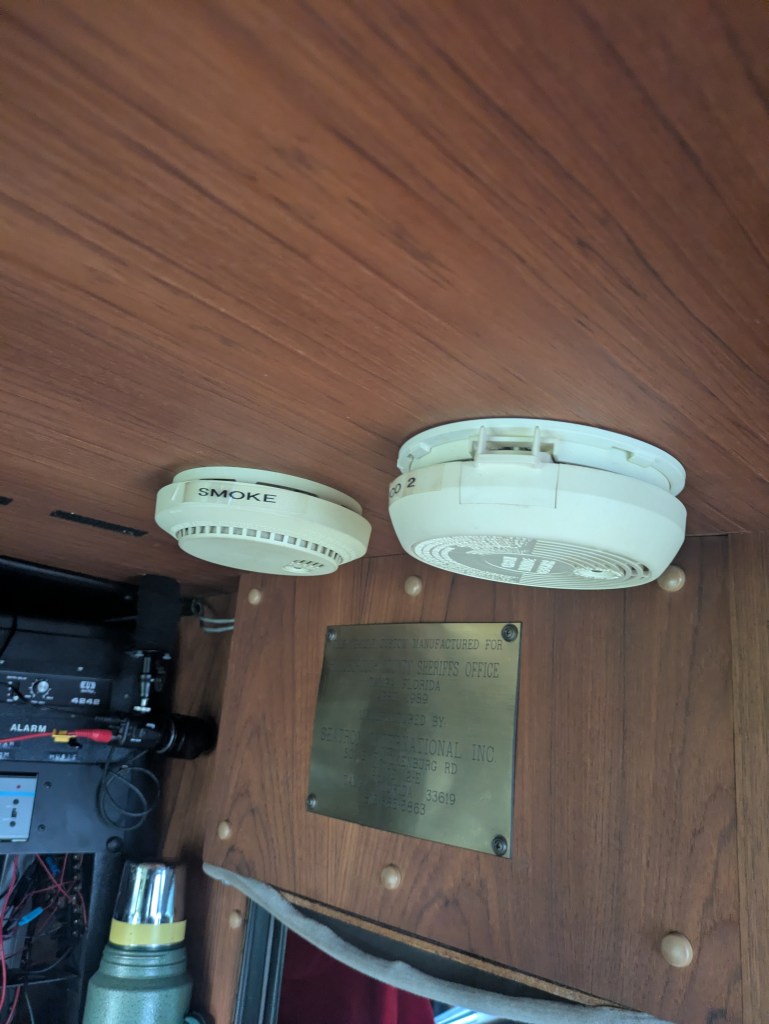
To bring the bay up to operational safety standards without completely ruining the cabin’s visual architecture, we pulled the non-functional smoke detector housing and installed a modern replacement. The new unit includes a sync sounder as well as a 900MHz wireless transponder that pairs directly with the security system in our shop.
This adds two massive protective features:
- Site-Wide Alerts: If the smoke detector triggers, it sounds an alarm throughout the entire property to alert us immediately.
- Automated Dispatch: If the alarm isn’t canceled, the fire department is automatically dispatched to our shop, ensuring this rolling time capsule is protected as much as possible.
Because the unit is linked to our shop’s security system, it won’t dispatch emergency services erroneously while out on the road—it simply drops out of range and functions as a standard standalone smoke detector until the van returns to the shop.
Staging the Operational Cover
Undercover surveillance vehicles relied heavily on blend-in utility disguises to sit unnoticed in commercial lots or residential streets for hours at a time. While the exterior looks like an unassuming work van, the interior cab needs immediate visual cues to maintain that cover if someone glances through a window.
To complete the front-cab transition, we mounted a high-visibility yellow hard hat and a high-vis safety vest directly off the cab partition post behind the driver’s seat. The hard hat was actually inside the van when we bought it, and the vest is well-used and period-correct to the style worn when the van was actively in service.
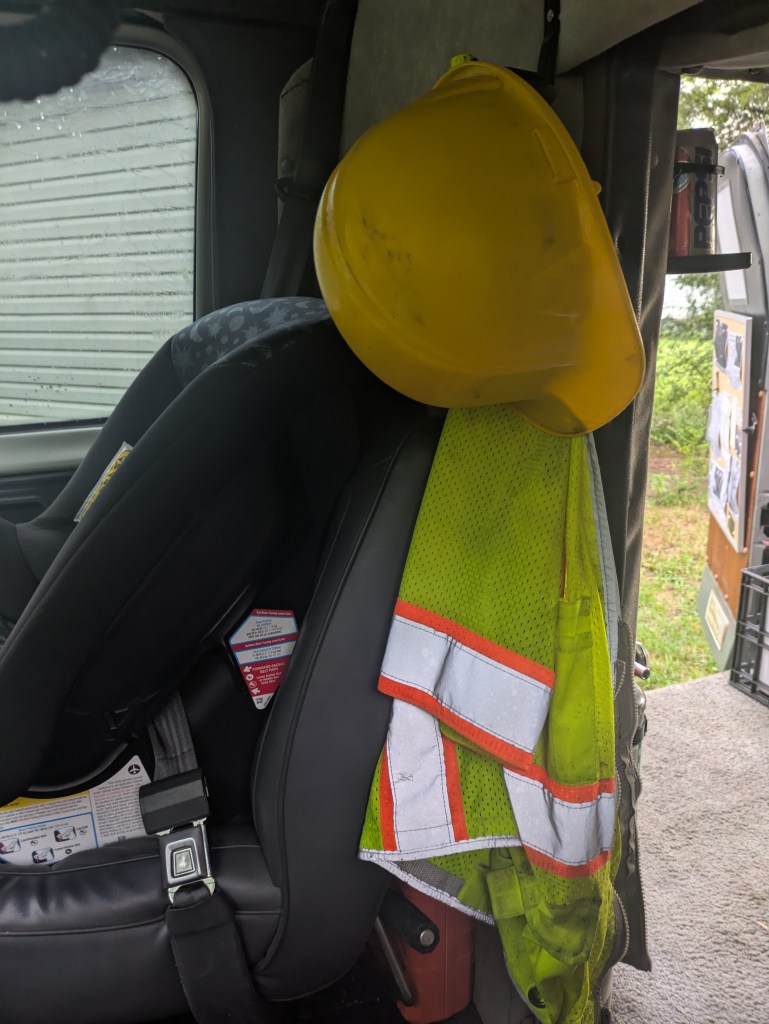
Finally, we added a front window shade to protect the cab’s interior. After surviving intact for so many years, we aren’t going to let UV exposure crack the leather and trim now.
With active environmental monitoring mounted over the Seatron builder’s mark and the front-cab cover elements in place, the Econoline maintains both modern safety compliance and authentic field staging. Coming soon will be a modern fire extinguisher and a modern CO detector.
- CASE FILE 030: The Racks & Custom Plates
Every mechanical fix we perform on this 1989 Ford Econoline is an act of historical forensic restoration. When we patch a wire or trace an old relay, we aren’t just fixing a van—we are preserving an instrument of leverage.
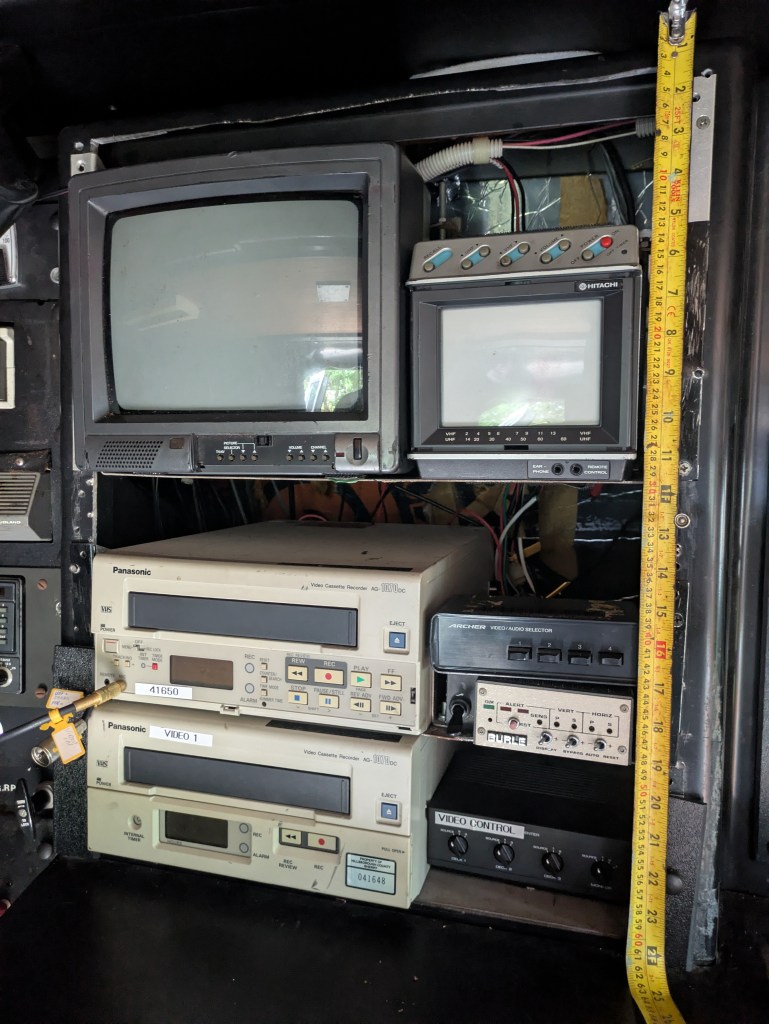
Inside a late-1980s undercover surveillance vehicle, the equipment rack is the spine of the entire operation. It houses the power distribution panels, video recording decks, audio receivers, and signal routing controls. Decades of wear, moisture, and utility modifications left our original rack structures functional, but scarred.
The Engineering Strategy: Form Meets Utility
Surveillance upfitters in the late 1980s like Seatron International didn’t use off-the-shelf consumer enclosures. They built rugged, modular steel and aluminum cages designed to withstand constant vehicle vibration, high thermal loads, and heavy physical abuse.
Restoring these racks requires a two-part approach:
- Structural Integrity: Replacing damaged parts and securing loose equipment.
- Custom Faceplates: Designing custom plates to cover open rack spaces and provide a clean, unified surface.
Completing the Visual Architecture
This was a low-tech upgrade. We first measured the primary rack along with the dimensions of all the equipment, then laid out a template on cardboard. Once we were happy with how the template fit, we cut the entire piece out of a single sheet of 7/16-inch plywood. We routed the edges, sanded it smooth, and finished it with flat black paint prior to installation.
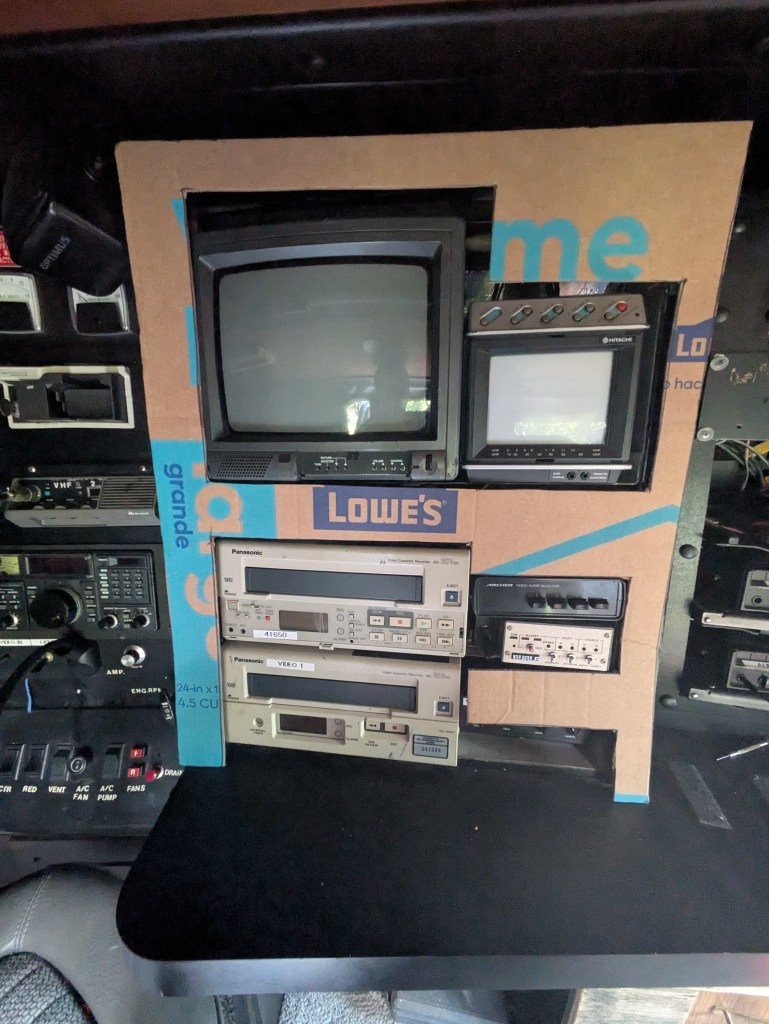
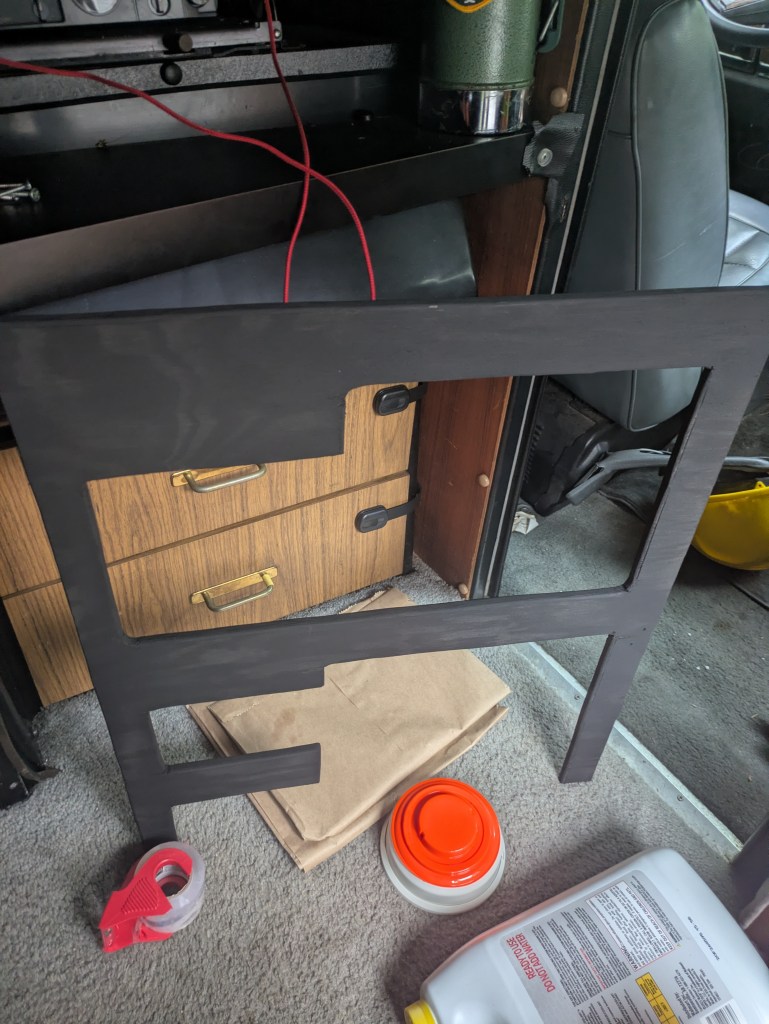
Placing these custom plates into the rack assembly bridges the gap between raw hardware and functional history. When you look into the rear cargo area, you no longer see an aging, hollowed-out utility van. You see a self-contained, high-leverage mobile command station engineered for long-term tactical deployment.
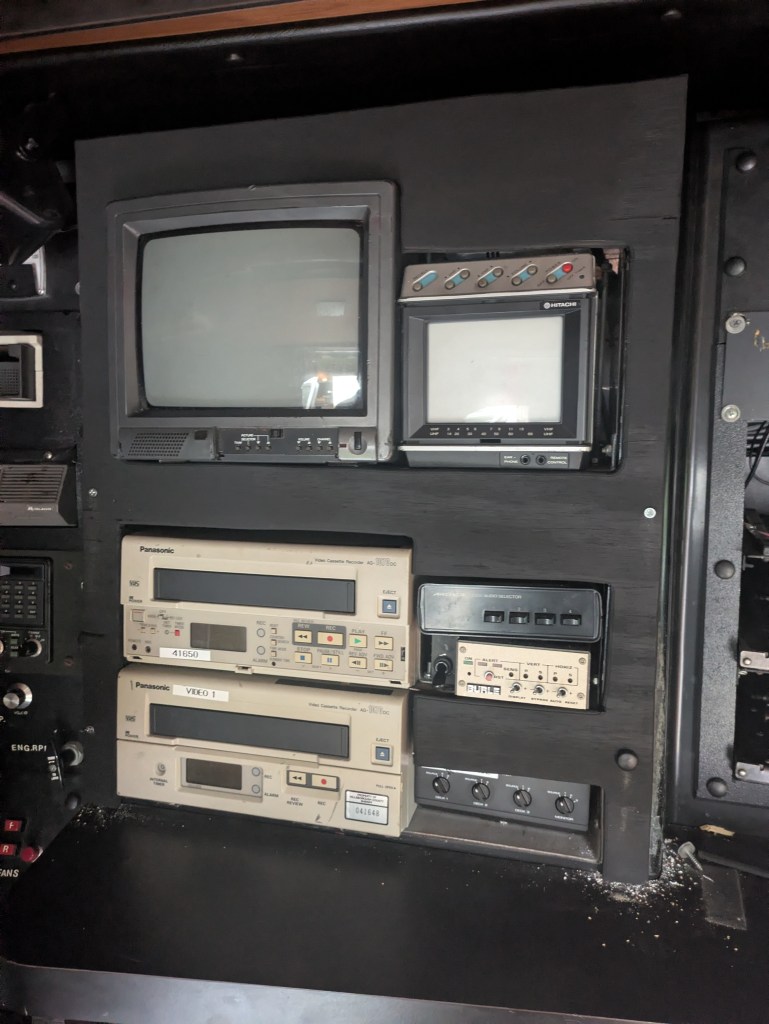
Now that the first rack is done, on to the second.
- Case File 029 – How the HCSO Forced the Hand of History
Every mechanical fix we perform on this 1989 Ford Econoline is an act of historical forensic restoration. When we patch a wire or trace an old relay, we aren’t just fixing a truck—we are preserving an instrument of leverage.
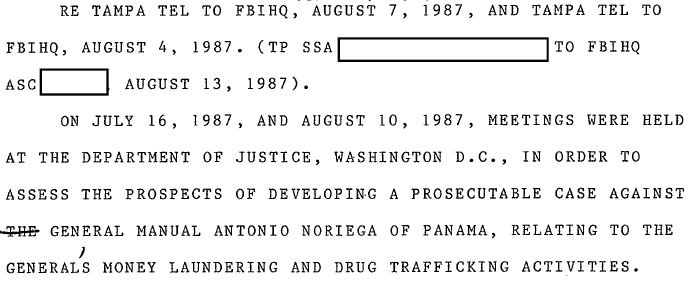
For years, the overarching narrative of the late-1980s drug war belonged to the federal agencies. The movies and the history books tell a grand story of the DEA, the FBI, and the CIA tracing lines from Washington, D.C., all the way to Panamanian strongman General Manuel Noriega. But the declassified Senate hearing transcripts and FBI investigative files reveal a much more local, rugged truth.
Before the DEA took over the international theater, and before the grand juries handed down global indictments, the entire international house of cards was brought down because local Florida detectives—specifically the Hillsborough County Sheriff’s Office Vice Squad—were doing the dangerous street-level work of squeezing targets on the ground.
Squeezing the Tampa “Money Houses”
Long before federal wiretaps and multi-agency task forces were formalized under structural Justice Department umbrellas like “Operation Sandshark” or “Operation Starbank,” local law enforcement in Tampa was grappling with an unprecedented, staggering volume of untraceable cash flooding the county.
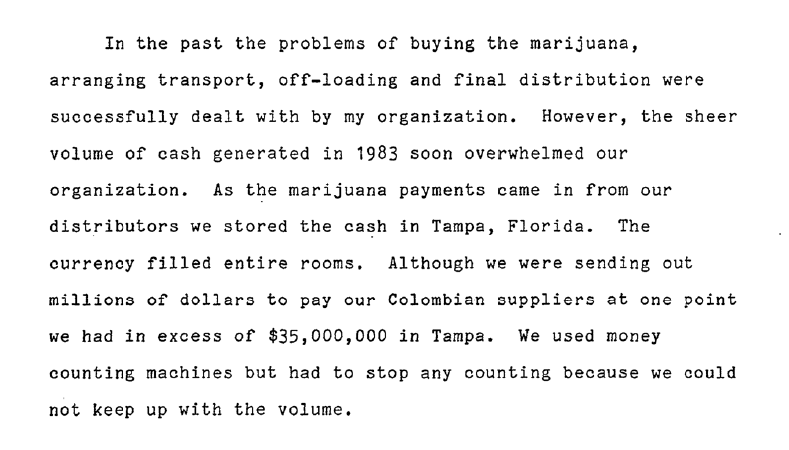
In his sworn testimony before the U.S. Senate Permanent Subcommittee on Investigations, convicted smuggling kingpin Steven Michael Kalish dropped a bombshell about his logistics: his international organization had chosen Tampa, Florida as a domestic repository.
As regional distributors across the eastern United States paid for their shipments, suitcases and commercial cardboard boxes packed tightly with small-denomination currency were physically moved through the streets of Tampa. The operation grew so massive that it eventually totaled in excess of $35,000,000 in cash hidden inside the Tampa jurisdiction, entirely filling up local stash rooms. The volume of paper currency was so overwhelming that the organization had to stop counting the bills themselves—even with automatic money-counting machines running constantly—forcing offshore banks in Panama to handle the counts upon delivery.
It was the early, silent tracking of these cash-delivery vehicles by local undercover assets that provided the essential paper trails, license plates, and financial patterns that federal prosecutors later used to prove the domestic leg of the international conspiracy.
The Unsung Foundation
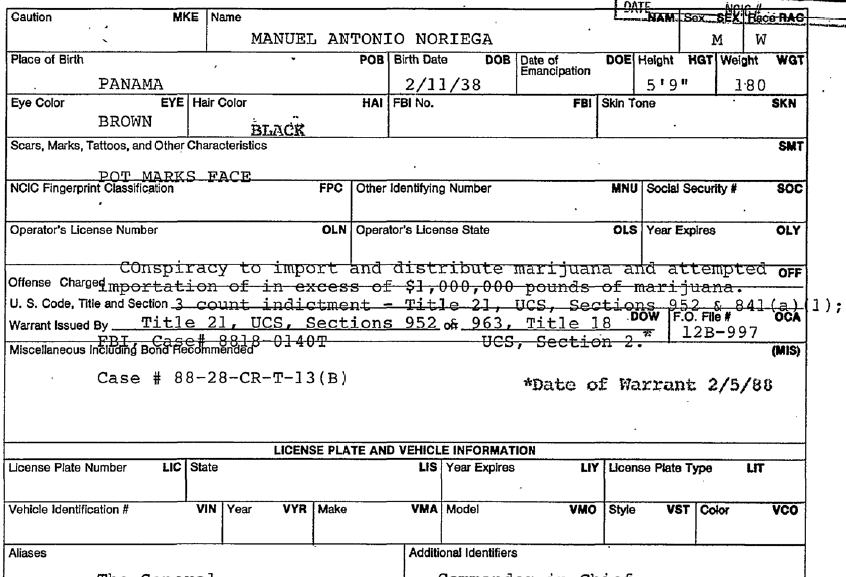
When the U.S. Attorney’s Office for the Middle District of Florida officially announced the three-count indictment against General Noriega on February 5, 1988, the official record indicated that the groundwork of the case actually originated in Hillsborough County.
The international conspiracy case—which charged Noriega with accepting over $1 million in bribes to protect containerized drug shipments and launder cash through shell corporations—did not materialize out of thin air. It was built directly on the backs of earlier local prosecutions.
The official Department of Justice announcement explicitly notes that the federal task force’s breakthrough was built on the prior convictions of Kalish, Leigh Bruce Ritch, Albert Samuel Fortna, and twenty-seven other co-conspirators. Those pivotal central Florida takedowns were the direct result of sustained investigative efforts managed on the ground by local agencies, including the Hillsborough County Sheriff’s Office.
The Verdict
The federal government took the victory laps in the national media, but the declassified record proves that the global machine didn’t start in Washington. It started on the hot pavement right here in our home jurisdiction. Every time we fire up the CRT monitors, flip the battery cutoff switches, and step past the cargo barrier of our Econoline, we are stepping into the exact tactical environment engineered to handle this type of surveillance.
The feds didn’t build the case against international dictators from a clean desk in D.C.—they inherited it because local county detectives were doing the heavy, quiet work of squeezing targets on home turf until the whole global network unraveled.
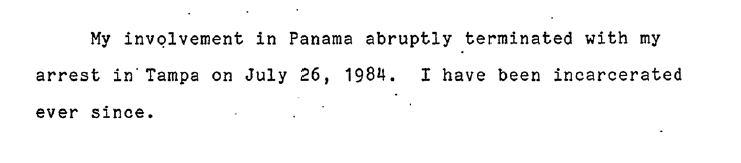
Sources: U.S. Senate Permanent Subcommittee on Investigations (Testimony of Steven M. Kalish); U.S. Department of Justice, Office of the United States Attorney, Middle District of Florida, Official Press Release (Internal FBI Reference: Operation Starbank, File 12B-997) – From the FBI Vault
- Case File 028: The Hillsborough Dragnet
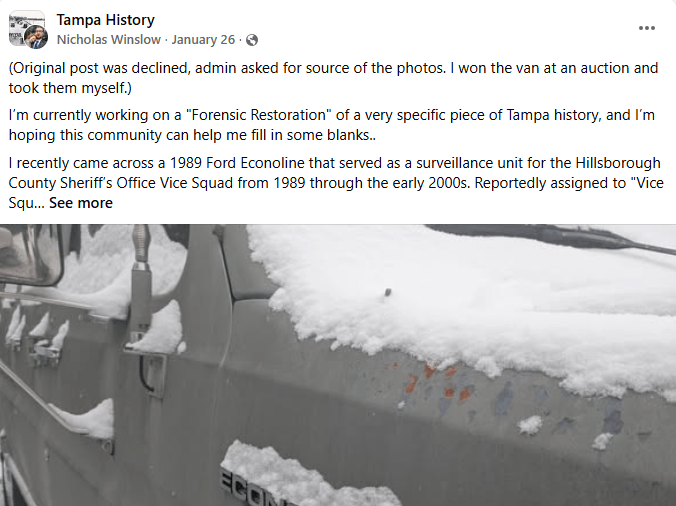
When we first brought the Vice Van home, we launched a digital dragnet, dropping a public post into a local history group to see if anyone recognized the vehicle. Over the course of a few days, that casual inquiry has evolved into an absolute goldmine of actionable data. The ghosts of the Hillsborough County Sheriff’s Office (HCSO) and the targets they tracked have stepped forward to provide concrete operational history.
Unmasking the Cover Stories
Our inventory previously uncovered an “Air Quality Survey Vehicle” magnet lost inside the cabin. The community quickly confirmed that this rig lived a double life under multiple cover stories. According to former fleet operators, the van routinely carried ladders on the roof and utilized magnetic decals, along with matching uniforms and a Twice Daily fleet card to blend seamlessly into local neighborhoods.
When parked on location, the disguise was flawless. Targets would literally lean right against the exterior panels outside of local businesses, completely oblivious to the detectives watching them through the specialized dome window and periscope system mounted on the roof.
The Architecture of the Ice Box
In Case File 026, we started work restoring a makeshift cooling system under the floorboards. The forum put us in touch with an Intelligence Detective from the era. That detective helped confirm the design, noting that back in the late 1980s, the unit was engineered as a covert, ice-filled reservoir. It was built specifically to act as a silent climate control unit, allowing operators to stay cool during long stakeouts without giving away their position with a running engine.

The Technician’s Blueprint
The most significant breakthrough came from a retired Surveillance Technician who moved to the Vice unit in 1997 and took over as the primary operator of The Vice Van. That technician unmasked some mystery controls, including a specific toggle and push-button assembly under the dashboard. It isn’t a kill switch—it’s an emergency Battery Boost. If the primary truck battery died during a long stakeout, the operator could hold that button down to link the house batteries directly to the starter to crank the engine.
That technician moved on to supervise the department’s undercover fleet, and confirmed that this van was one of four similar units at the time. Backed by a massive post-9/11 federal budget, this vehicle along with others served the HCSO supporting joint task force operations involving local police, the DEA, and the FBI, amongst others. It covered everything from local buy-bust operations to major federal targets. That technician even identified an orange box still laying in the floorboard, and asked if his cameras were still in it. The box was in the exact place he left it when the van was retired from service in Hillsborough County.
Views from the Perimeter
The file wouldn’t be complete without a view from the other side of the glass. A local resident, Al Katz, chimed in with a vivid memory of the van parked outside his house while he was “conducting illegal behavior” in the mid-90s. His operations came to an abrupt halt when six large vice detectives suddenly exited the vehicle to arrest him while he was simply walking to his car to pick up a pizza.

We also connected with local residents like Sue Kellogg-Jadzcak, who recounted letting HCSO Vice and the Tampa QUAD Squad use her northwest bedroom as a lookout post to monitor and take down drug houses nearby.
The Verdict
We already knew the Vice Van called Hillsborough County home, but the digital forum has finally unveiled the true depth of its operational lineage. This metal box didn’t just sit on street corners; it was a front-row witness to the shifting landscape of American law enforcement. The surveillance conducted from the HCSO fleet covered everything from street-level buy-busts to underground gambling and prostitution stings. Most incredibly, the intelligence gathered by HCSO Vice over the years fed into a much larger machine—flipping low-level dealers in a domino effect that climbed all the way to the top, ultimately influencing major military action in South America.
- Case File 027: Clear Water and Local Alliances
After a long stretch of continuous flushing and heat cycles, we have finally reached a major milestone: the investigation into the 351 Windsor’s cooling system appears to be closed.
The Thermal Victory
Following a final round of chemical flushing, the fluid is no longer resembling chocolate milk or apple juice – it’s mostly clear and clean. With the twelve years of calcified scale and internal engine block rust successfully dissolved and purged, we will replace the temporary thermostat with a new, name-brand OEM-temperature unit and fill the system with fresh antifreeze. Just to be safe, we’re holding off on doing that right now – a few more weeks of flushing and rinsing everything out will be done first.
Community Alliance
Reviving a vehicle that has been dormant for over a decade relies heavily on local support to solve problems, and while we can’t begin to thank all out friends, family, and vendors individually, we want to give a brief shout-out to a couple of operations that helped keep this project moving forward.
We greatly appreciate the team at Pugh’s Tire and Service, as well as All City Locksmith for their assistance and support in this endeavor.
We’d also like to thank Retired Detective Graham with the Hillsborough County Sheriff’s Office for filling in some gaps that have helped us get The Vice Van going again.
The Verdict
The baseline mechanical foundation of the Vice Van is officially locked down. With the engine no longer trying to boil itself alive, we can finally shift our primary focus away from basic survival mechanics.
- Case File 026: Thermal Management
As we move closer to a fully operational status, we turned our focus to the “Life Support” systems. A surveillance van is essentially a metal box filled with heat-generating electronics and human operators; without functioning climate control, it’s a furnace. The Vice Van utilizes a multi-layered approach to cooling, ranging from standard automotive tech to a specialized ice-based “silent” system.
The Ice-Powered Circulator
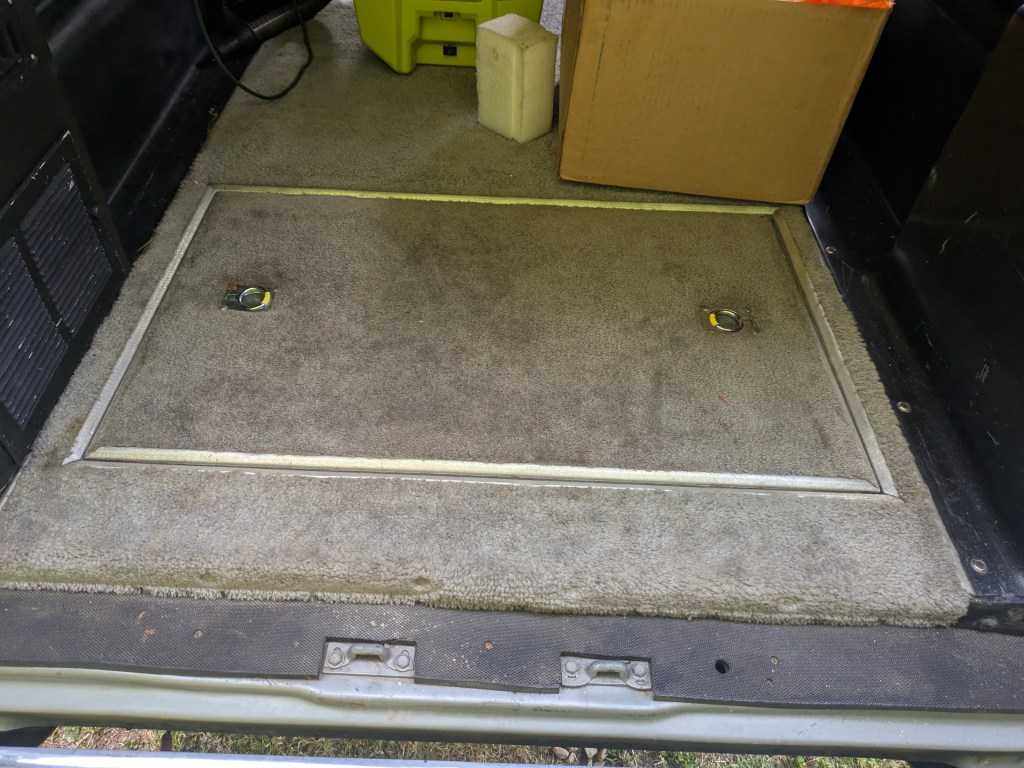
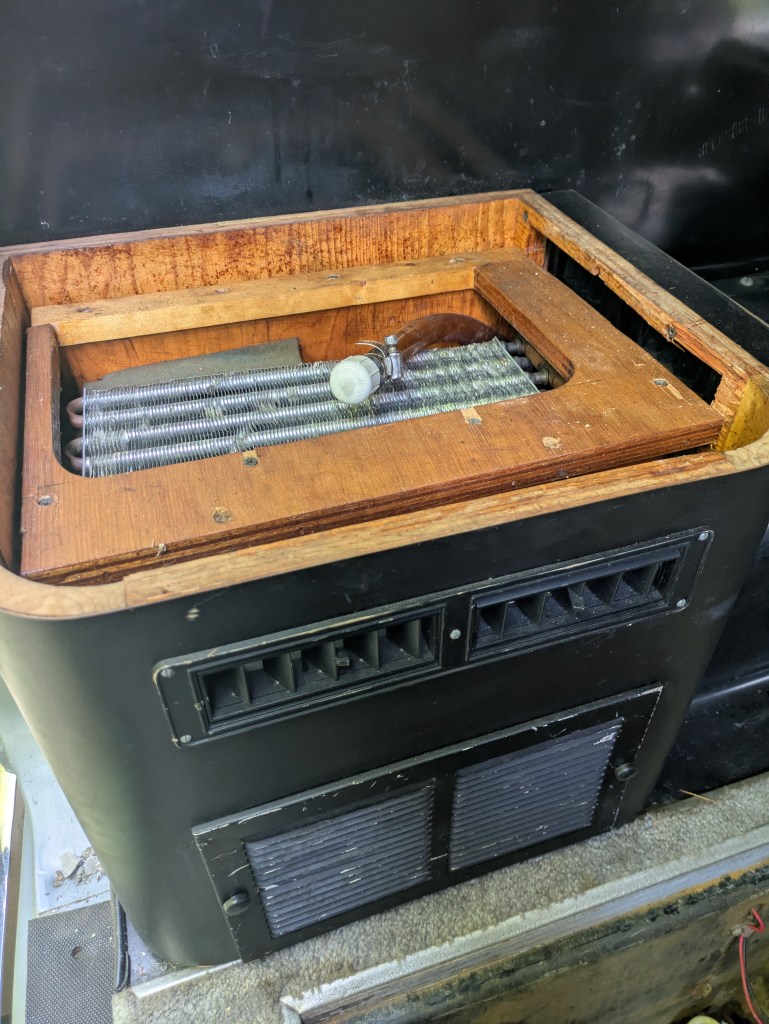
At the rear of the van sits an ice-powered cooling unit—designed to provide air conditioning without the noise of a running engine. The system was dormant, requiring the replacement of both circulation pumps to bring it back to life.
The current challenge is the “purge.” We are having a difficult time removing trapped air from the makeshift radiator core. Our current tactical solution is a “rolling bleed”: driving the van to allow vibration and motion to shake the air bubbles toward the filler neck, where we top off the antifreeze as the level drops.
The Reservoir Drain
While the primary drain pump works perfectly, we’ve discovered a forensic flaw: it is nearly impossible to evacuate the last bit of water from the reservoir. To prevent stagnant water from rusting the holding tank during storage, we are exploring a modification—installing a removable plug or a dedicated drain petcock at the lowest point of the reservoir to ensure it can be dried out completely when not in use.

The Side Door Vent & Discovery
An investigation into the side door vent assembly yielded two significant breakthroughs:
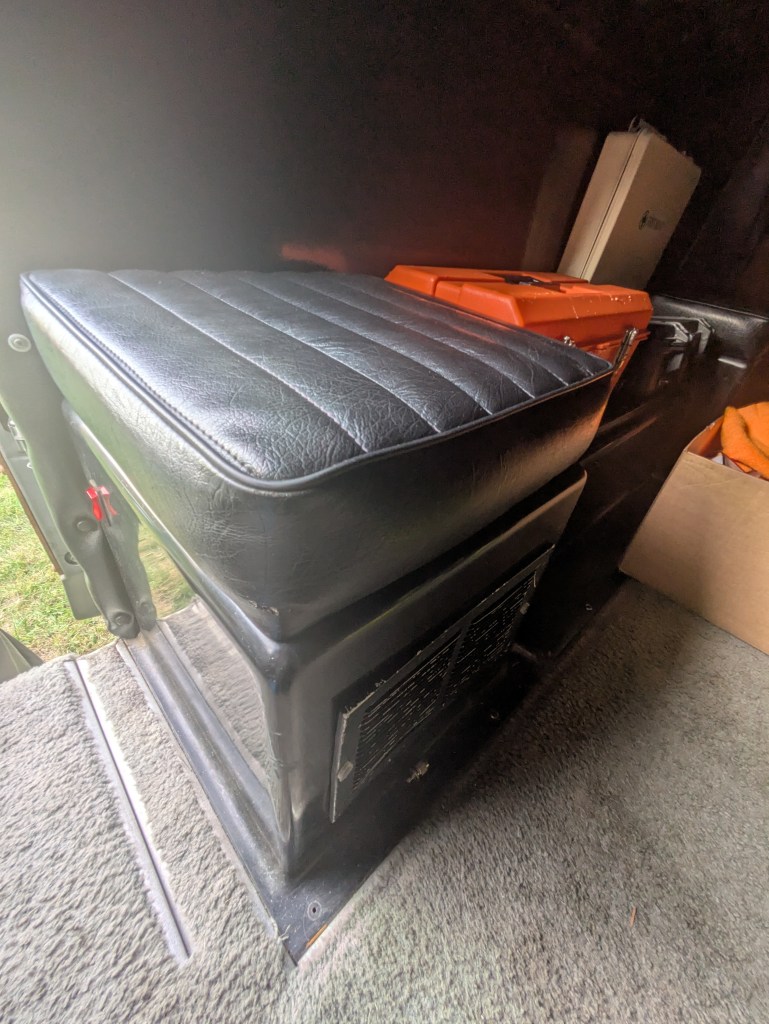
- Integrated Cooling: We discovered the vent is actually tied into the truck’s primary A/C system. This is a massive win; it means that once the van’s main A/C is restored, we can cool the entire rear operations area with the flip of a factory switch.
- Exhaust Capability: The unit features a dedicated vent fan designed to pull air out of the cabin and exhaust it beneath the chassis. This allows for constant air exchange during a stakeout without opening doors or windows.
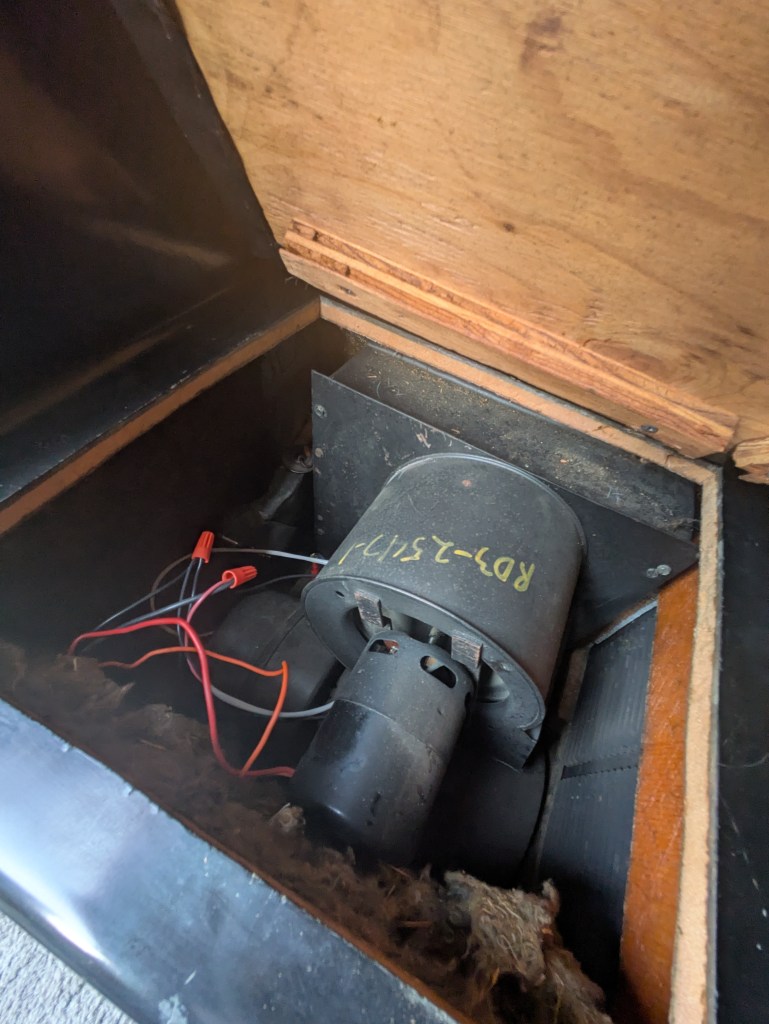
The Electrical Recovery
Restoring power to these systems required some creative re-wiring. The side door units were completely “dark.” After a fruitless search for damaged fuses or broken wires in the original harness, we elected to bypass the mystery and run a fresh, dedicated power line to the assembly.
Conversely, the rear door system was a simpler fix. It was merely missing its fuse. Once replaced, the A/C fan returned to life, functioning perfectly across all three speeds. Finally, we tested the two high-mount auxiliary fans; both are operational and move a significant amount of air, though they are predictably noisy—a small price to pay for airflow in a sealed van.

The Verdict
The Vice Van’s climate systems are slowly returning to service. We have “silent” cooling for the back, integrated truck A/C for the transit, and a series of exhaust fans to keep the air moving. Once we clear the air pockets from the ice-system and finalize the reservoir drain, we’ll have a climate-controlled workspace that’s ready for any environment.
The investigation is cooling down—literally.
- Case File 025: The Power Grid
The investigation has moved to the lifeblood of the surveillance suite: the house electrical system. To run a rack full of CRT monitors, VCRs, and radios, you need more than just a healthy alternator; you need a massive, stable reservoir of power.
Restoring Capacity
We officially brought the house power back to its original operational capacity by adding two more deep-cycle golf cart batteries to the bank. These 6-volt workhorses are the backbone of the van’s off-grid capability, providing the long-draw endurance required for extended stakeouts. By wiring them in series-parallel, we’ve matched the original footprint of the van’s power system as it was configured decades ago.

Isolation and Protection
While the Vice Van is equipped with a vintage inverter that has a built-in charging circuit, we’ve decided to move away from that “all-in-one” approach for the sake of longevity.
Vintage surveillance gear is sensitive to voltage spikes and the “noisy” power often produced by older charging tech. To mitigate this risk, we’ve installed heavy-duty battery cutoff switches. This allows us to completely isolate the batteries from the van’s sensitive electronics when they aren’t in use, ensuring that no stray current or parasitic draw can threaten the hardware.
The Dedicated Charging Suite
To maintain the health of the cells during storage, we’ve moved to a dual-path charging strategy:
- Chassis Maintenance: A dedicated trickle charger now monitors the primary truck battery, ensuring the 351 Windsor always has the cranking amps it needs.
- House Restoration: For the golf cart batteries, we’ve installed a specialized smart charger/maintainer with a “repair-restore” mode to keep the chemistry peak.
The Diode Modification
During the initial rollout of the house charger, we encountered a technical anomaly. We noted that while the charger performed well under load, it would actually allow the batteries to backfeed and drain through the charger’s internal circuitry whenever it was unplugged from the wall. To stop this parasitic drain, we performed a field-fix by installing an inline diode. This acts as a one-way electrical valve, allowing the charge to reach the batteries while preventing any backflow from emptying our power reservoir when the van is off the grid.
The Verdict
The grid is back online. By decoupling the charging process and adding the diode “fail-safe,” we’ve created a stable, isolated environment for the van’s delicate electronics. We can now power down the van, flip the isolation switches, and know the batteries are protected and ready for the next deployment.
The Vice Van now has the staying power it needs.
- Case File 024: The Narrative and the Kit
With the cooling system finally stabilized and the engine reliably holding its temperature, we shifted our focus from the mechanicals to the “soul” of the Vice Van. A surveillance vehicle is more than just a collection of cameras; it’s a workspace designed to tell a story through the evidence it collects.
The Evidence Board
With a little help, we completed one of the primary display boards that will live in the rear of the van. We moved away from the sterile look of a modern office and leaned into the forensic aesthetic of the era. The corkboard is now covered with newspaper clippings, maps, and photos, all secured with era-appropriate metal thumbtacks. It’s a visual anchor that immediately transports anyone who steps inside back to the peak of the van’s active service.
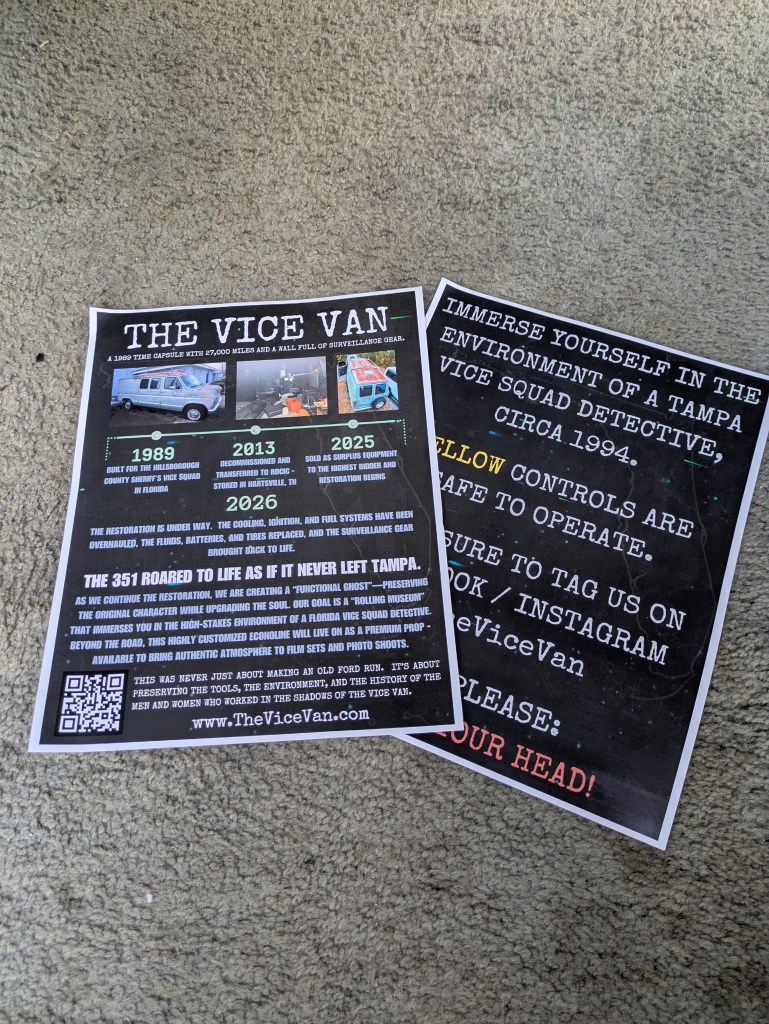
To supplement this, we designed several informational flyers and to display on and around the van. These act as silent docents during shows, allowing the van to tell its own story and explain its unique history even when we aren’t there to give a guided tour.
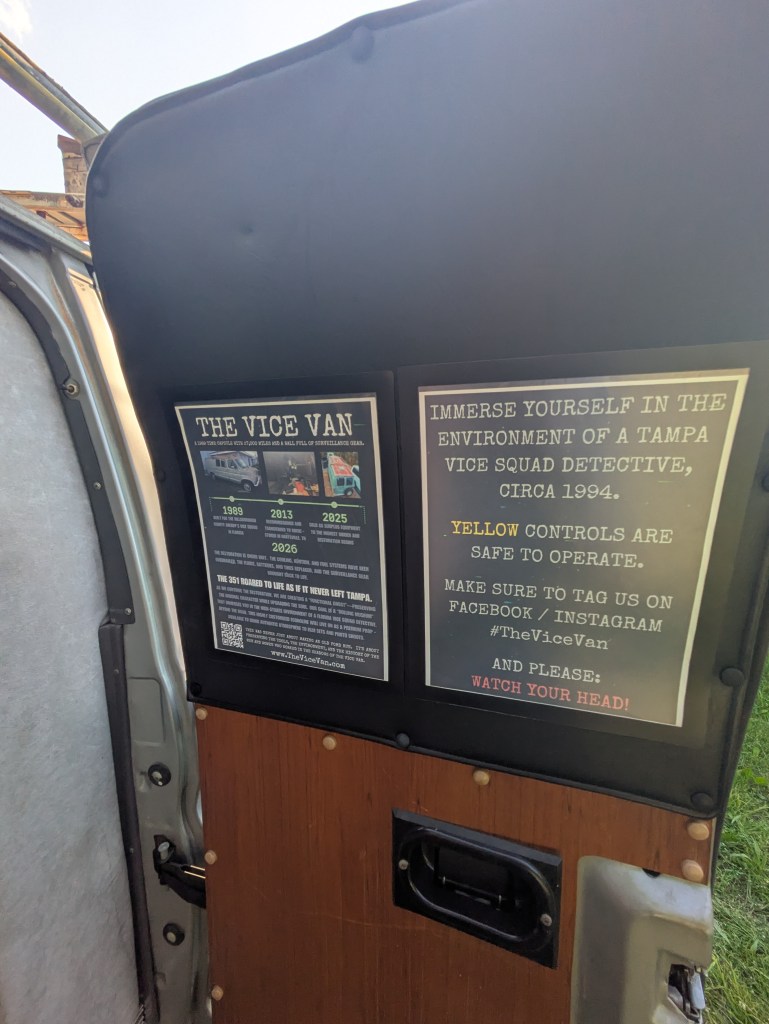
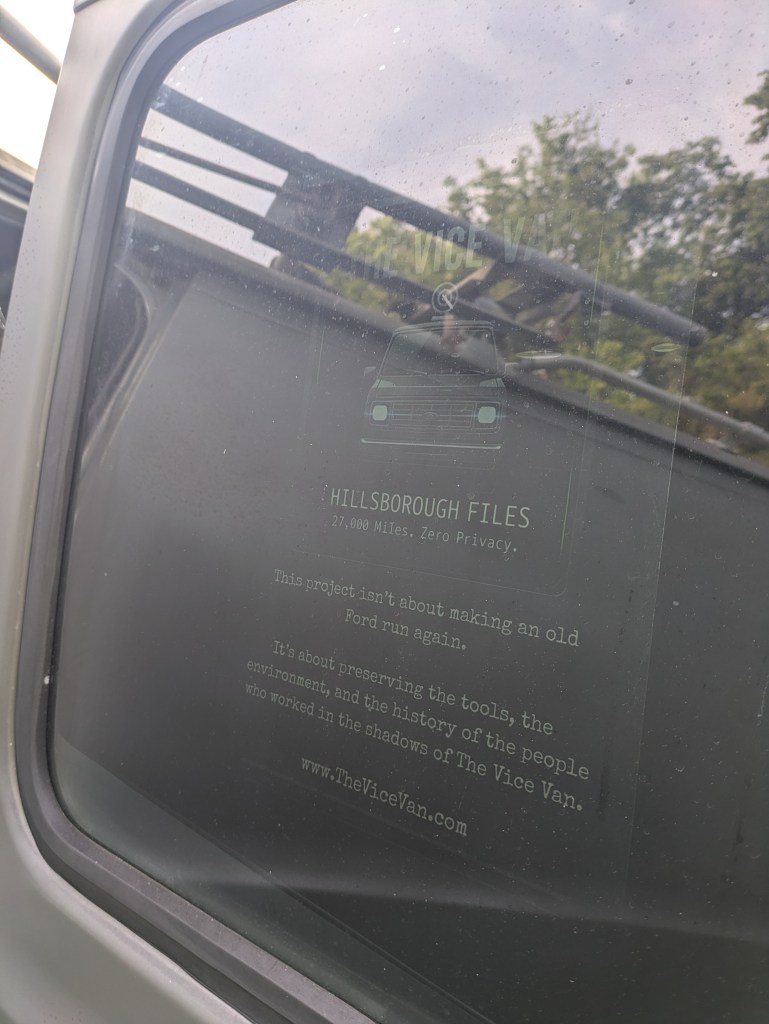
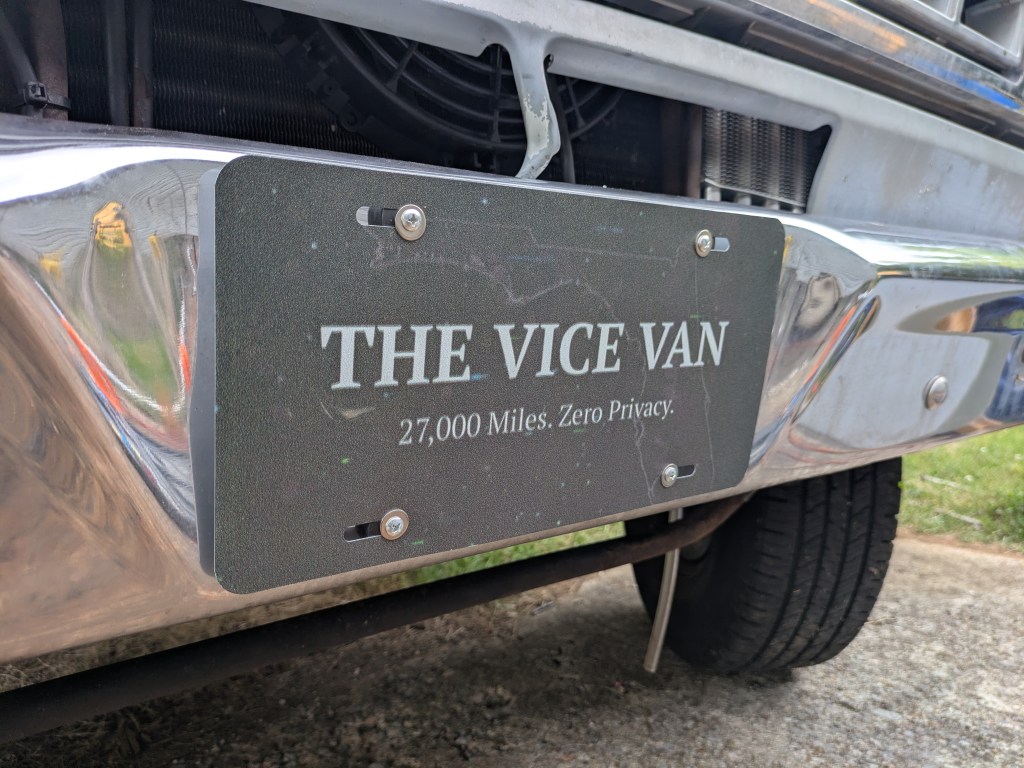

The Comms Upgrade
The “Vice” aesthetic requires a specific type of hardware. We recently expanded our onboard tech suite with a collection of vintage portable radios and repeaters obtained from a local sheriff’s office. These aren’t just props; they are the style and age of equipment that would have been utilized by law enforcement during this van’s tenure. Integrating this heavy, tactile gear reinforces the authenticity of the surveillance rack.

The Logistics: Street-Ready Preparedness
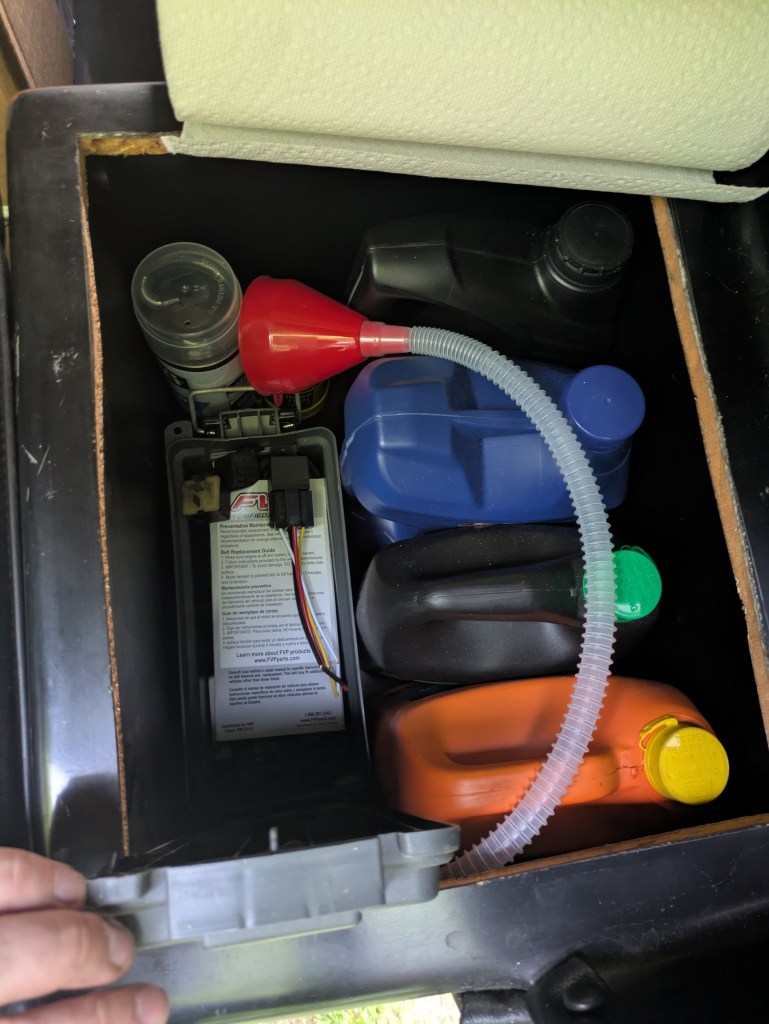
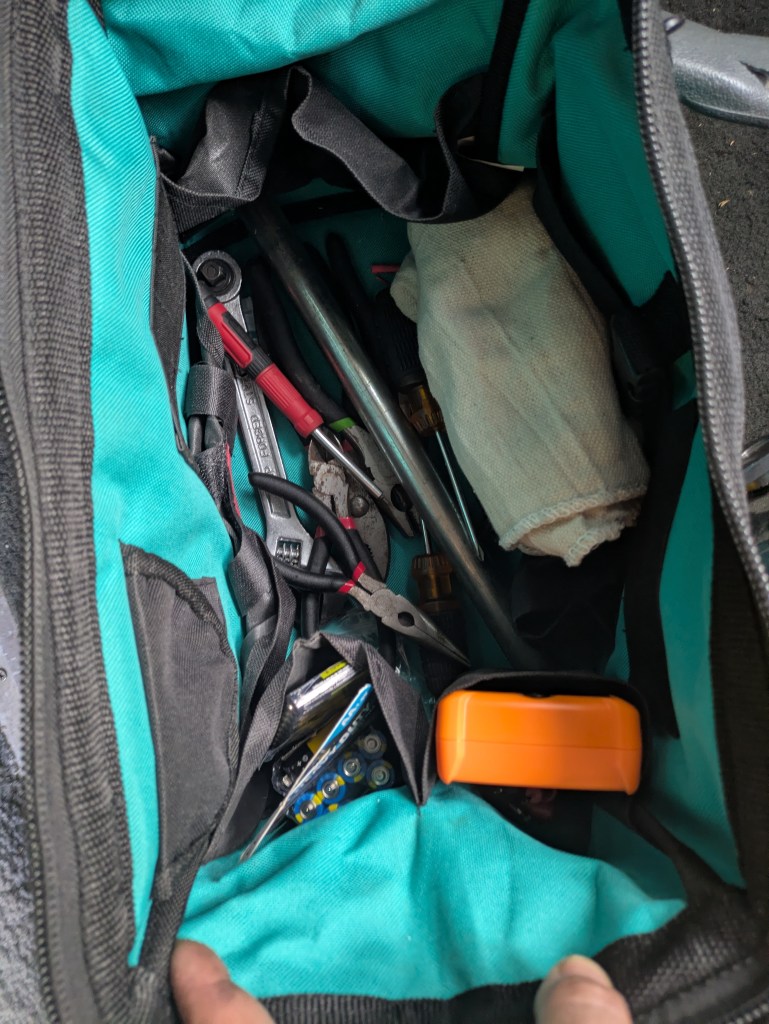
While we’ve exorcised the major ghosts in the machine, we aren’t naive about the realities of driving a 1980s vehicle that sat for over a decade. We’ve officially outfitted the van with a full “emergency” to handle the unexpected:
- Fluid Reserves: Extra oil, transmission fluid, brake fluid, and antifreeze.
- The Tool Chest: A dedicated set of hand tools (sockets/ratchets/wrenches/pliers/screwdrivers/strippers), extra fuses, and a multi-meter.
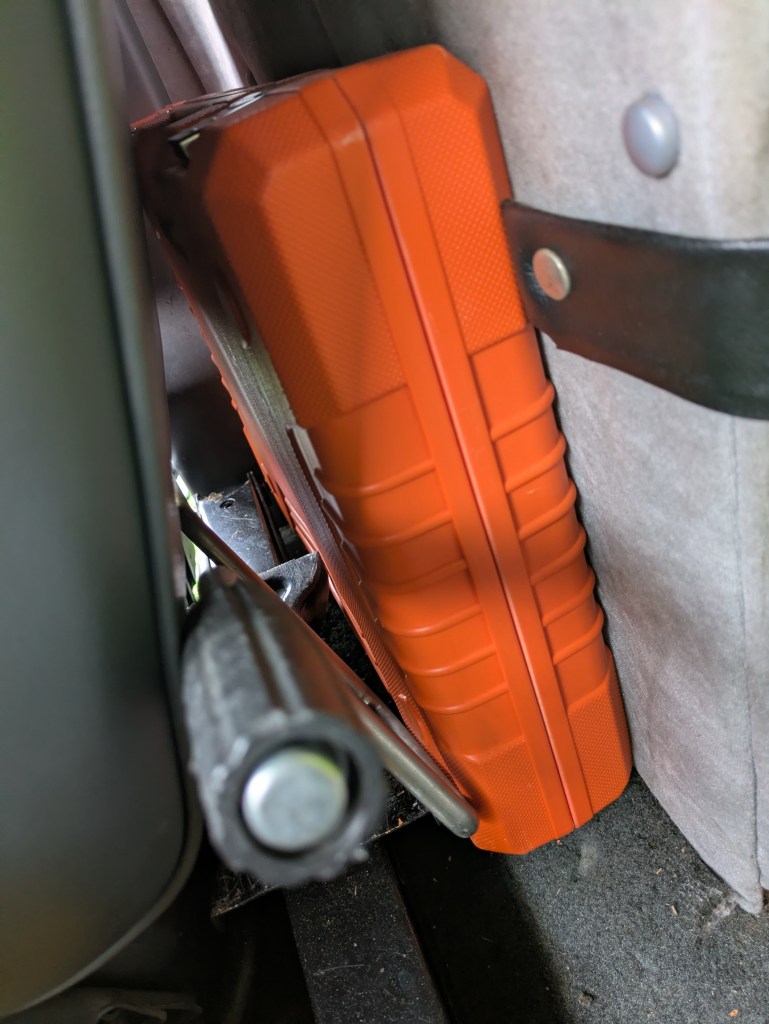
- Power & Recovery: Jumper cables, a portable lithium battery jump pack, and rags, jacks, tire wrenches, and spare bulbs.
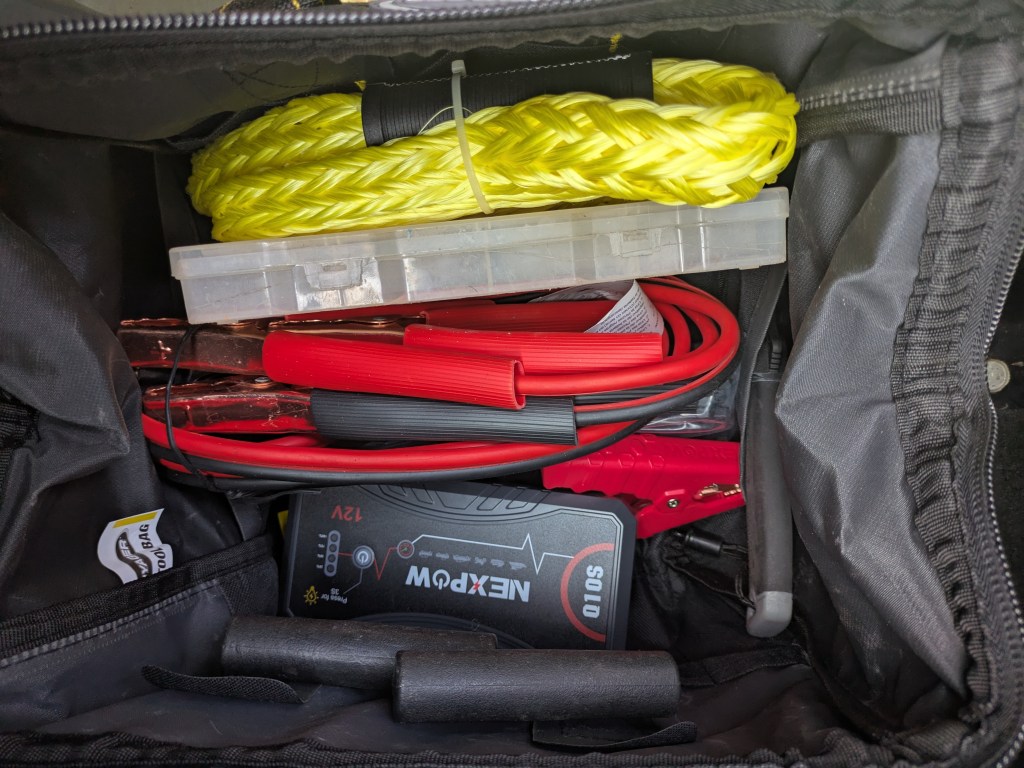
The Verdict
The Vice Van is becoming a more complete “character.” By focusing on the display boards and the era-specific radios, we are narrowing the gap between a “project van” and a “time capsule.” The addition of the emergency kit means we are no longer just hoping the van makes it home—we are prepared to ensure it does.
The investigation is no longer just under the hood; it’s on the walls and in the racks.
- Case File 023: The First Mile and the Deep Clean
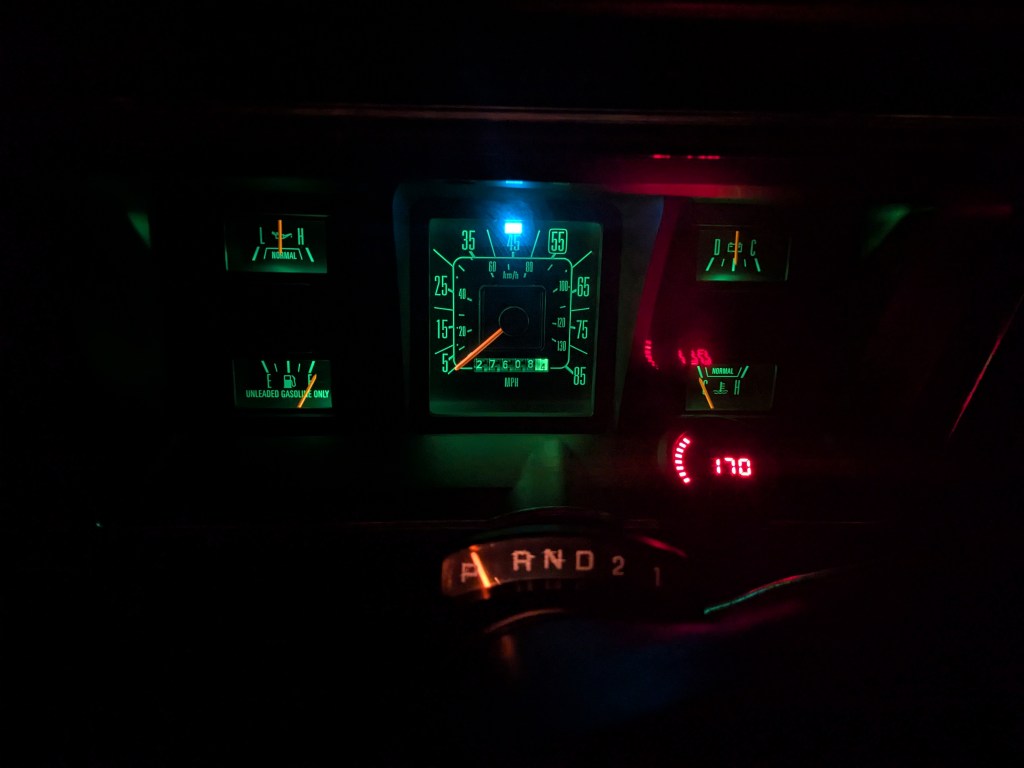
With the cooling system overhauled—take two—we returned to the driveway for another round of endurance testing. The results were initially promising: the 351 Windsor reached 185°F quickly and sat there for a solid hour, rock steady. We called it a night, letting the van cool down completely before a second verification idle the following morning.
The First Mile
The next morning, the van reached operating temperature without incident. For the first time in over a decade, the Vice Van saw the open road.
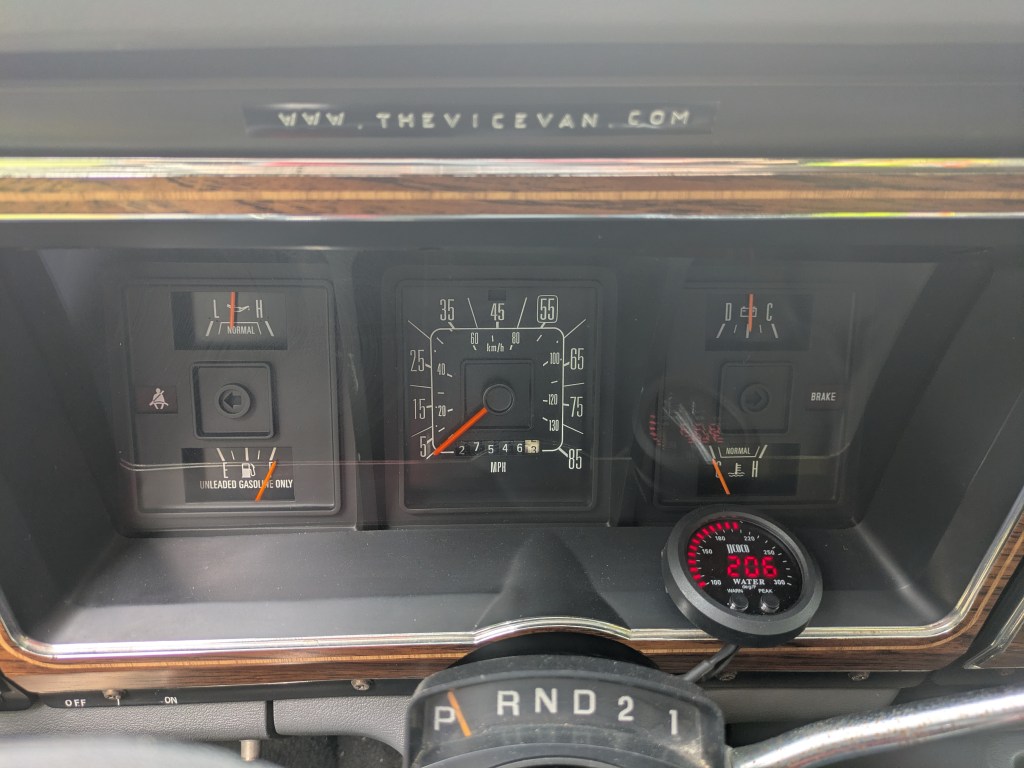
We took a brief, cautious trip to a nearby gas station to fill the tank with fresh 93 octane. During the transit, the van performed remarkably well. It reached highway speeds without hesitation, and the three-speed automatic transmission shifted smoothly. The steering felt responsive and tight, though the overall handling remains a nostalgic reminder of 1980s suspension tech.
However, the van had one more surprise at the pump. Right as the tank topped off, we heard the splash of gasoline hitting the pavement. We have a fresh leak to investigate—likely a dry-rotted filler neck or vent hose—but for the moment, we had a full tank and a running engine.
The Creeping Needle
Upon returning, the temperature began a slow, steady creep upward. When the digital gauge hit 220°F, we cut the ignition. We initially suspected the fan clutch, which spun freely even at operating temp. Replacing it helped, but it wasn’t the “silver bullet.” We even doubled down by adding auxiliary cooling fans and a larger transmission cooler to move more heat, but the needle still refused to stay down.
The Forensic Discovery: Chocolate Milk
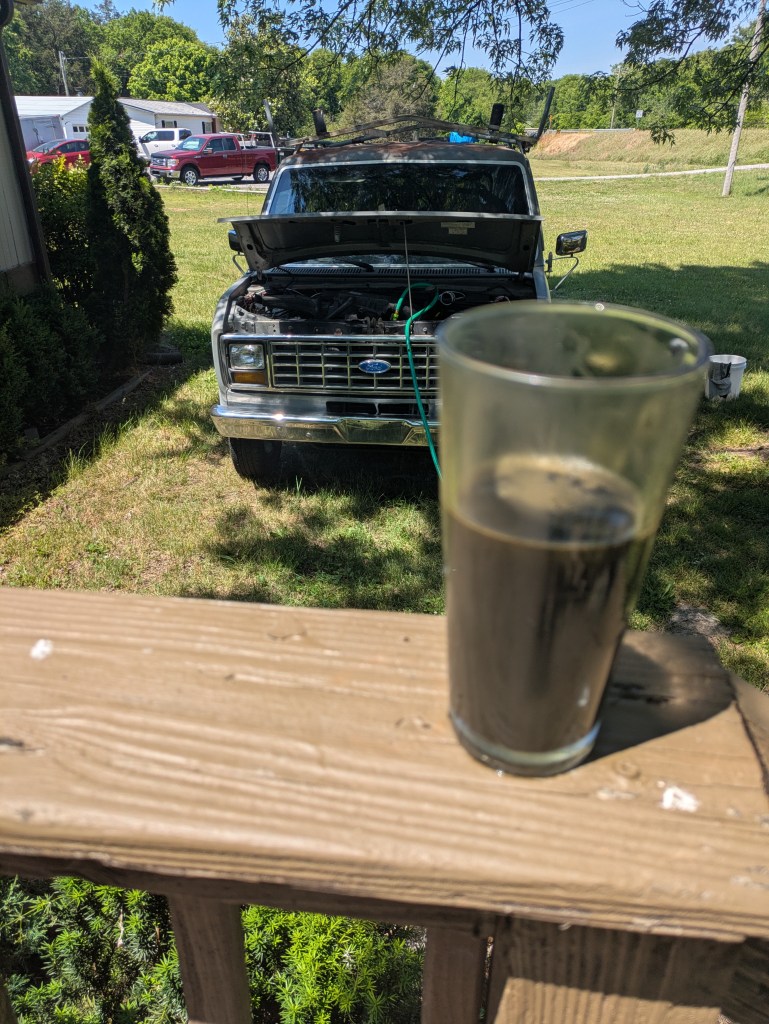
We noted an alarming detail: despite being a nearly new system, the coolant was already filthy. When the radiator had exploded in the previous installment, it revealed a dark brown sludge. We began a series of flushes with clean water, which immediately turned the color of chocolate milk.
The diagnosis was clear: twelve years of dormancy had allowed a massive buildup of rust and scale inside the engine block. The radiator wasn’t failing; it was being insulated by a layer of internal decay.

The Chemical Solution
After several water flushes, we deployed two doses of Thermocure. The effect was immediate. The water, which had finally started to clear, turned rusty again as the solution began dissolving the scale. Over the course of several days, we cautiously ran the van to operating temperature and let it cool back down, allowing the chemicals to eat through the block’s internal “crust.”
It is worth noting that during these high-heat cycles, our brand-new fail-safe thermostat did exactly what it was marketed to do: it got too hot and locked itself in the open position. While it’s technically “broken,” it’s currently a benefit. We’ll eventually replace it with a high-quality OEM-temp unit, but for now, the constant flow is helping the cleaning process.
The Verdict: Street Ready
The results were definitive. After a final series of flushes, the “chocolate milk” was gone. We took the van on a 12-mile night run with zero issues, followed by nearly 30 miles the next day in the direct sun. The temperature held steady. The coolant is now looking more like “apple juice” and less like sludge—a massive victory.
We’ve filled the system with clean water and a Blue Devil flush solution to let it soak for several more days, ensuring every last bit of rust is dissolved. The Vice Van has finally found its cool.
- Case File 022: Pressure Points
With the engine finally holding a steady idle, we pivoted our focus toward making the Vice Van street-legal. The goal was simple: move the investigation from the driveway to the open road.
Establishing Control
The first priority was the braking system. The pedal, which had previously been “just a suggestion,” was completely non-responsive. We performed a full system bleed, purging years of air and degraded fluid. The result was a success—the pedal regained its firmness, and for the first time in twelve years, the van has the mechanical capacity to stop.
To complement the newfound stopping power, we addressed the rear tires. Replacing the dry-rotted rubber with a fresh set ensures we aren’t courting a blowout on our first outing. With the mechanical safety checked and the insurance and registration officially updated, the Vice Van is—on paper—ready for the roadway.
The Relay Retrofit
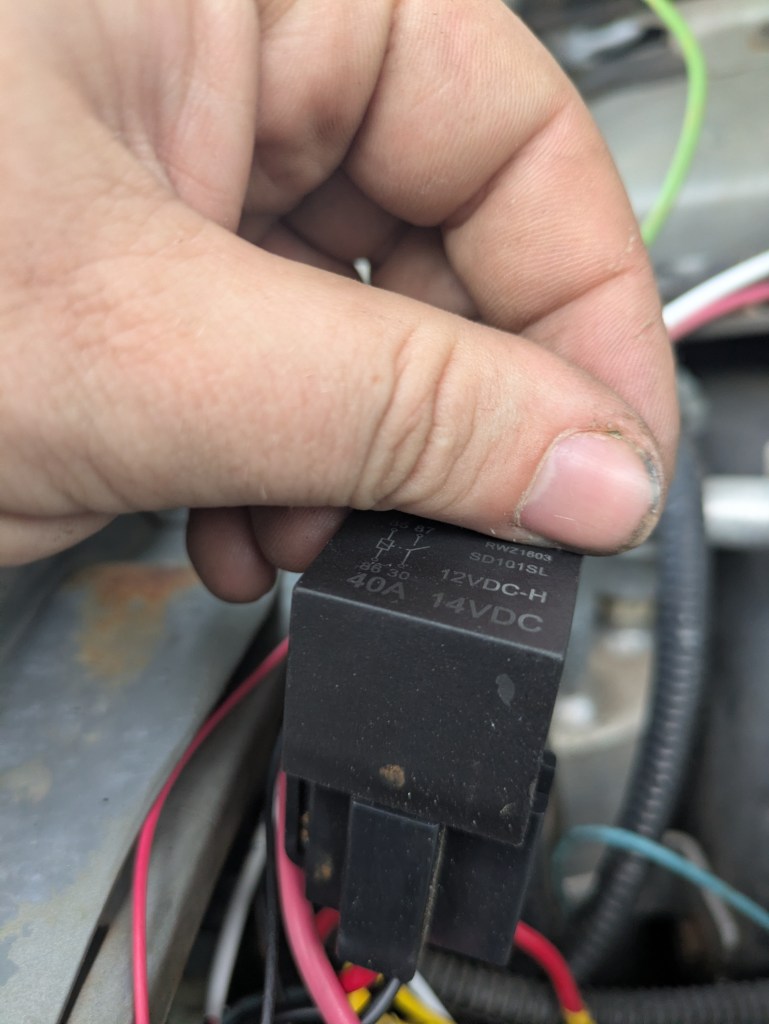
Before the final test, we addressed a lingering electrical suspect: the fuel pump relay. The original proprietary Ford relay was not only expensive but notoriously difficult to source in a pinch. With some help from our friends at a nearby shop, we elected to cut the vehicle harness and convert the system to a standard, “off-the-shelf” Bosch-style relay. It’s a cheaper, more reliable solution that ensures if the pump loses power on the road, a replacement is only as far as the nearest auto parts store.
The Thermal Event
Before attempting a maiden voyage, we elected to perform one final stress test: an extended idle to monitor for heat-soak or fluid leaks. For two hours, the 351 Windsor sat perfectly.
Then, the Vice Van reminded us that “new” does not always mean “reliable.”
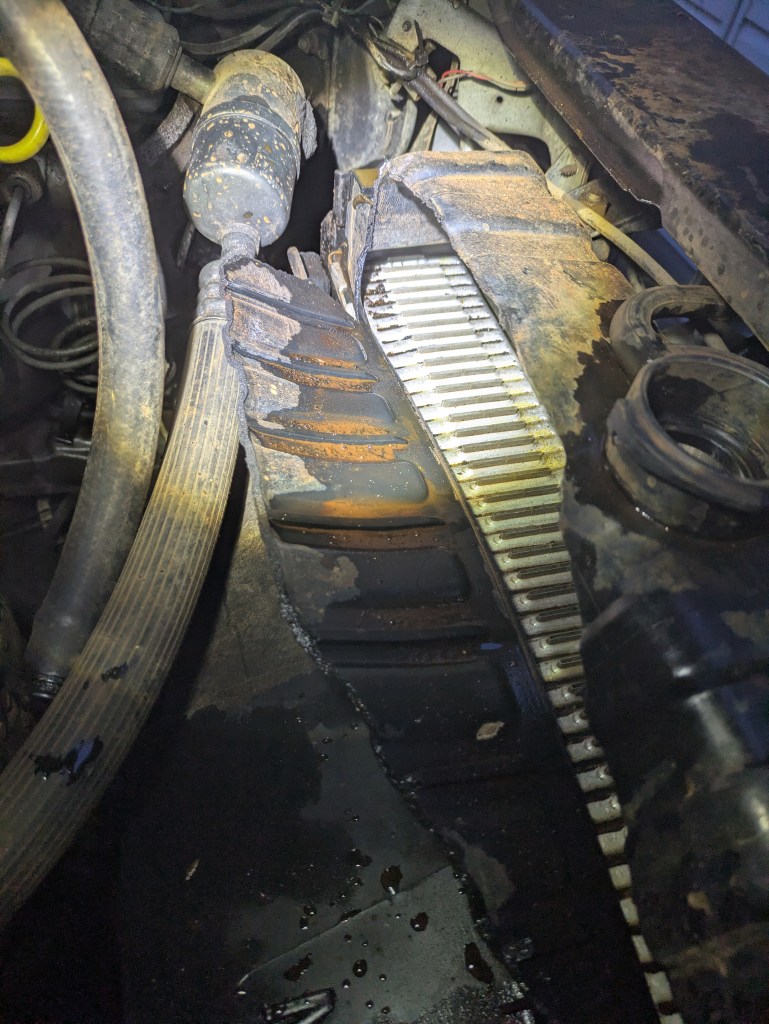
Without warning, the radiator suffered a catastrophic failure. The plastic tank burst apart violently, spraying pressurized coolant across the engine bay and down the exterior of the van. While the engine didn’t show signs of a traditional overheat prior to the pop, the “wholesaler closeout” unit clearly couldn’t handle the long-term pressure of a heat-soaked Windsor.
Back to the Drawing Board
The investigation into the cooling system has been reopened. We’ve cleaned the “coolant bath” off the van and are moving to a more robust setup. Our revised strategy includes:
- Current-Production Radiator: We’ve moved away from discontinued stock in favor of a slightly more expensive unit that is still actively manufactured.
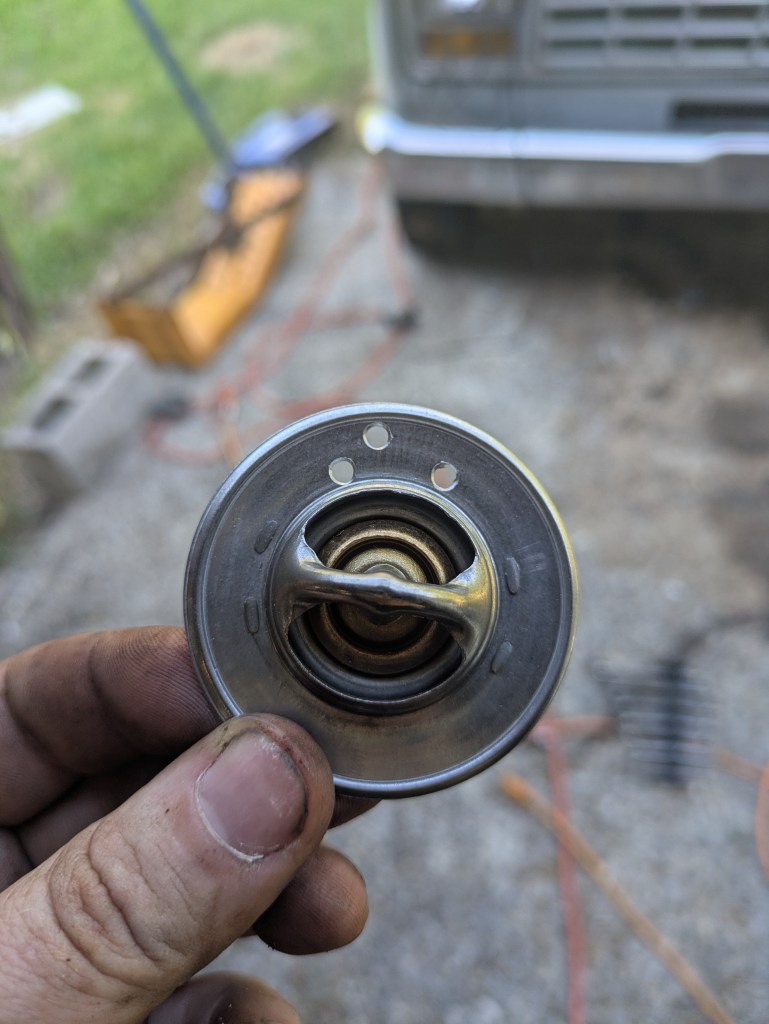
- Thermostat Modification: We are installing a “fail-safe” thermostat, but with a tactical modification: we drilled a small bleed hole in it to allow air to escape the block more efficiently during the fill process.
- Rubber Overhaul: Replacing the aged coolant hoses that were likely stressed by the pressure spike.
- Data Accuracy: During the idle test, we noted the factory dash gauge was reporting lower than expected. To eliminate the guesswork, we are adding an auxiliary digital temperature gauge to monitor the Windsor’s actual thermal state in real-time.
The Verdict
The Vice Van is street legal, but it isn’t street ready. We’ve conquered the brakes and the bureaucracy, but the cooling system has proven it still has teeth. The explosion was a setback, but better to happen in the driveway than five miles into our first test drive.
We are clearing the debris and reinforcing the system. The investigation continues.
- Case File 021: Eliminating the Variables
With the Vice Van now “mobile” and the interior “eyes” watching us, we’ve returned our focus to the 351 Windsor’s refusal to stay running. We have reached a crossroads in the investigation. Rather than chasing a single ghost through a maze of thirty-year-old wiring, we’ve decided to clear the board.
The Strategy: Systemic Renewal
We aren’t indiscriminately throwing parts at the problem; we are performing a strategic replacement of every high-probability failure point. After twelve years of dormancy, components like sensors and diaphragms don’t just “wear out”—they degrade chemically and mechanically. To find our culprit, we are removing the suspects one by one.
The Parts Manifest Our overhaul is targeting the three pillars of internal combustion: Air, Spark, and Fuel.
- The Ignition Suite: To resolve the “dies when warm” symptom, we are replacing the entire ignition path. This includes a new distributor, Ignition Control Module (ICM), ignition coil, spark plugs, and wires. If the spark is failing due to heat-soak, this will bury that problem for good.
- The Sensor Array: To ensure the computer is getting clean data, we’re installing a new MAP (Manifold Absolute Pressure) sensor and IAT (Intake Air Temperature) sensor.
- Fuel Delivery: Knowing the fuel has had over a decade to varnish and corrode, we are replacing the fuel pumps, fuel filters, and the fuel pressure regulator.
- Maintenance Essentials: A fresh air filter is going in, and while the serpentine belt looks remarkably well-preserved, we are retiring it due to age. Rubber has a memory, and twelve years is a long time to remember being still.
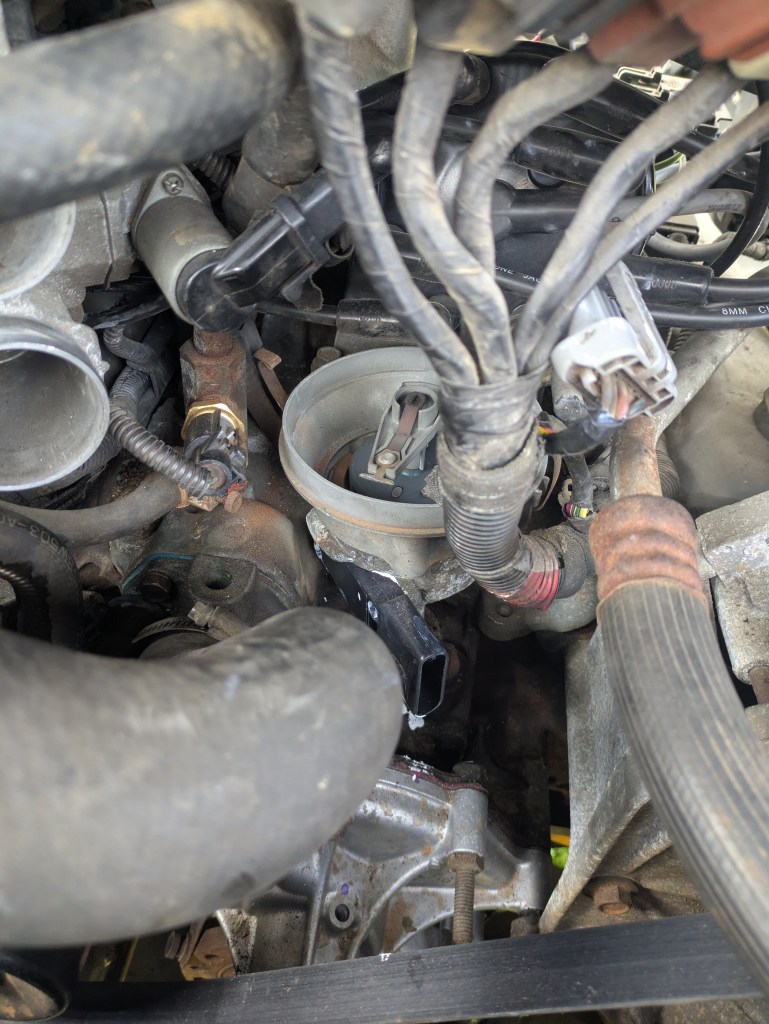
The distributor is remarkably easy to change, as long as you label it well! 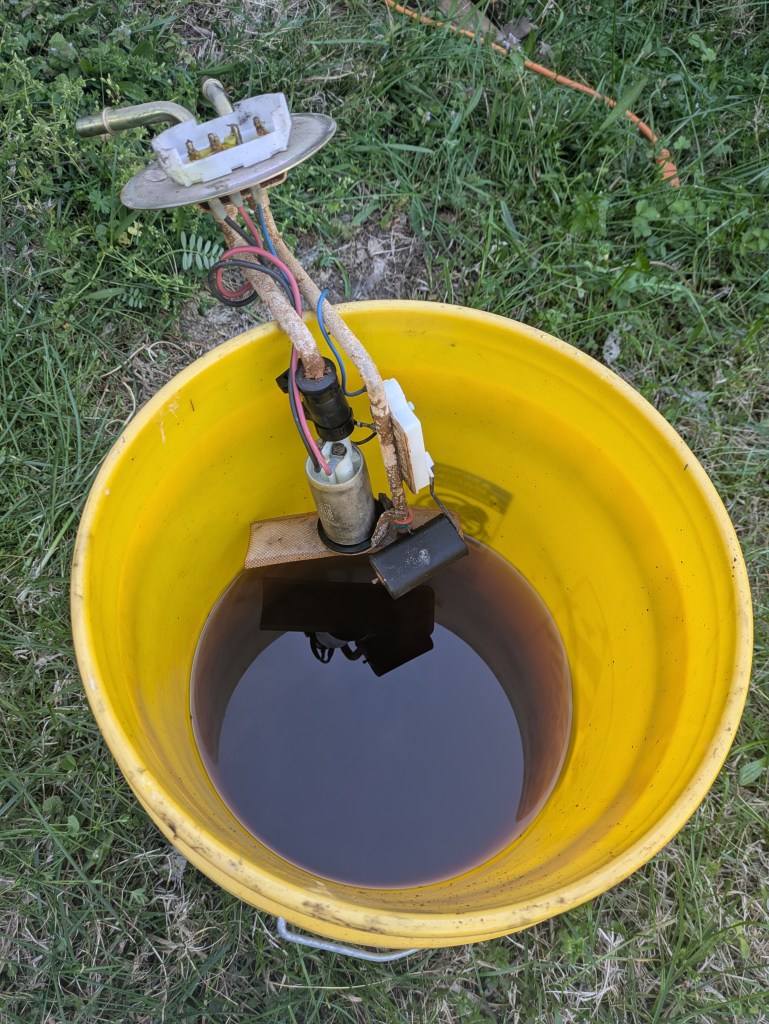
The fuel pump, along with the fuel, have certainly seen better days. The Alternator Anomaly
During our brief “First Flight” test, we uncovered a new piece of evidence: the alternator is dead. It isn’t providing a charge to the system, which adds another layer of instability to the engine’s electronics. A new alternator, along with a wiring pigtail and voltage regulator, are slated for installation to ensure the system has the 14 volts it needs to think clearly.
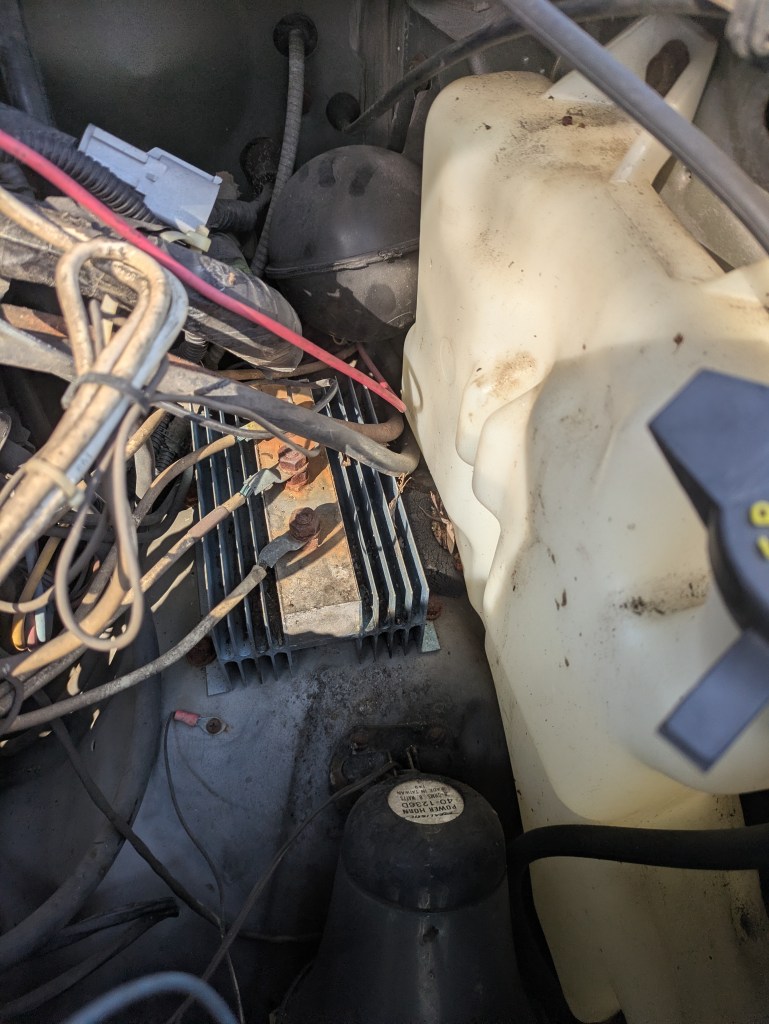
We elected to delete the charge controller – there’s no need in having the engine charge the house batteries anymore, and it’s another failure point. 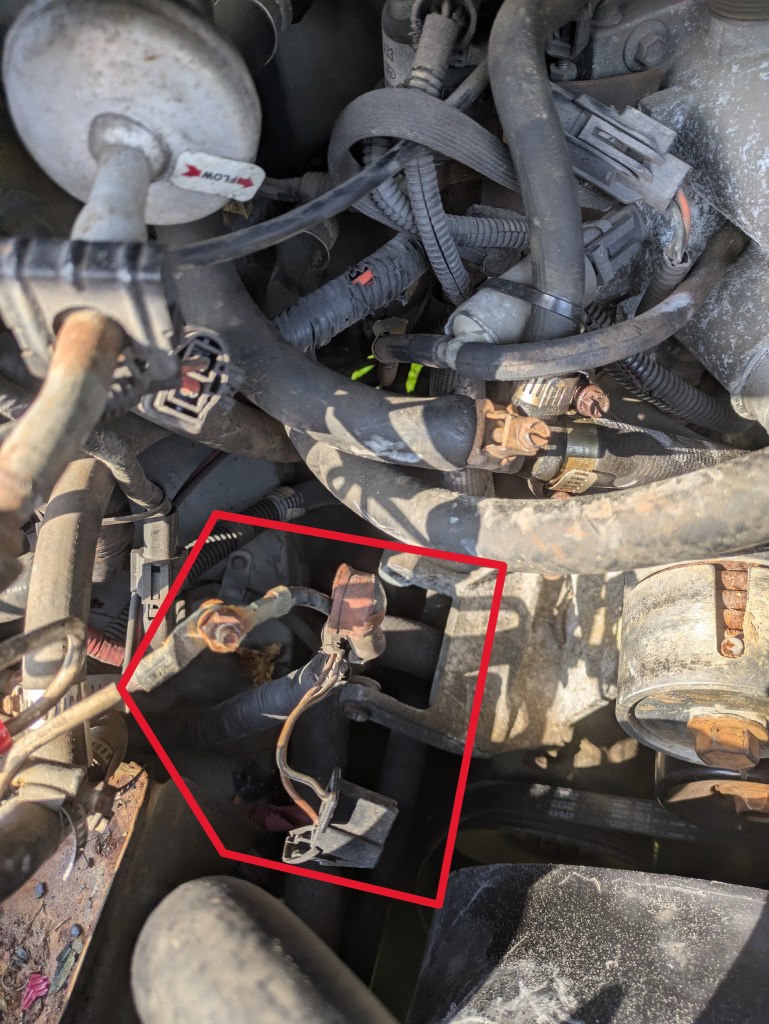
We noted a lot of questionable wiring while changing the alternator, all of it was replaced. The goal is simple: eliminate every possible “maybe” until the only thing left is a running engine.
The Verdict
The “shotgun” approach, while intensive, proved to be the correct forensic path. After the final connection was tightened and the timing was set, the Vice Van roared to life.
For the first time in over a decade, the 351 Windsor sat at a smooth, stable idle. We monitored the gauges and let it run for over an hour—no stumbles, no overheating, and crucially, no “abrupt dying.” The ghost in the machine has been exorcised – at least for now.
Interestingly enough – the fuel pump relay stopped working again, and it was full of water when we pulled it off. A replacement, along with a relocation, is coming soon.
The Vice Van isn’t just a project anymore; it’s a running, breathing machine. We’ve conquered the cooling, the fuel, and the fire. Now, it’s time to figure out how to make it stop.
- Case File 020: The Glow of the Past
Before we dive back into the mechanical gremlins stalling our progress, we shifted our focus to the interior. If the Vice Van is going to live again, it needs the right atmosphere. We’ve begun the process of restoring the cabin’s “tactical” lighting and reviving the onboard surveillance tech.
Illuminating the Interior
The lighting system was a literal dark spot. The mid-cabin light was completely dead, requiring us to gut the housing and retrofit it with color-correct temperature LEDs. It now provides a clean, reliable glow without sacrificing the vintage aesthetic.
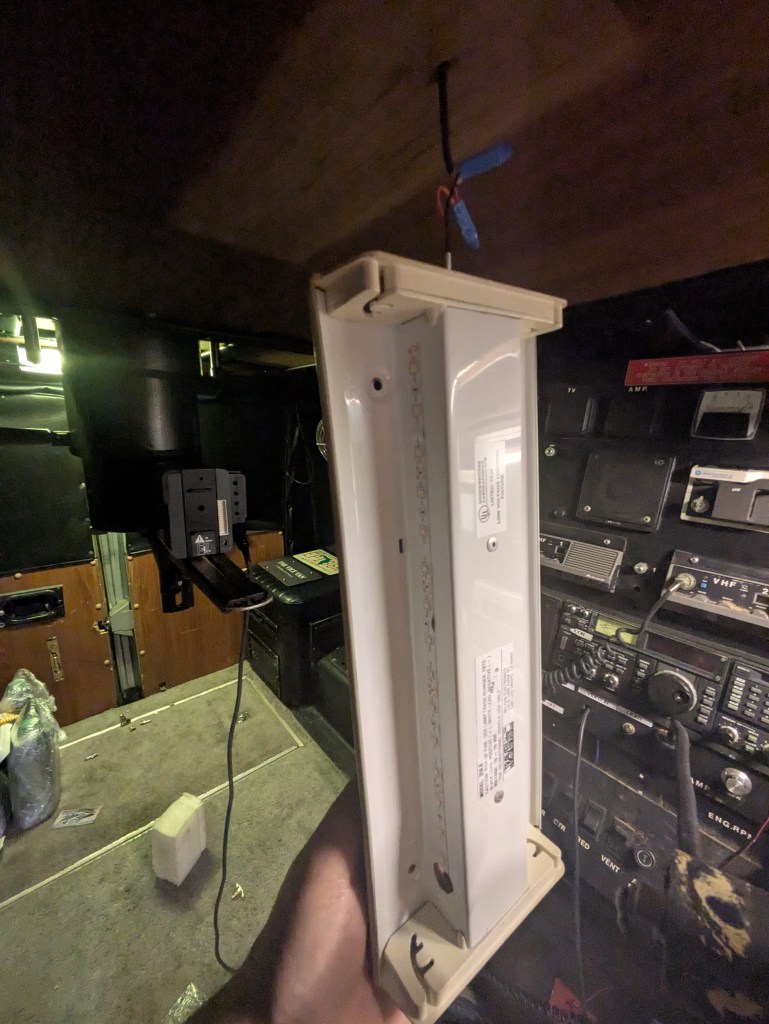
The front light presented a different challenge: a missing red lens. Since a period-correct replacement has proven impossible to source, we improvised. We installed high-output red LEDs and positioned the original (non-functional) bulb over them. The result is a perfect forensic illusion—it looks exactly like an old-fashioned fluorescent tube bathed in red light, maintaining the “low-profile” surveillance vibe.
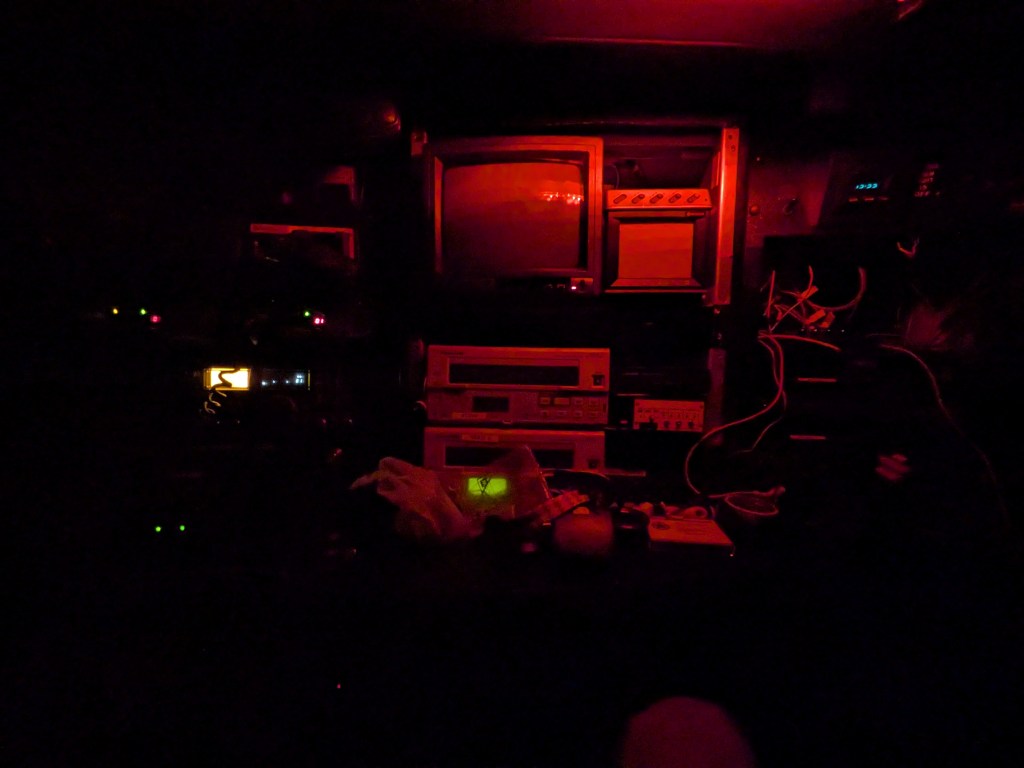
The VCR Evidence The most haunting discovery came from the onboard electronics. We found a piece of plastic jammed in the VCR, which was still holding a tape from the van’s previous life. After clearing the jam and hitting play, we were met with a few seconds of grainy video—a flickering, shocking reminder of the surveillance missions this van once spearheaded. It’s a brief window into a cold case that hasn’t been opened in decades.
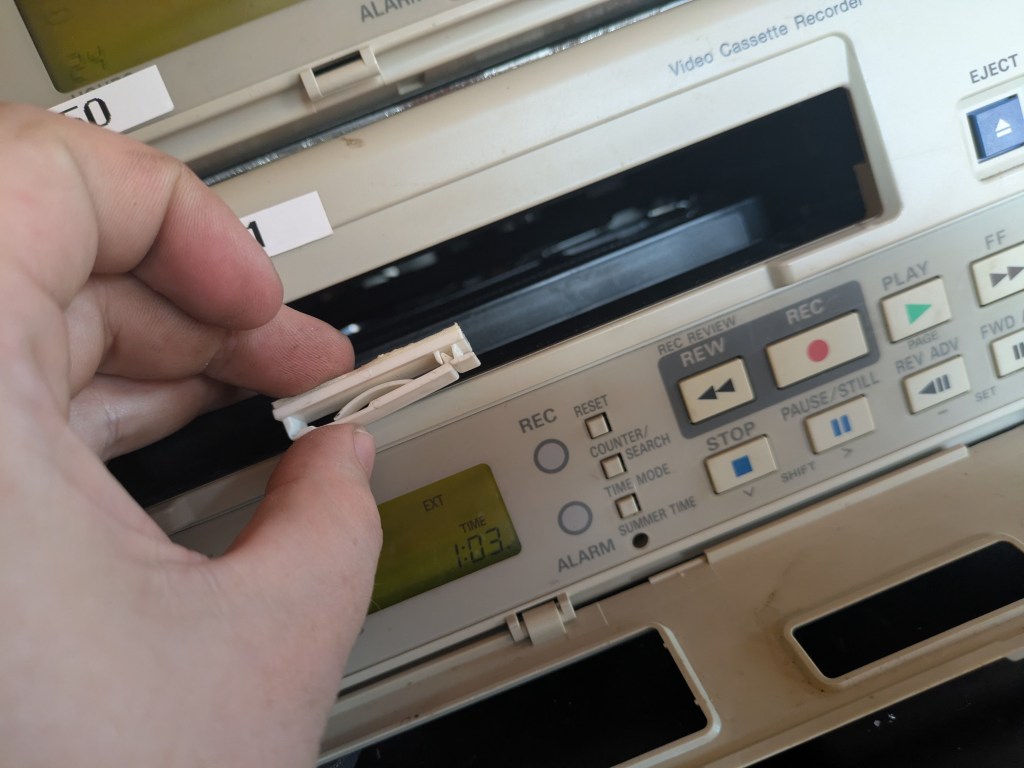
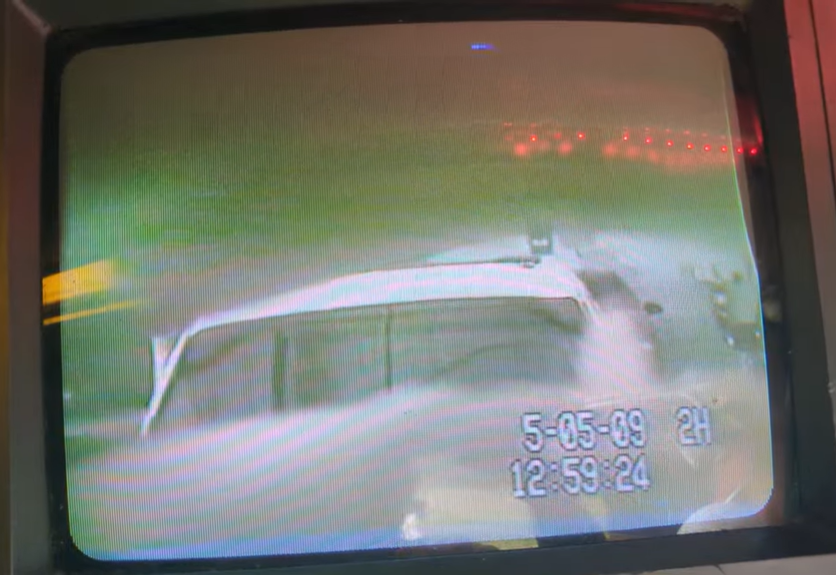
Optics and Interference We also turned our attention to the van’s “eyes.” We cleaned the periscope assembly and began troubleshooting the primary video camera. After connecting all the cables and wiggling all the buttons and knobs, the signal flickered back to life.
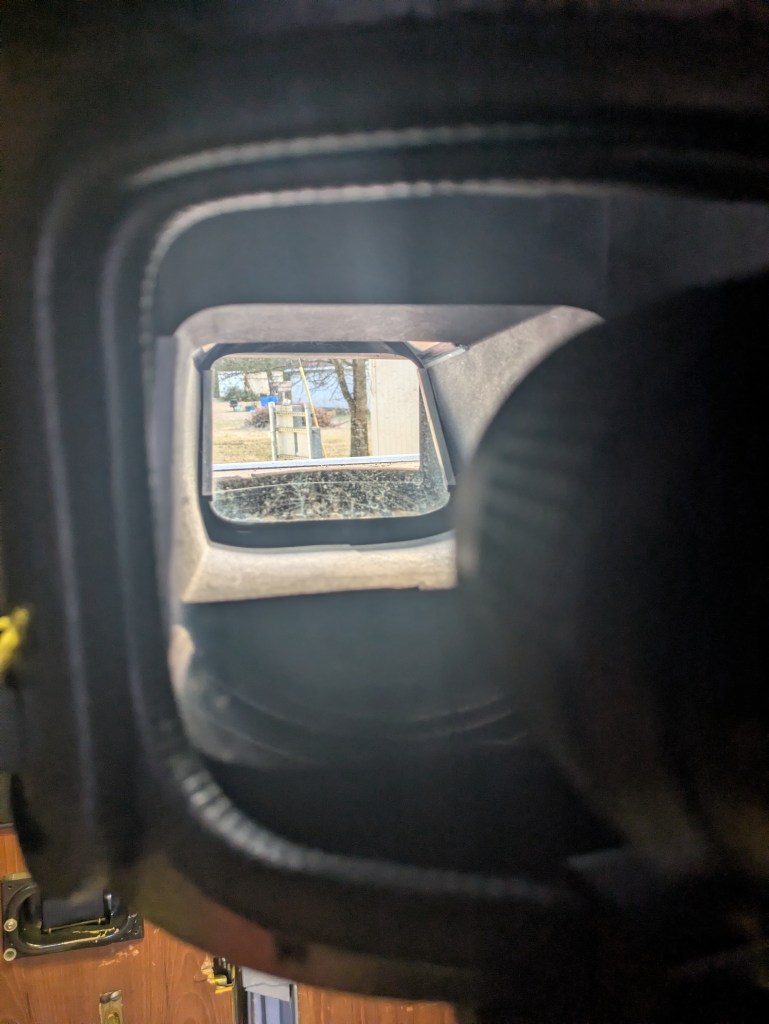
However, we encountered a technical anomaly: a heavy amount of “snow” and signal noise. Through a process of elimination, we discovered the culprit was the onboard battery charger. The electromagnetic interference was bleeding into the video feed; once the charger was disconnected, the picture cleared up instantly.
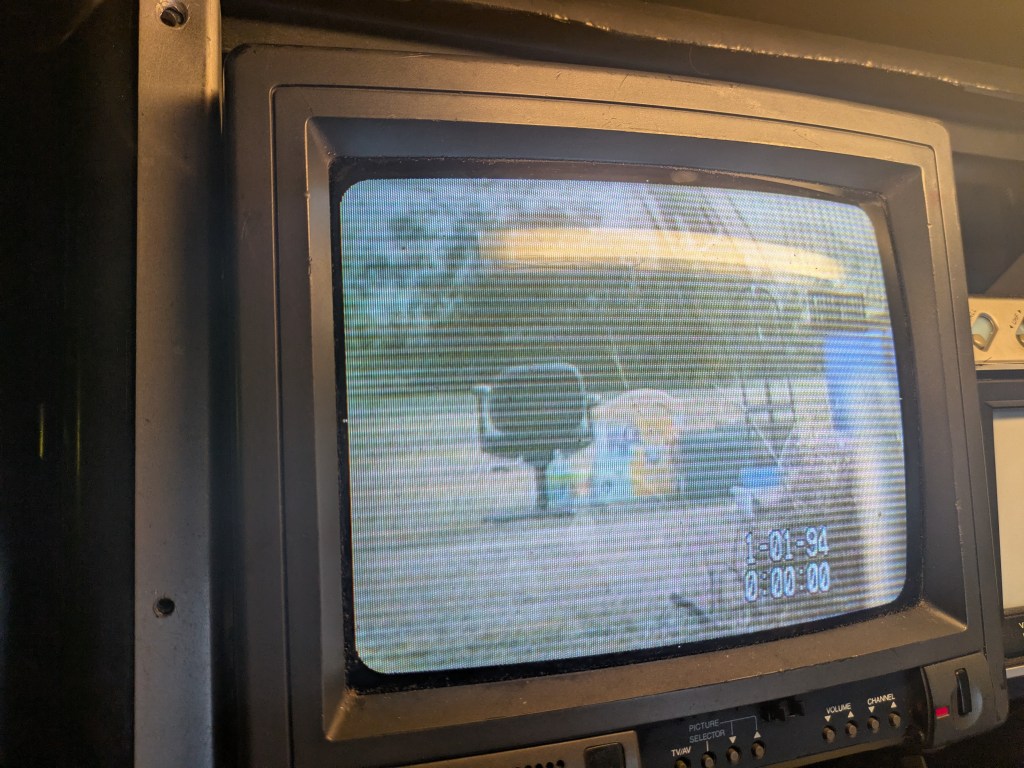
The Verdict The Vice Van is starting to see—and look—like itself again. The red glow is back, the cameras are live, and the ghosts in the VCR have been acknowledged. We have the atmosphere; now we just need the reliability to match.
The interior is ready for a stakeout. Now, we just have to figure out why the engine won’t stay invited to the party.
- Case File 019: Breaking Inertia
While we continue to investigate the engine’s tendency to “go dark” at operating temperature, we faced a more immediate logistical hurdle: the Vice Van was a literal anchor. To move it around the shop or the driveway, we needed a footprint that wasn’t compromised by rot and age.
The Rubber Evidence
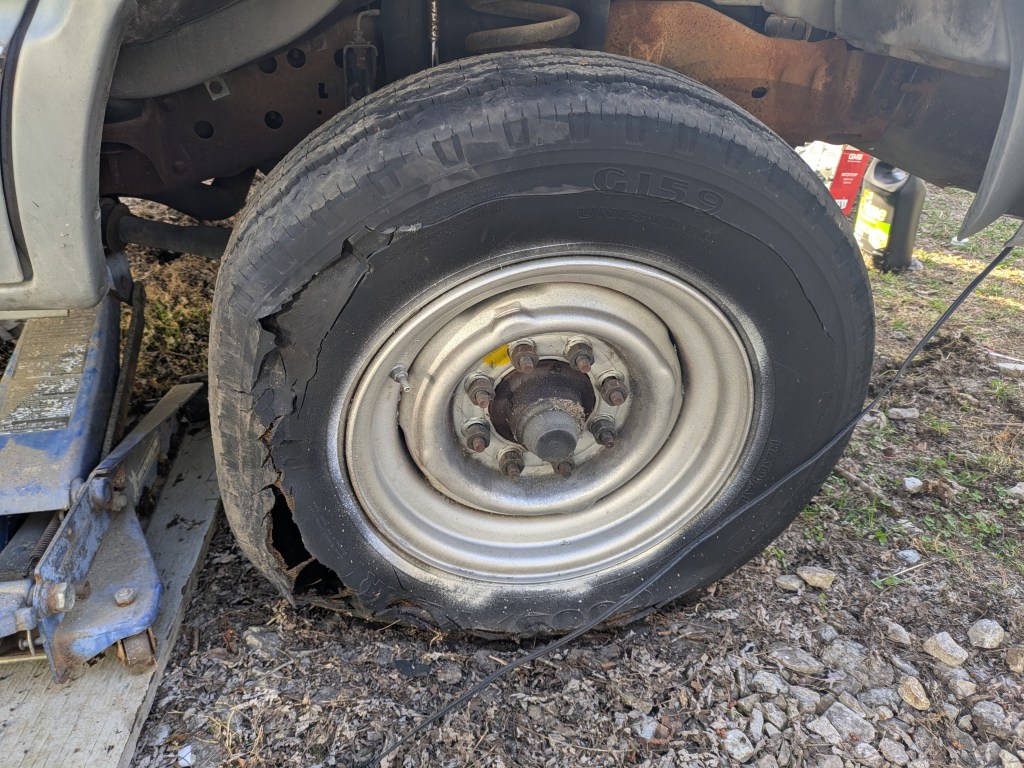
The existing tires were the definition of “end of watch.” The front pair was in the worst condition, with the passenger side tire sporting large holes that made holding air a physical impossibility. Since the van is still a long way from being roadworthy, we couldn’t justify a brand-new set of performance rubber.
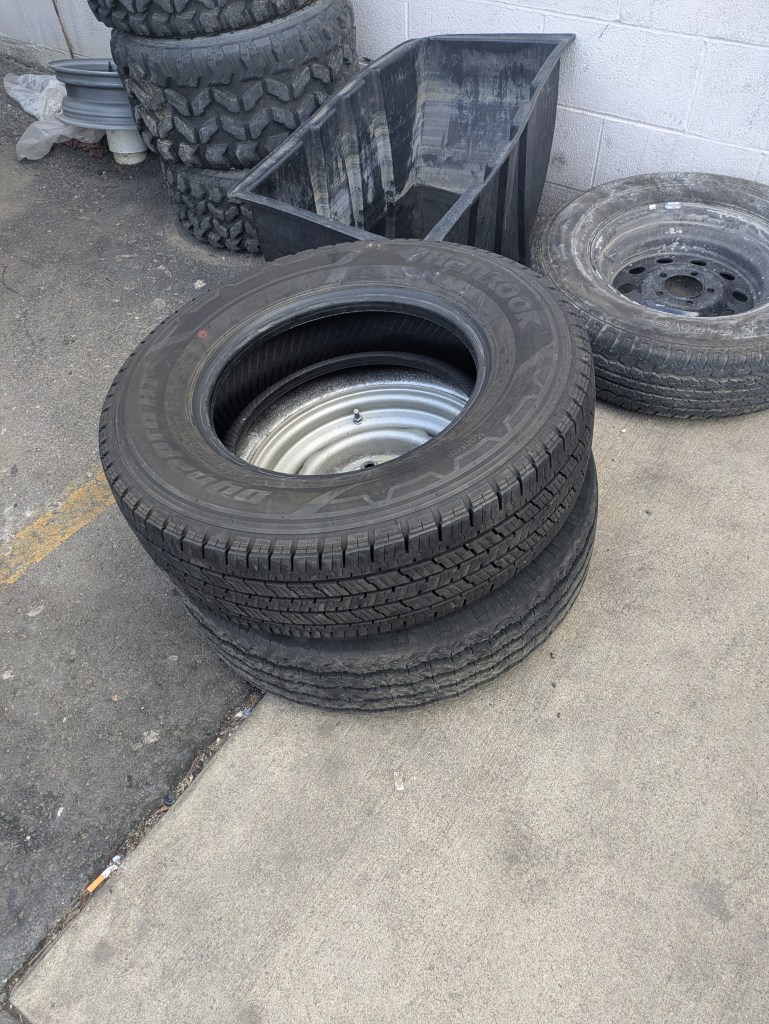
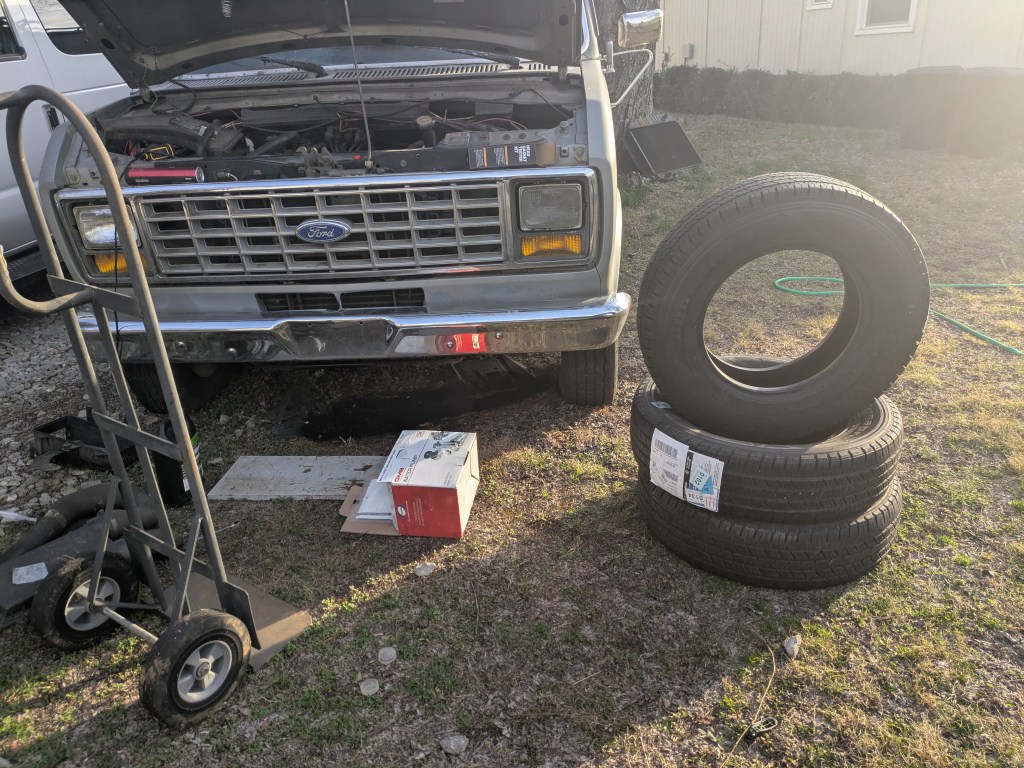
Instead, we sourced a used but acceptable set of tires on eBay for a steep discount. They aren’t forever-tires, but they are the “probationary” set we need to get mobile.
The Extraction
Getting the front wheels off was its own battle. After twelve years of dormancy, the wheels were frozen to the hubs, requiring a significant amount of persuasion to break them free. Once liberated, we cleaned the years of grime off the wheels and touched up the paint before heading to a local shop to have the new-to-us rubber mounted and balanced.
First Flight
With the front tires installed, the moment of truth arrived. For the first time in over twelve years, the Vice Van moved under its own power.
The successful transit revealed two critical pieces of data:
- The Good: The steering feels surprisingly smooth, and the 351 Windsor feels powerful—even in a short distance, the torque is evident.
- The Bad: The braking system is almost non-existent. The pedal offers little resistance, and stopping is more of a suggestion than a command.
The Verdict
The van is no longer a lawn ornament. It can move, it can steer, and it has the heart of a powerhouse—it just can’t stop. We’ve cleared the hurdle of inertia, but the lack of brakes means the next phase of the investigation will have to stay within the safety of the driveway.
The rear tires will be replaced at a later time, before the van sees the open road.
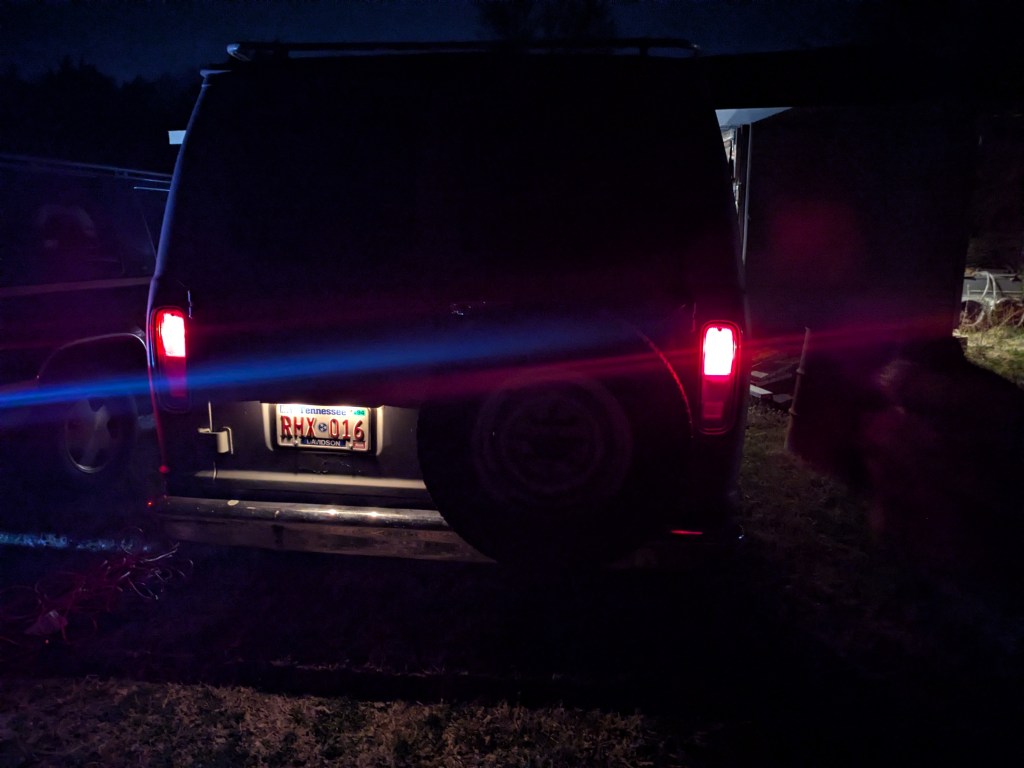
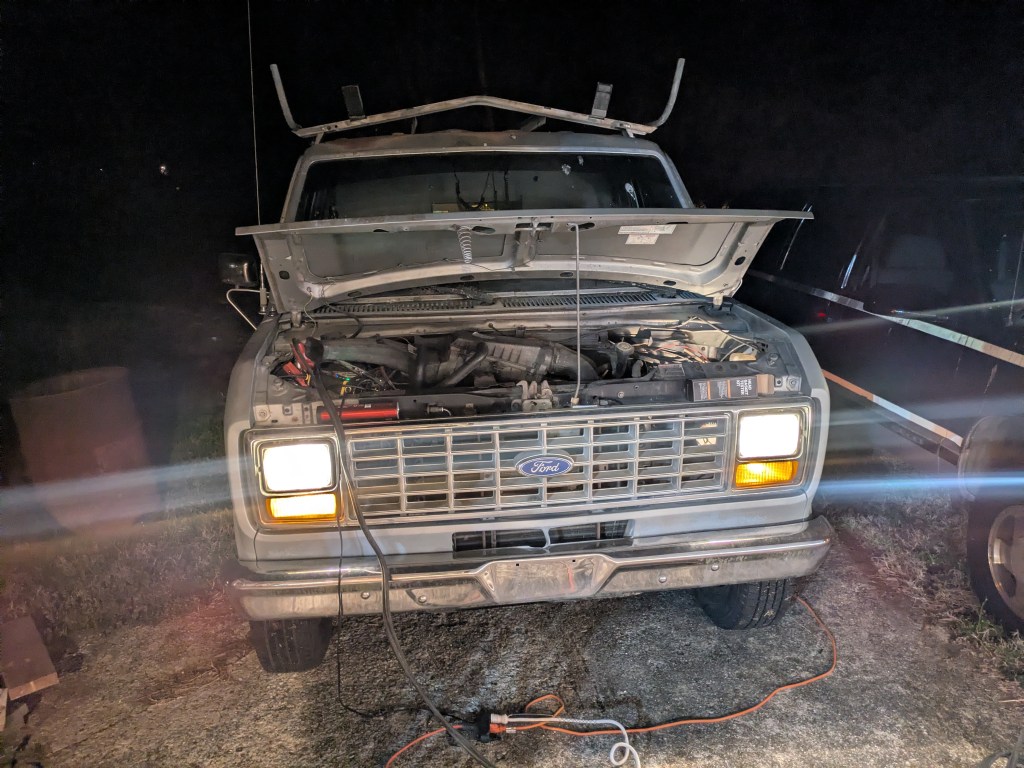
- Case File 018: Scars of the Past
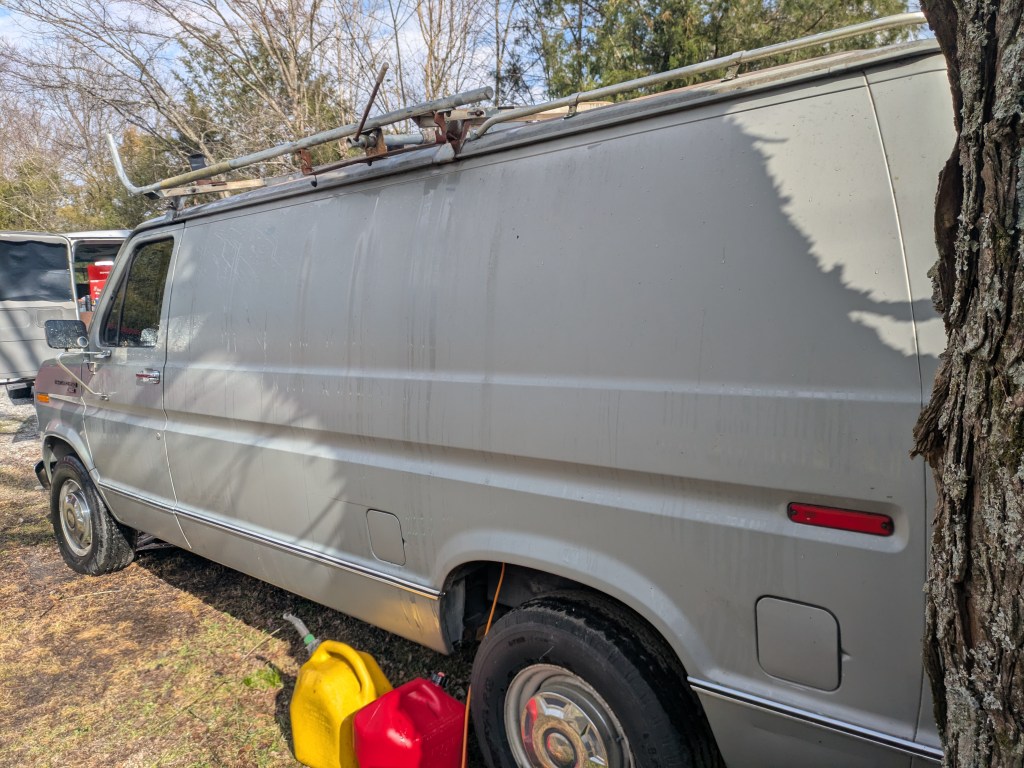
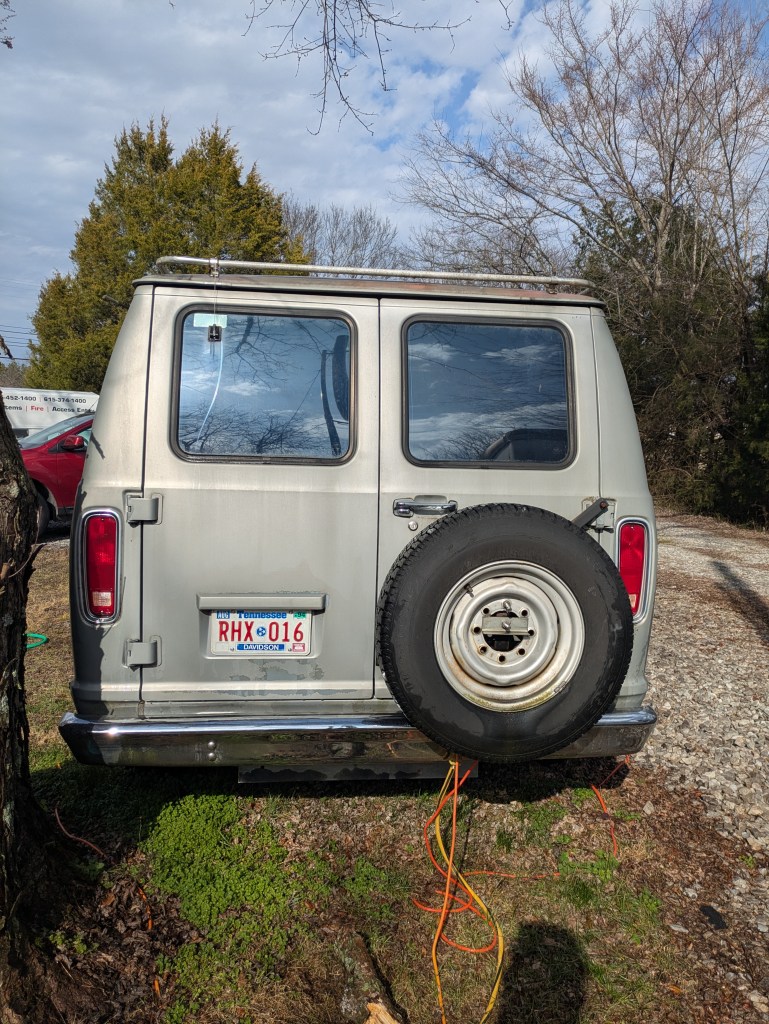
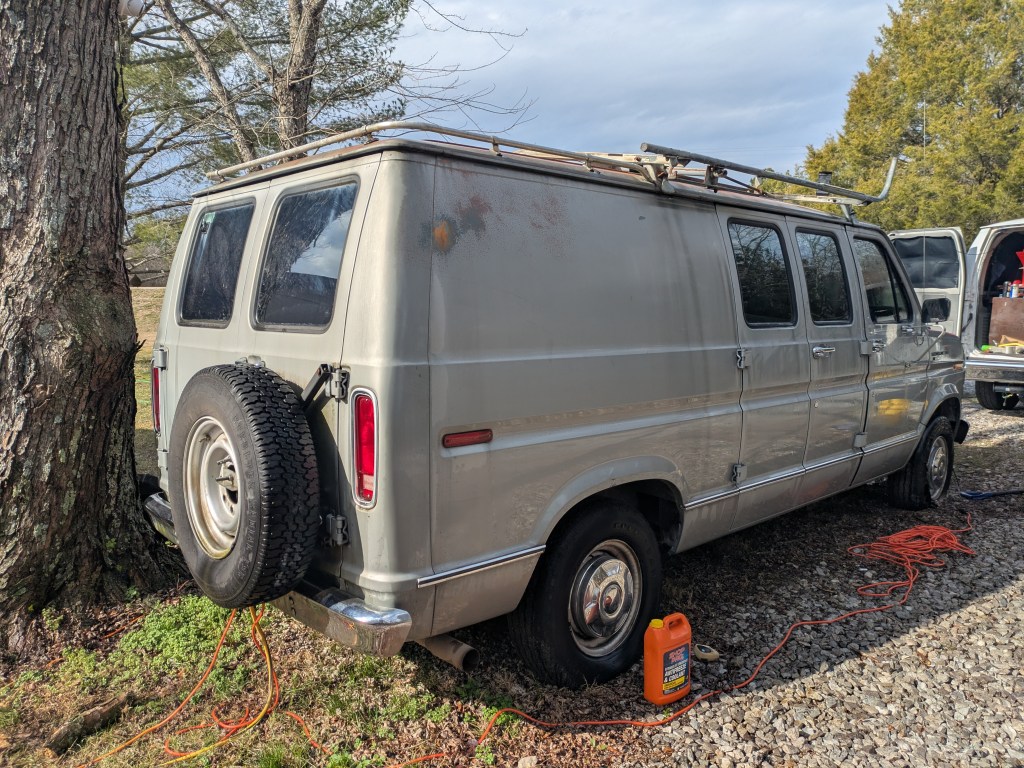
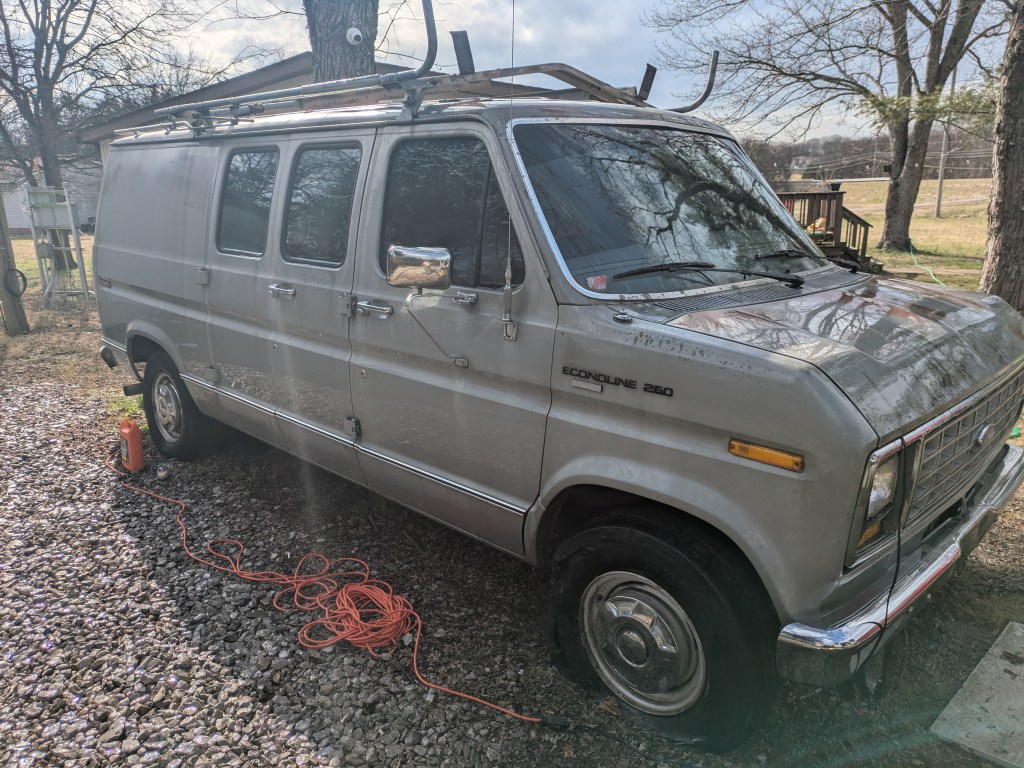
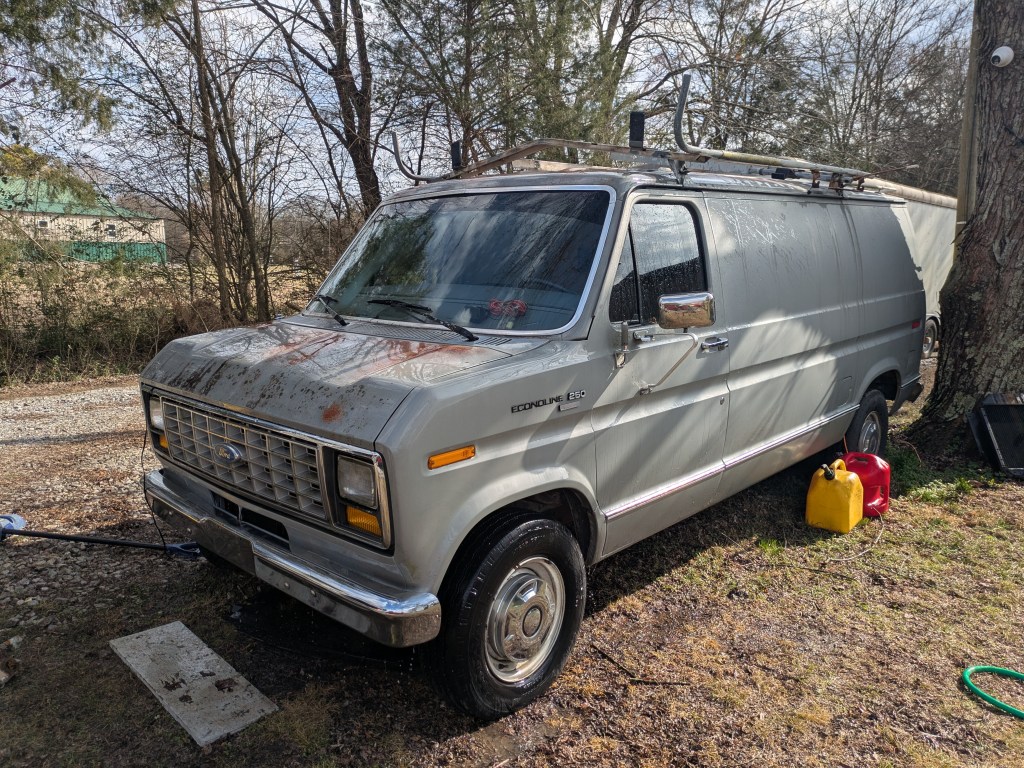
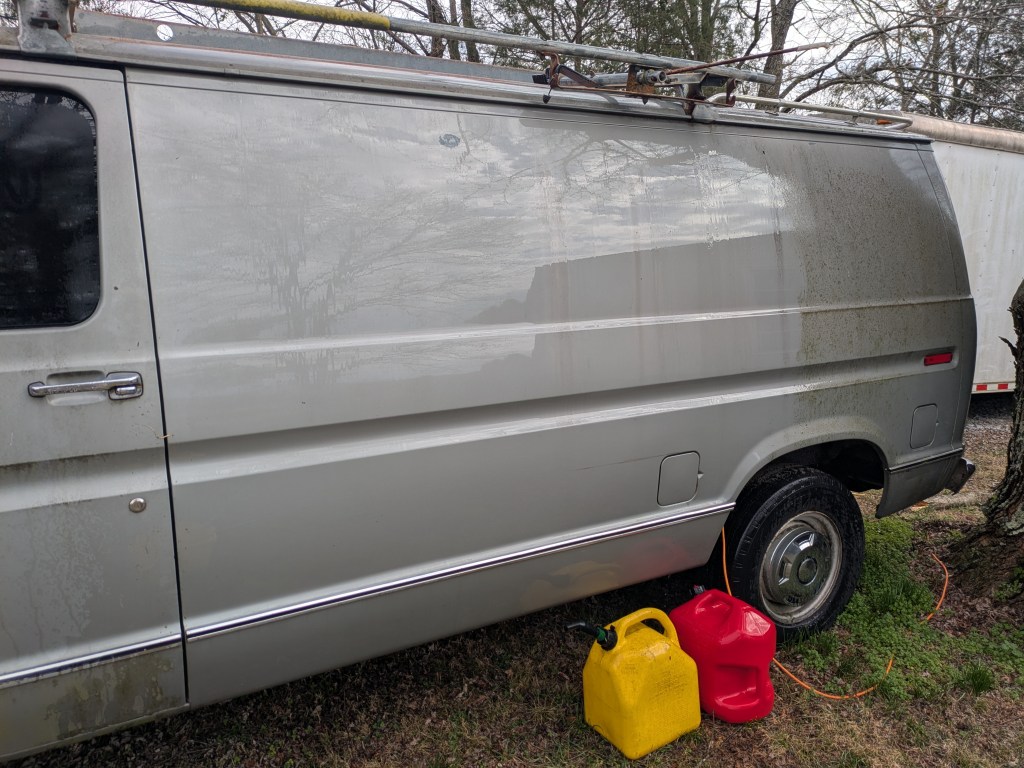
While we chase the “ghost in the machine” regarding the engine’s refusal to stay running, we decided to step away from the grease and focus on the exterior. For the first time in over twelve years, the Vice Van was subjected to a thorough decontamination. A decade of storage grime and moss was stripped away to reveal the true state of the canvas beneath.
The Surface Evidence
The results were not necessarily unexpected – After a light scrub with a stiff brush, we confirmed that the body is remarkably straight and the paint—while heavily “chalked” and faded from sun exposure—is in surprisingly good shape. More importantly, there’s no obvious “rot”. Aside from some surface scale, there isn’t significant rust to be found on the rockers or wheel wells.
However, the wash highlighted something important: the hood and the roof are in significantly worse condition than the rest of the body. The paint there isn’t just faded; it’s localized rust and oxidization that doesn’t match the rest of the body. This isn’t abnormal – the roof and hood would have seen a lot more sun exposure over the years than the rest of the body.
A Cold Case Lead
A possible explanation for the poor condition of the hood came to us by surprise – We’ve been in contact with a retired detective who once worked in “The Vice Van” – and he shared some unexpected intel. The Vice Van had once survived an engine fire. Details are scarce, but the detective jokingly commented that it was likely “put back together with duct tape and zip ties” – a sad but common story regarding government service garages.
It’s safe to say – The extreme heat from that internal blaze cooked the paint from the inside out. The hood wasn’t just weathered by the sun; it was heat-treated by a fire that nearly ended the van’s career before we ever found it.
Shockingly – It fared remarkably well and was put back in good working order, with very few obvious signs of damage.
The Verdict
Knowing the van’s history slightly changes the perspective on the restoration. We aren’t just fighting twelve years of neglect; we’re working on a survivor that has literal battle scars. It’s undetermined yet if we’ll paint the hood, or if we’ll preserve its scars to tell a story.
The Vice Van looks better than it has in a decade, but as we’ve learned with the cooling system, a clean exterior doesn’t mean the investigation is over. We’ve cleared the first layer of grime, but the mystery of why she dies at operating temperature remains the priority.
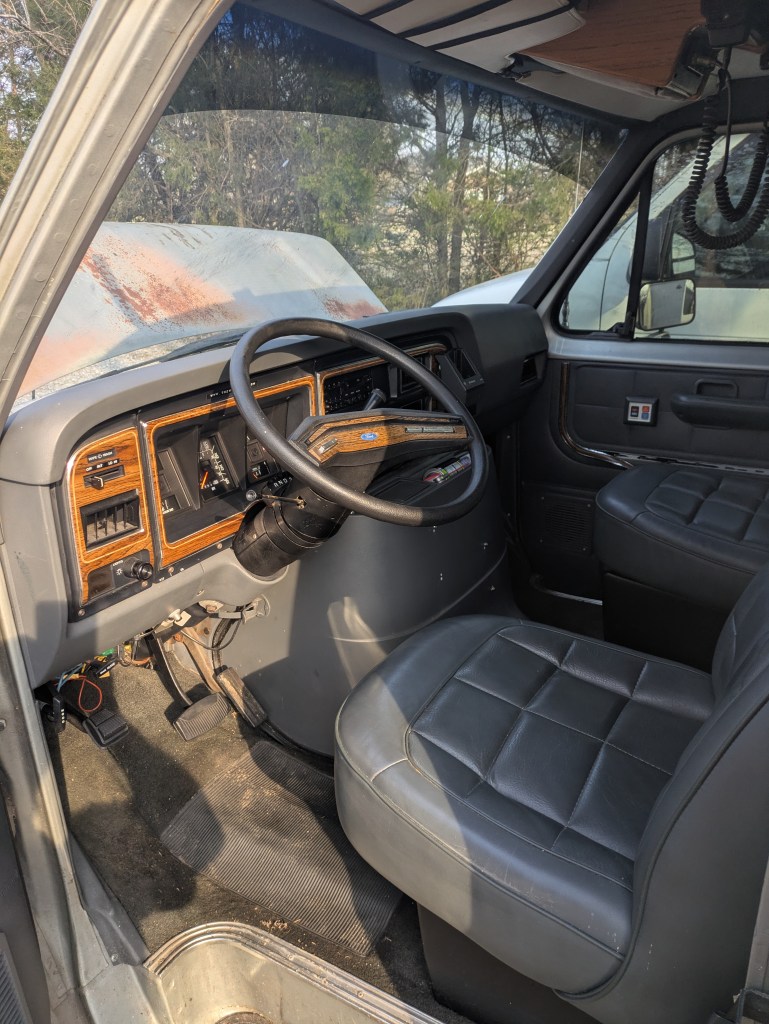
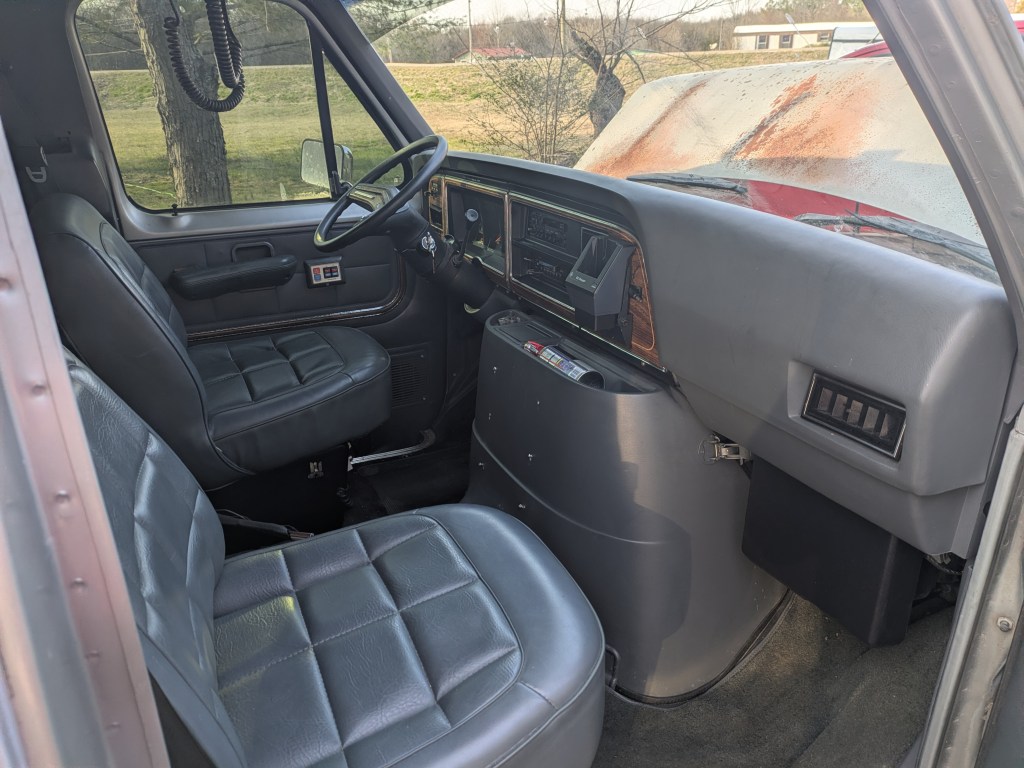
- Case File 017: The Thermal Deadlock
The Easy Fix Falls Short
In any investigation, you start with the most likely suspect. We replaced the thermostat first—a quick, inexpensive, and logical starting point for a vehicle that has been dormant for twelve years. Unfortunately, the “easy fix” didn’t solve the problem. Despite the new hardware, the 351 Windsor continues to climb toward critical temperatures within minutes of idling.
Forensic Temperature Mapping
To narrow down the failure, we verified the system was fully topped off with coolant and performed a “burp” to ensure no air pockets were trapped in the block. We then broke out the non-contact infrared thermometer to check the heat flow.
The data was conclusive:
- Inlet: The top of the radiator rapidly climbed to 230°F.
- Outlet: The bottom radiator hose remained at a stagnant 34°F (Outside temperature was approximately 24°F).
The Diagnosis: Total Obstruction
This massive temperature differential confirms that while hot coolant is reaching the top of the radiator, it isn’t moving through the core to the bottom. We’ve ruled out several other variables:
- The Water Pump: We observed active air bubbles and movement during the filling process, indicating the pump is mechanically spinning and attempting to move fluid.
- Airflow: The radiator fan is clearly engaging and spinning as designed.
- Thermostat: We visually inspected the thermostat with no obvious issues, and replaced it with a new one as a precaution.
Given that the van was extremely low on coolant when we first recovered it, it is highly likely that years of internal corrosion and scale have completely blocked the radiator core. The system is essentially a closed loop that has been capped off internally.
Next Steps
The verdict is in: the radiator is functionally a brick. We are now at a crossroads: attempt a flush to see if the blockage can be broken loose, or move straight to a full radiator replacement. Additionally, we still have no cab heat – Which begs the question: Is the heater core also blocked? Or is the radiator alone causing the entire system to stay stagnant? There’s only one way to find out.
The “While We’re In There” Reality
As it turns out, the radiator wasn’t the only casualty of a twelve-year slumber. Once we pulled the old unit, it became clear that the water pump—which we initially thought was moving fluid—was functionally compromised. The antifreeze had broken down to the point the outlet was completely blocked, and couldn’t be opened with a screwdriver or a water hose.
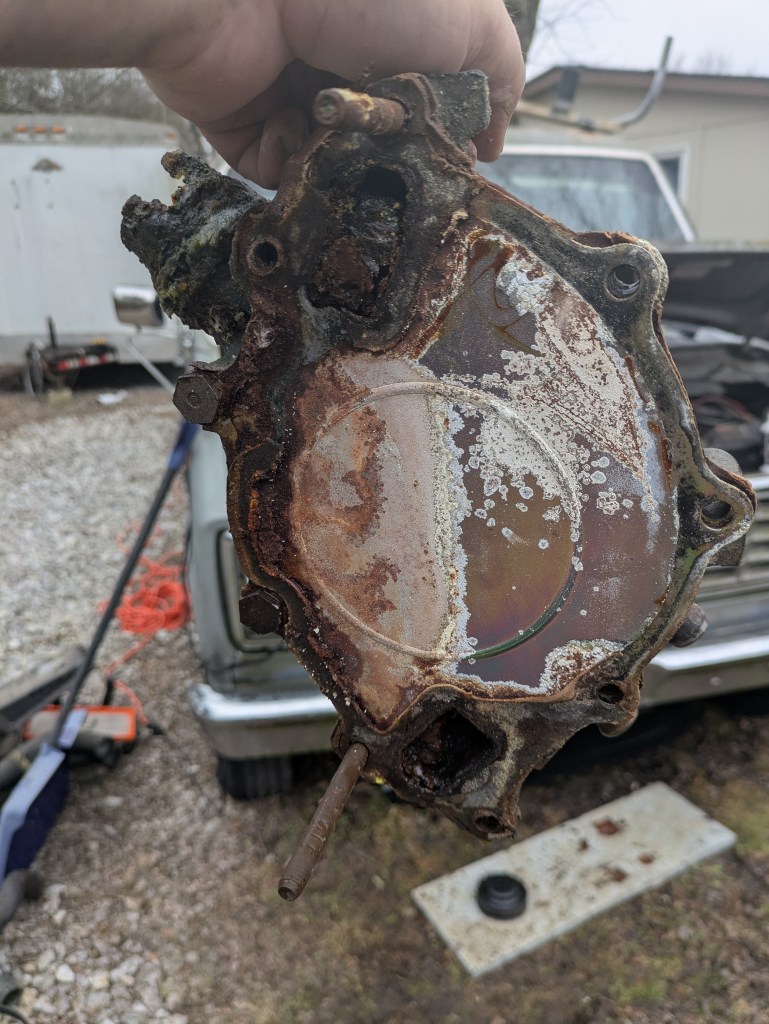
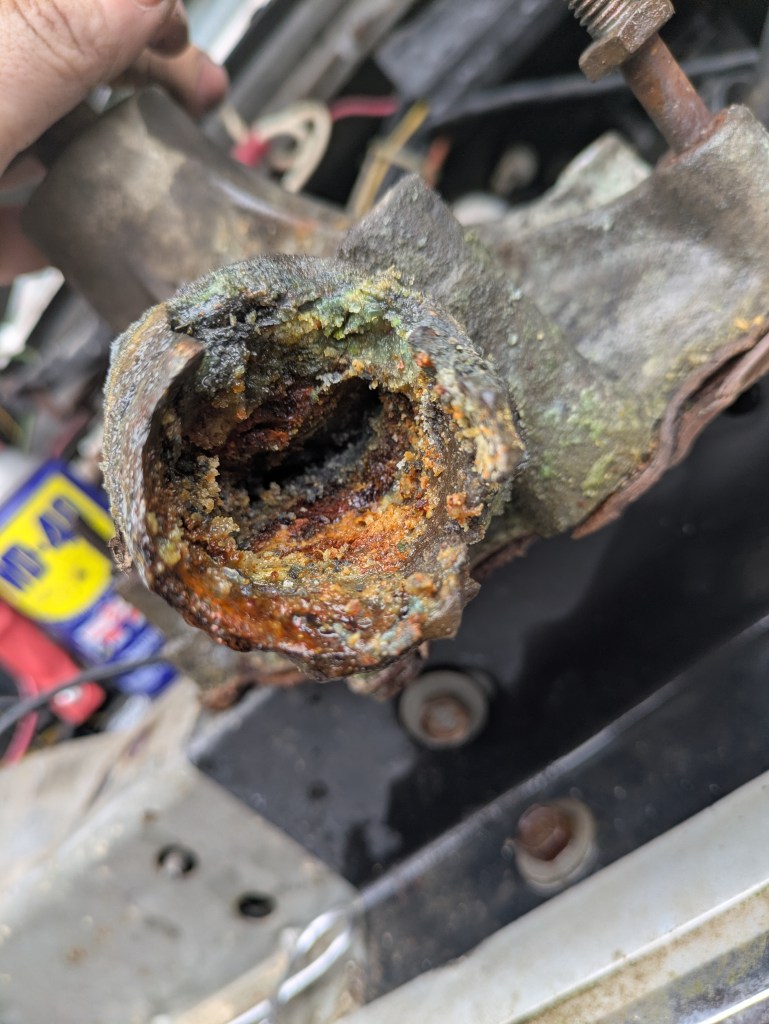
We doubled down, installing a new water pump and a fresh coolant temperature sensor to ensure the computer and the gauge were actually speaking the same language.
From Overheating to Going Dark
With a new radiator, pump, and sensor, plus flushing the heater core both directions, the 351 Windsor finally has a circulatory system that works. The “burp” appeared to be successful, the thermostat opened on cue, and for the first time in over a decade, the van sat at a smooth, stable idle. We watched the needle climb steadily toward operating temperature, expecting a victory lap.
Then, the Vice Van reminded us who’s in charge.
Just as the engine reached its sweet spot, it stumbled briefly and died. She immediately started back up, before dying again.
The Next Mystery: The Ghost in the Machine
We’ve conquered the fire (overheating), but now we’re chasing a ghost. Is it a heat-soaked ignition module? A fuel delivery issue triggered by the warm-up cycle? Or perhaps a sensor that only fails once the block reaches a certain thermal threshold?
The cooling system is finally healthy, but the Vice Van clearly isn’t ready to leave the driveway just yet. The investigation continues.
- Case File 016: The Acoustic Time Machine
The Sonic Environment
A rolling museum is more than just a visual experience; it’s a sensory one. To truly transport visitors back to the mid-90s, we began designing a custom audio environment for The Vice Van. The goal was to recreate exactly what a detective would have heard while sitting on a long stakeout in Tampa thirty years ago.
The “Hidden” Hardware
To keep the interior looking period-correct, we are utilizing low-profile, “trigger-based” audio players hidden behind the equipment rack. These devices are elegantly simple: When they receive power, they immediately begin playing an .mp3 from a micro SD card. The device has a built in 2w amplifier, so there’s very little hardware needed.
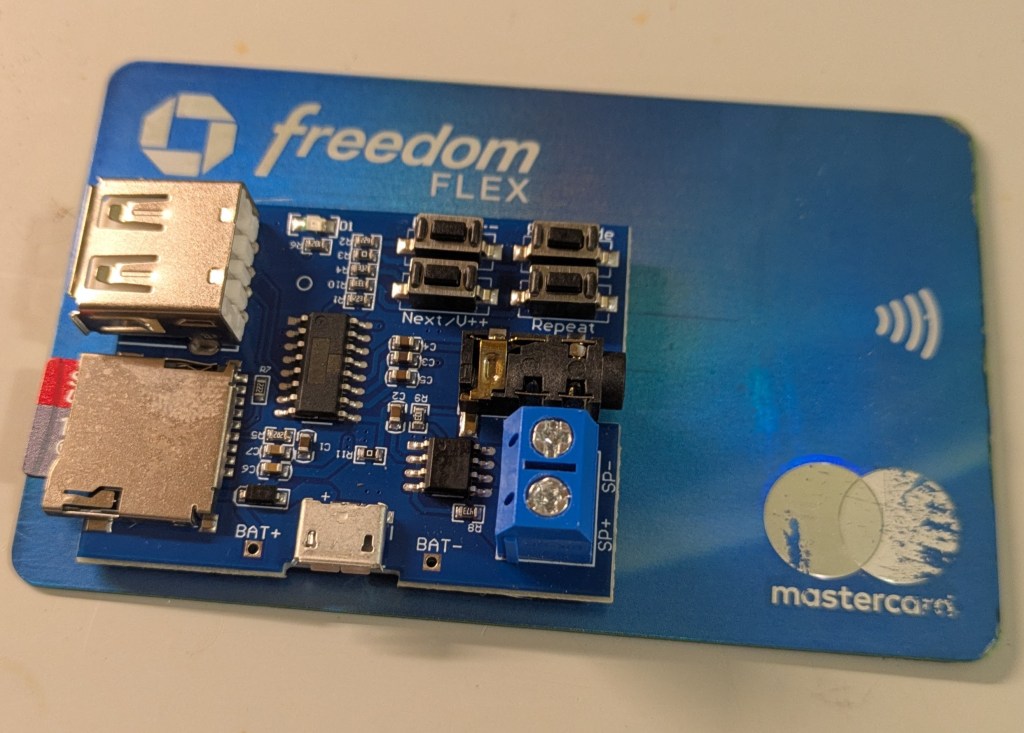
We’ve integrated these players directly into the van’s original architecture:
- Activation: Power is wired to one of the now-unused vintage toggle switches in the surveillance rack.
- Playback: The audio is piped through original vintage speakers—one located in the cab and one in the rear operations center.
When the switch is flipped, the van “wakes up” with the sounds of 1994.
Acoustic Archeology: Sourcing the 90s
We spent several hours sourcing authentic 1995 audio fragments from local Tampa radio archives. This included vintage local commercials, station IDs, weather segments, and a hand-picked selection of songs that topped the local charts in the mid-90s.
To ensure the audio felt “original” to the van, we didn’t just play the files. We mixed them into a continuous one-hour broadcast and then electronically “aged” the audio—adding subtle distortion and frequency clipping to mimic the output of a 30-year-old analog speaker system. The audio file will replay itself every hour, as long as the switch is on.

Operational Traffic: Clearwater PD
We are also implementing a second audio player to handle tactical and dispatch chatter. For this, we’ve used vintage dispatch recordings obtained featuring the Clearwater Police Department. While they aren’t HCSO-specific, they represent a local agency from the correct time period and provide the perfect “background noise” for a surveillance operation. We may update these recordings in the future if HCSO-specific archives surface, but for now, they add a vital layer of realism to the equipment rack.
The Result
The effect is transformative. Stepping into the van and flipping the designated radio switches instantly replaces the silence with the specific cultural and tactical frequency of 1994 Tampa. It provides the perfect backdrop for the Marantz recorders and Icom receivers, turning the van from a static object into a living, breathing workspace.
- Case File 015: Heartbeat & Hardware
The Electrical Win
Following the successful bypass of the fuel pump relay in Case File 013, we moved to permanent hardware testing. We replaced the fuel pump relay, and the new unit worked exactly as expected. This was a critical “green light”—it confirms that there are no further electronic interlocks or secondary kill switches currently preventing the primary fuel system from functioning.
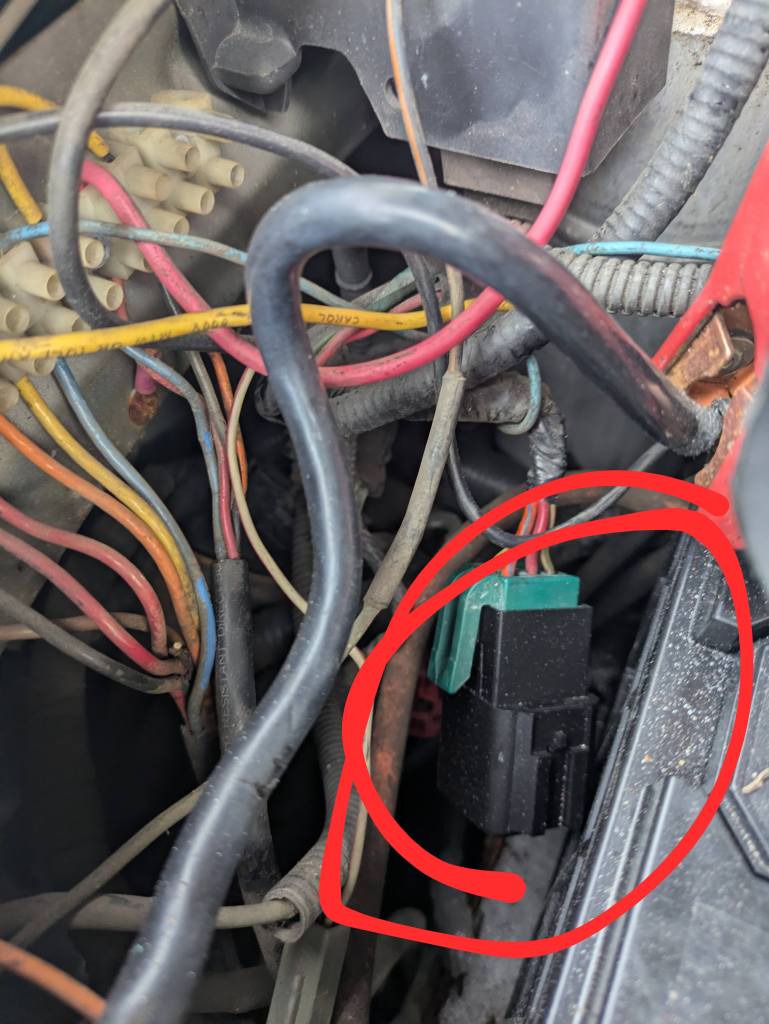
The “Dry Storage” Theory
With the relay active, we added five gallons of high-octane fuel along with a healthy dose of fuel additive. The results were immediate: The Vice Van started up, albeit not easily, and ran strong. Unlike previous tests, the engine continued to run for a significantly longer duration. This strongly supports the theory that the vehicle was stored with little to no fuel. While the dashboard fuel gauge appears to be inoperative, it is a minor concern compared to the victory of a running, idling 351 Windsor.
The Systems Audit: Thermal & Hydraulic
While the engine was running, we performed a wider audit of the mechanical systems. The news is a mix of “better than expected” and “investigation required”:
- Thermal Management: The van is running hot. While there is currently no working heat in the cab, the engine temperature climbs toward overheating quickly. We are hoping for a simple fix, such as a stuck thermostat, but further troubleshooting is required.
- Braking System: The brakes are currently non-functional. There is very little pressure; pumping the pedal provides a momentary hold before it collapses to the floor. This indicates air in the lines or a master cylinder failure. Our next step is to bleed the system and inspect for leaks.
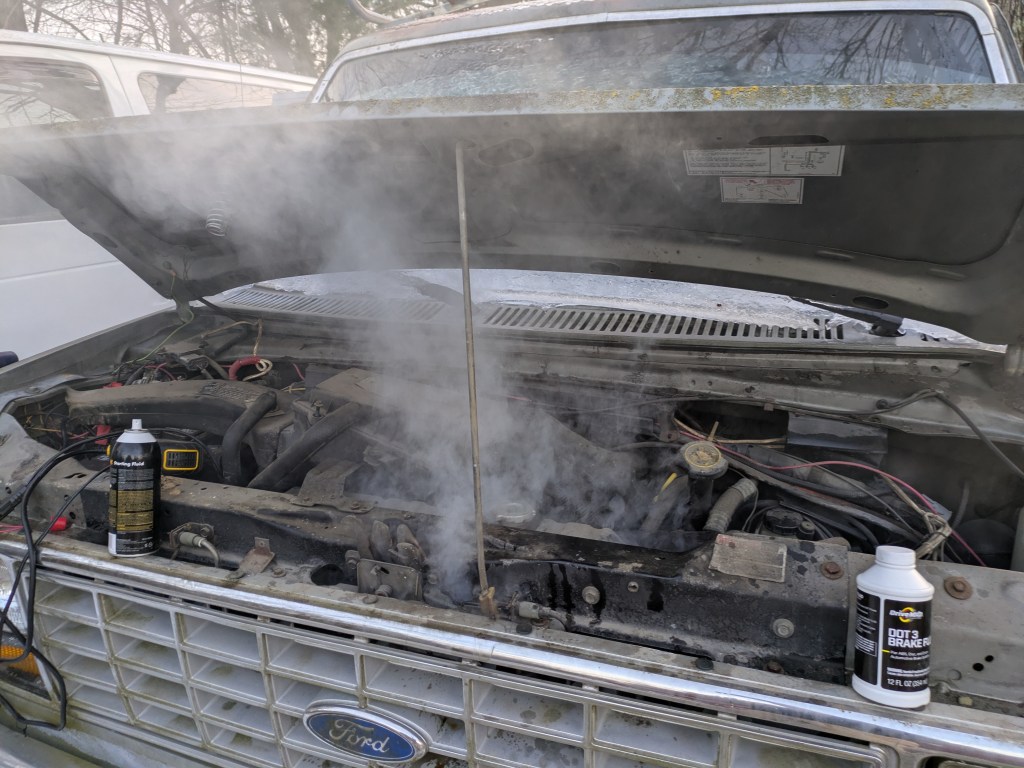
The Alternator Mystery
During an under-hood inspection, we discovered another electrical anomaly: The main wire running to the alternator has been cut. The routing is unique—it runs from the alternator into a distribution box or isolator before heading back to the battery. This was likely part of the specialized charging system used to maintain the house batteries during surveillance ops. We will need to test the distribution box to ensure it hasn’t shorted internally before we repair or replace the main charging lead.
Due to the age and anticipated use of the van, when we’re replacing the alternator wire we’ll go ahead and replace both battery terminals before adding a battery cutoff switch and a battery maintainer.
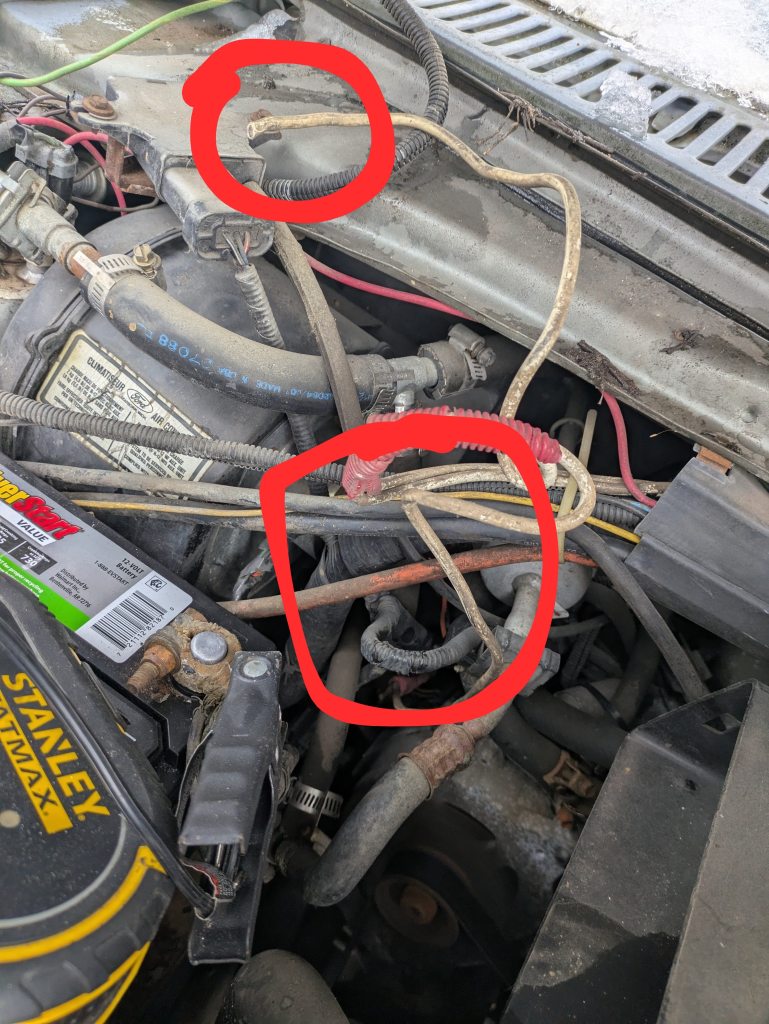
Current Status
Overall, the van remains in better condition than initially anticipated. We still have a significant mechanical “To-Do” list, but having a stable, running engine allows us to begin addressing the safety and cooling systems one by one.
- Case File 014: The Modern Ghost & The Analog Bypass
This installment is about the “Restorer’s Dilemma.” In a forensic restoration, there is a fine line between a museum piece that does nothing and a functional tool that honors its history. For The Vice Van, we’ve reached a point where the original 1980s silicon is fighting back. Between obsolete EPROMs and decaying rubber belts, we are making the executive call to pivot: Keep the aesthetic, bypass the headache, and bridge the 30-year gap with a “Functional Ghost.”
1. The Radio Swap: Midland and Motorola vs. Tait LMR
The original Midland radios are beautiful, but they are “brick” technology in the worst way. Programming them requires physical EPROM chips that are essentially extinct, and even if we burned new ones, we lack the licensing to operate on the frequencies they were built for. The Motorola Converta-Com is in very poor condition, and is missing the paired portable radio.
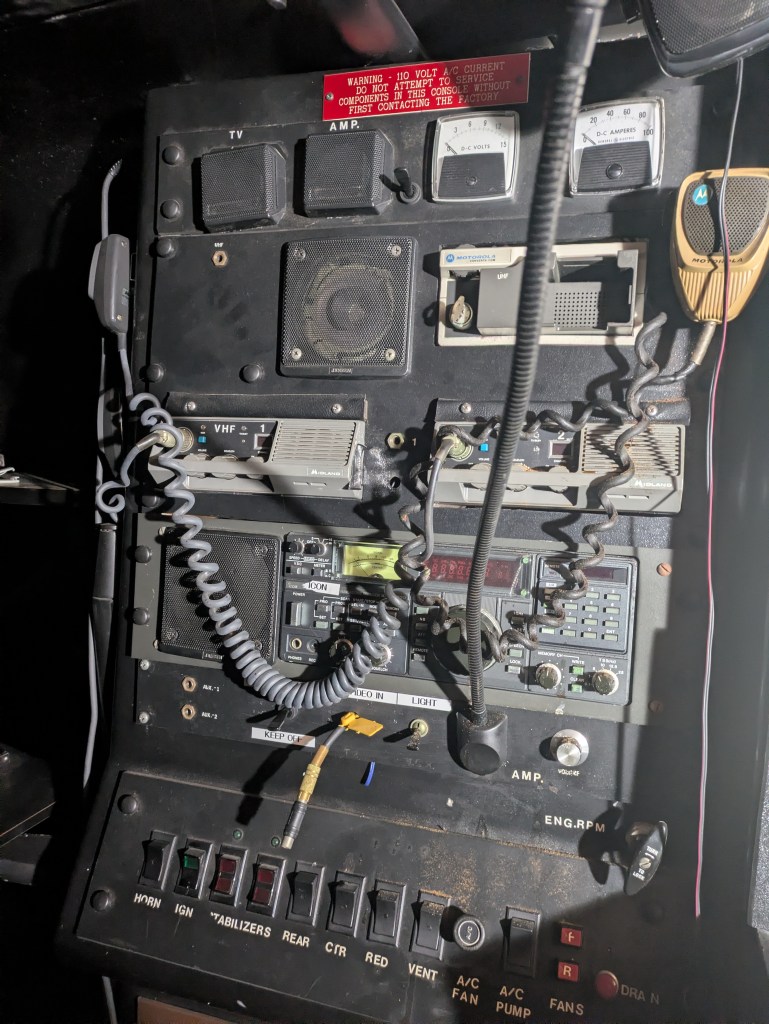
- The Solution: The Midlands stay in the rack as “Dummies” to preserve the visual weight of the gear stack.
- The Replacement: We are sourcing 1900s-era Tait T2000 series LMRs (specifically the T2020, surplused from the Alcoa, Tennessee Police Department) for both the rear rack and the front dash. Launched in 1994, these are period-perfect and can be PC-programmed. We’ll install these where the decaying Motorola Converta-Coms are currently mounted.
- The “Legal” Loophole: We will be setting the Taits to Receive-Only on standard FRS (Family Radio Service) frequencies.
- The Result: By using a modern handheld FRS radio outside the van, we can “broadcast” into the van. The Tait radio picks up the signal and blasts it through the vintage speakers. It looks and sounds 100% authentic to an HCSO Vice operation, while remaining perfectly legal as a prop.
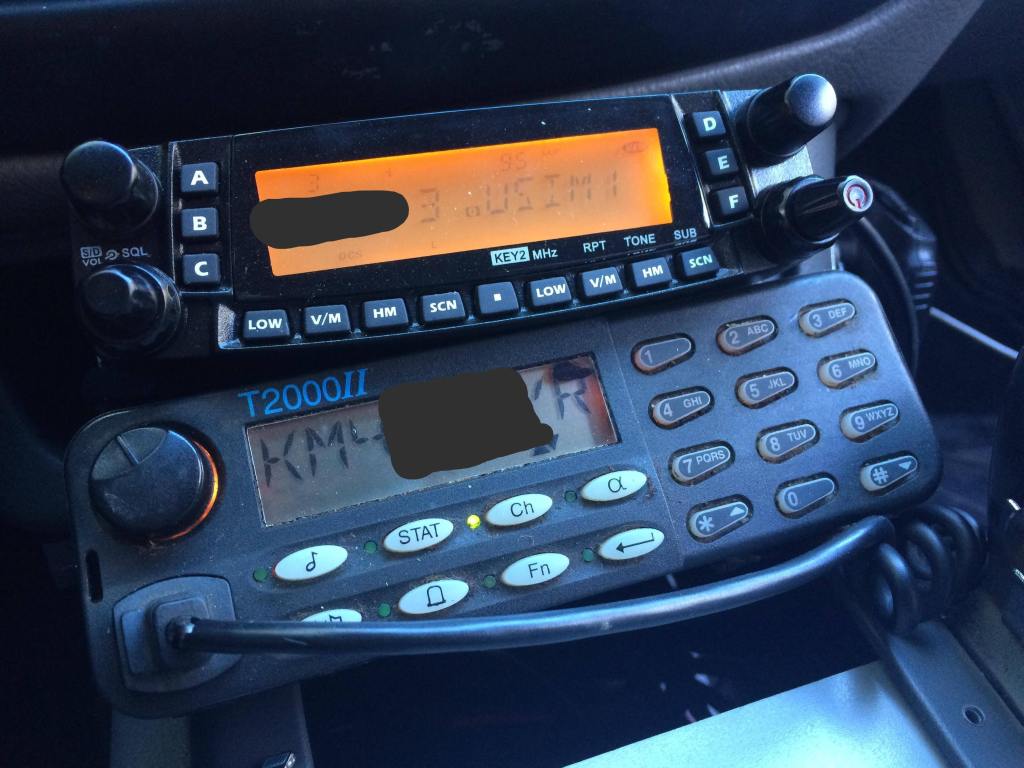
2. Bypassing the “Magnetic Graveyard”
The dual VCRs and cassette decks in the Seatron rack are in excellent physical shape—the faceplates are clean and the buttons still have that satisfying 90s “thunk.” However, 30 years of Florida and Tennessee humidity has caused extensive damage.
- The Executive Call: A full mechanical rebuild of four tape-driven units is a massive time-sink for minimal gain. Instead of fixing the “Recording” side, we are focusing on the “Live” side.
- Audio Bypass: We’re bypassing the tape decks entirely, with plans to bring multiple audio sources straight to a speaker or speakers in the van.
- Video Bypass: The VCRs are being bypassed in the same manner. The Periscope Camera signal is going into one of the CRT screens via a video adapter.
3. The CRT Strategy
With the VCRs out of the loop, we now have two clean CRT displays ready for a mission.
- Monitor A (The Eye): Dedicated to the “Live” feed from the periscope. Moving the periscope provides instant, zero-latency feedback on the screen—the ultimate 1995 stakeout experience.
- Monitor B (The Brain): Driven by a Raspberry Pi 2, running a custom-designed “HCSO Vice Squad” status display. It creates the illusion that one screen is “Live” while the other is “System Status.”
The “Functional Ghost” Philosophy
By making these choices, we aren’t “faking” the restoration; we’re adapting it. The van still feels like a heavy-duty surveillance post from 1989, but it’s no longer a hostage to 30-year-old rubber bands and EPROM burners. It’s responsive, it’s loud, and it’s finally starting to “talk” back.
Teaser: The Sound of the Stakeout
We aren’t just making the van look right; we’re making it sound right. Coming up in the future, we are working on a dedicated audio environment for The Vice Van.
When the CRTs are glowing and the local weather is playing through a small speaker on the desk, you’ll feel like you’ve actually traveled back in time.
- Case File 013: Unraveling the Nest
The Technical Handshake
The investigation into the van’s “no-start” condition took a major turn recently. I managed to get in touch with a former detective intimately familiar with the unit. He provided the first piece of “living” intel: the van was likely equipped with a kill switch and a dedicated push-button under the dash designed to jump-start the engine using the house batteries.
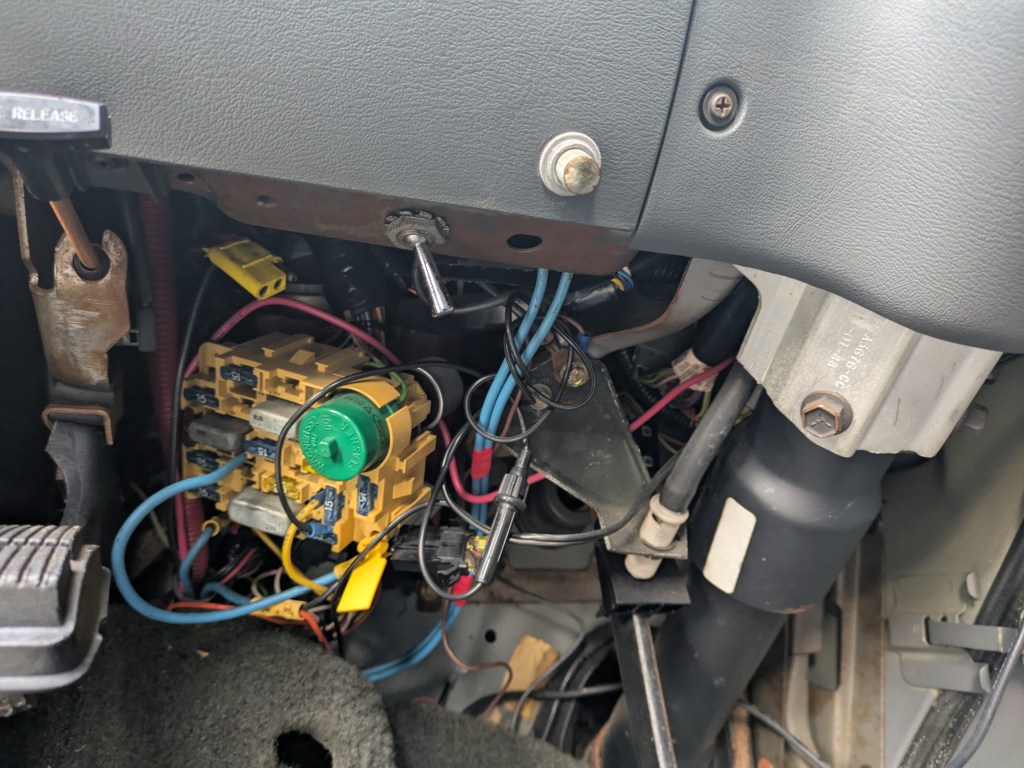
With a lead on the electrical layout, I began at the dash switch and started the painstaking process of following the “nest” back through multiple terminal strips and vintage electronics.
The Routing Investigation
Before moving to the van’s harnesses, I started with the basics: I checked the inertia switch and its associated wiring to ensure the safety impact-cutoff hadn’t been triggered or failed. I also located a highly suspect fuse—wrapped with copper and out of place—that is currently marked for further investigation.
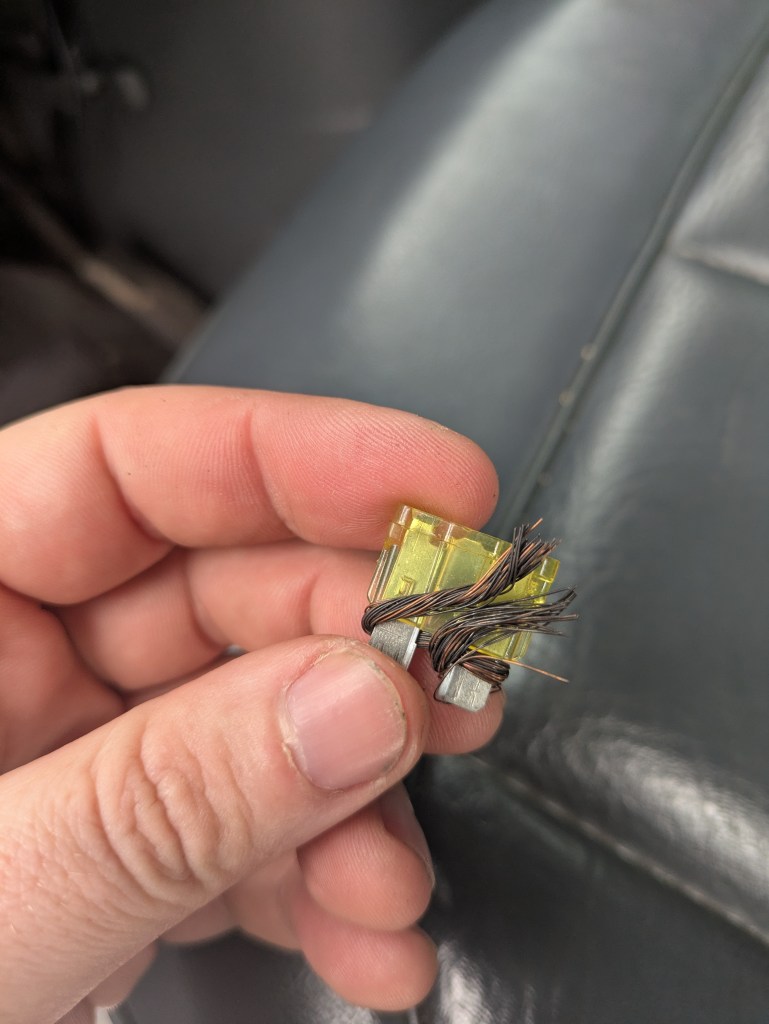
I initially traced the wiring toward the rear of the cab. After confirming the lines did not lead directly to the fuel pump, I shifted my focus forward. I followed the harnesses through the firewall, across the engine bay, and toward the primary battery. Off the solenoid, I navigated a dense cluster of wires on the passenger side. There, hidden in a tangle of loose-hanging leads, I finally found it: The Fuel Pump Relay.
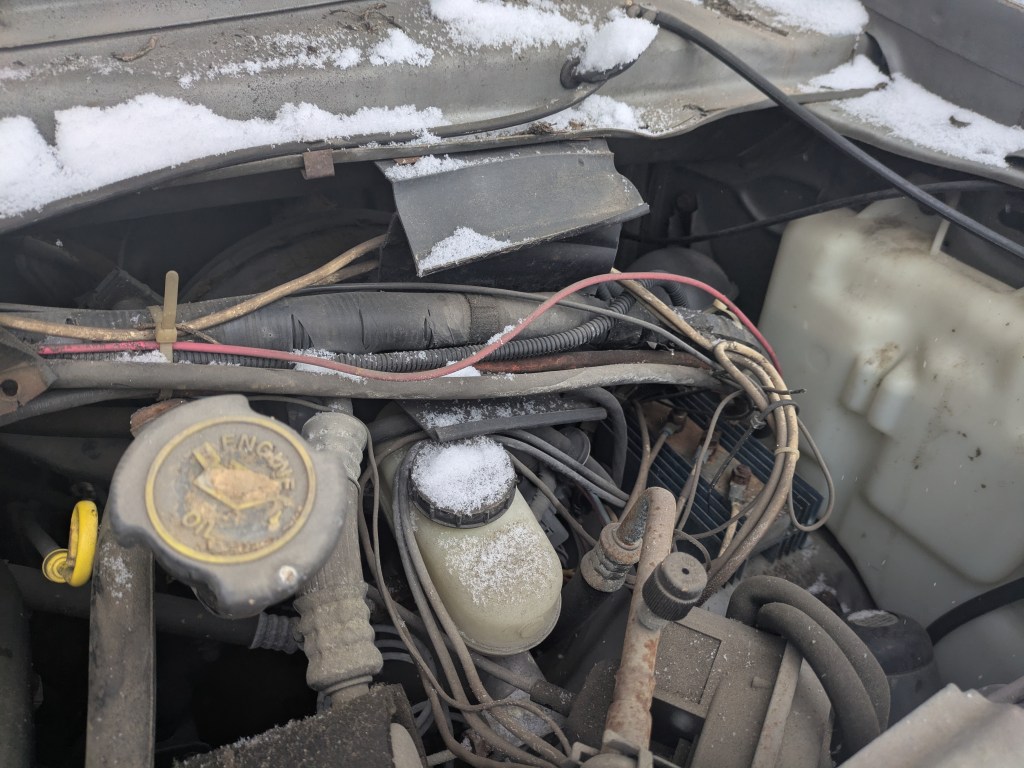
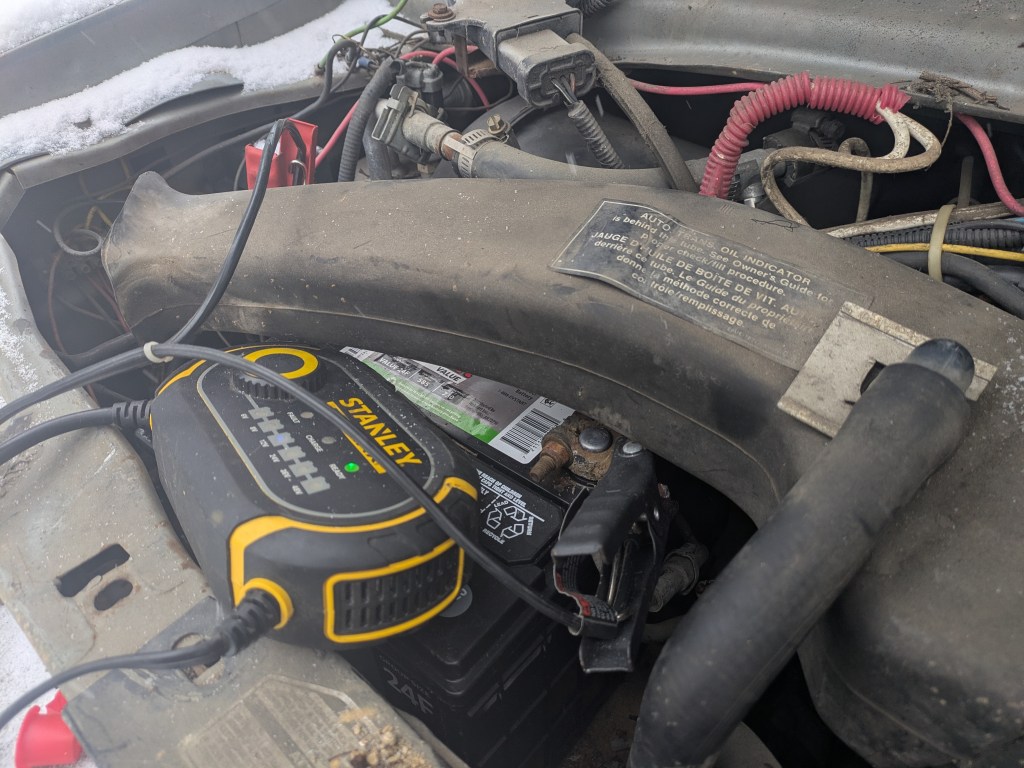
First Breath
Hoping for the best, I pulled the relay and bypassed it with a jumper wire. Immediately, I heard the distinctive hum of the fuel pump priming. With life in the lines, I added a gallon of fresh gas and turned the key.
The engine stumbled and sputtered at first—clearing out twelve years of dormancy—before finally roaring to life. The idle was remarkably smooth. No knocking, no ticking, just the steady rhythm of a Ford 351 that had been waiting over a decade to speak. While idling, I performed a basic systems check:
- Transmission: Verified engagement in both Reverse and Drive.
- Cooling: Added just over 2 gallons of antifreeze to the radiator.
- Braking: Added a full bottle of brake fluid to the master cylinder.
- Note: Leaks are highly probable given the volume of fluid added; further monitoring is required.
The Verdict
After idling for several minutes and approaching operating temperature, the engine stumbled and died. A quick burst of starting fluid brought it right back to life, narrowing our failure down to two possibilities:
- System Degradation: The fuel lines or filters are so heavily plugged they’ve finally choked out.
- The “Dry Storage” Theory: The van was stored with an empty tank—highly possible if the storage was as planned as I believe it was.
If the van was stored dry, it is an absolute mechanical win—it explains why the pump hasn’t seized or turned to varnish. However, we have a new mystery: while bypassing the relay worked, we now need to know if the relay itself has gone bad, or if there’s another electronic interlock hidden in the surveillance gear keeping the van from activating it.
The easiest way to determine if we have a fuel line problem or a lack of fuel: 5 gallons of high-octane fuel and a heavy dose of system cleaner are on the way.
The Vice Van is officially alive. Now we see if it stays that way.
- Case File 012: The Rosetta Stone and the Rats’ Nest
The investigation into the “No Fuel / No Start” condition has led us deep into the van’s literal nervous system. What we found behind the panels isn’t a factory Ford harness; it’s a dense, custom-engineered web of 1980s surveillance tech.
The Discovery: The Lost Schematic
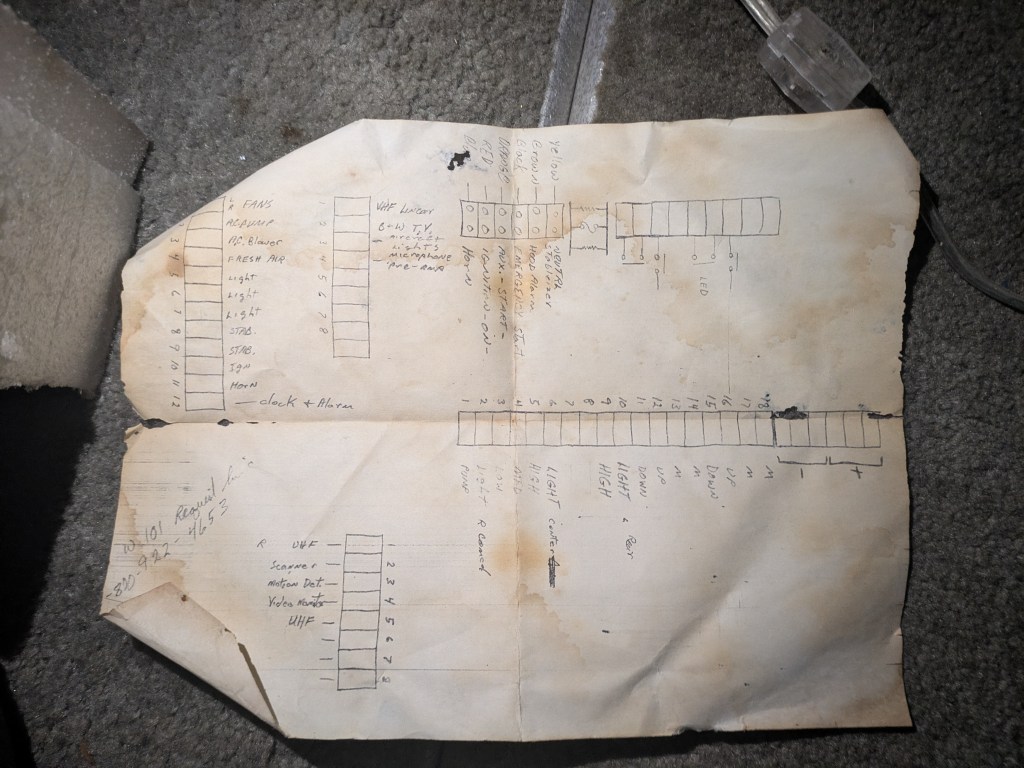
After hours of tracing blind wires, we found it: a hand-drawn, aged schematic folded up and forgotten under a seat.
- The Clue: The diagram confirms the complexity of the Seatron build, showing pinouts for “VHF Linears,” “Ignition,” and “Motion Detectors”.
- The Breakthrough: Most importantly, it reveals a “Clock + Alarm” circuit and an “Ignition-On” trigger. This is the first paper trail linking the surveillance grid to the Ford’s engine.
The Suspect: The AutoPage 4242 Interlock
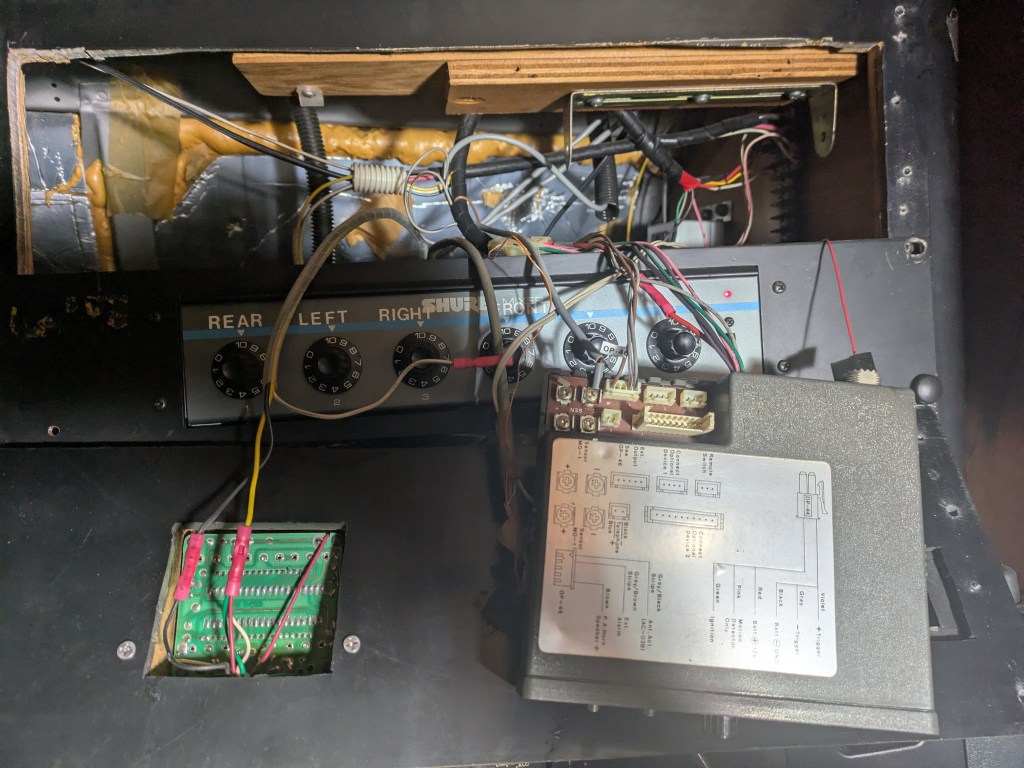
The heart of the “No Start” mystery possibly lies in the AutoPage 4242 alarm module we unearthed.
- The Forensic Detail: The module’s diagram shows a “Green” wire for Ignition and a “Pink” wire for a Motion Detector, amongst others. Additionally, we found a hidden switch behind the driver seat in the cab connected to the alarm system.
- The Theory: In high-stakes surveillance, these alarms weren’t just for sirens; they were often wired as Ignition Kills. If this vintage brain thinks the van is being tampered with—or if a 30-year-old relay has simply fused shut—it will cut power to the fuel pump relay indefinitely.
The Chaos: The Hidden Fuse Block
Behind the power center in the back of the van, we discovered a secondary fuse and relay center that can only be described as a “Massive Mess”.
- The Hardware: It’s a dense thicket of unlabeled fuses, terminal strips, resistors, and diodes.
- The Obstacle: One specific wire is hand-labeled “Clock + Alarm UN-Switch”. This confirms that the alarm system has a constant, un-switched power draw.
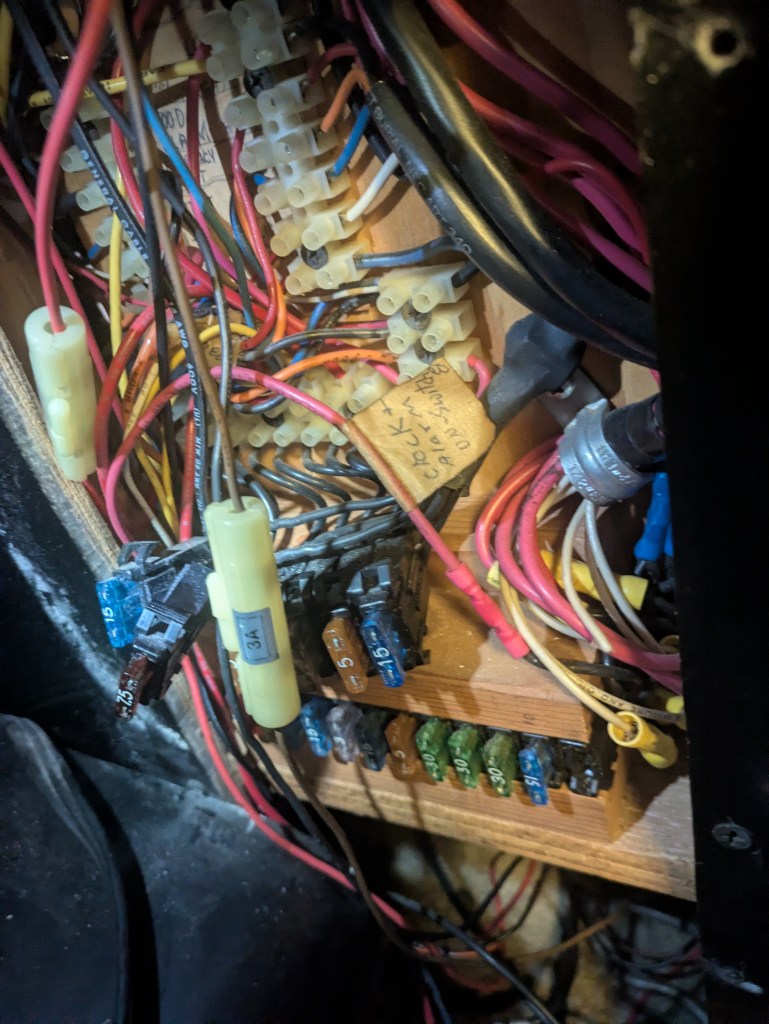
Technical Triage
We are now moving from “Restoration” to “Forensic Electrical Engineering.”
- Bypassing the Brain: We need to jump the “Ignition” lead on the AutoPage module to see if the fuel pump wakes up. (Spoiler – it didn’t.)
- Testing the Fuses: We tested and found two blown fuses, but replacing them didn’t change anything. We’re not quite sure yet what they are connected to.
- The Fuel Pump: Our next steps here are going to be connecting a meter to the fuel pump harness directly, in order to confirm we’re on the right track before tracing too many more of these wires.
Functional Integrity vs. Historical Preservation
In the world of forensic restoration, we are constantly balancing the scales between historical preservation and operational reliability.
To honor the legacy of Squad 527, the van must do more than just look like a time capsule; it has to function as a dependable machine. This requires a “transparent” approach to restoration: we intend to keep the AutoPage 4242 alarm and the dense web of 1980s relays physically in place to preserve the visual and structural history of the build, even as we move to bypass the aging interlocks that currently hold the fuel system hostage.
Similarly, while we aim to keep the radio stack looking exactly as it did during its peak service years, we may replace internal components or swap non-functional units with era-appropriate models that are legal to operate on modern frequencies.
The goal is a “functional ghost”—a van that looks like it just rolled off a 1989 stakeout, but possesses the modern reliability needed to ensure it actually reaches its destination under its own power.
- Case File 011: The Nervous System of The Vice Van
If Case File 010 was about the “Why” (FBI standards and stress), Case File 011 is about the “How.” After hours of tracing dusty cables and following wires through the dark corners of the rack, the nervous system of this van has finally been (partially) mapped.
The “Dual-Stream” Logic
The most striking discovery in the wiring is that this van was designed to record two different “truths” at the same time. It wasn’t just recording a video; it was creating a redundant, multi-perspective evidence chain.
1. The Master Feed (VCR 1 & The Large CRT)
This was the “money shot.”
- The Visual: The video signal flows from the periscope, through a RadioShack Switcher, into the Burle Alarm Controller, and finally into VCR 1.
- The Idea: This tape captured the “Target.” It recorded what the target was doing. It was monitored on the Large CRT—the primary focus in the rack.
2. The Ambient Feed (VCR 2 & The Hitachi Stack)
This was the “Context.”
- The Visual: Video flows directly from the switcher to VCR 2.
- The Audio: Controlled by an Archer Selector, this deck primarily recorded the Shure Mixer (outside ambient mics).
- The Idea: While VCR 1 focused on the target, VCR 2 recorded the environment. If a car honked, a door slammed, or a backup team arrived, this deck caught the “big picture.” It was monitored on the smaller Hitachi CRT. It’s unclear if there could have been a second video feed to the second CRT.
The “RadioShack Hack”
Another interesting forensic detail is the use of consumer-grade RadioShack and Archer selectors.
- Input 4 (Archer): This is wired as a “feedback loop” from VCR 1. It may have allowed the operator to take audio already recorded on the Master tape and “dub” it onto Marantz Tape Deck 2 for a detective to take back to the station in a cassette format immediately.
- Deck 3 (RadioShack): A lone video cable pokes out the front of the stack. This was the “Aux” port—likely for a “Bumper Cam” or a handheld unit used when a target moved out of the periscope’s line of sight.
The Green Wire
Amongst the meticulously labeled system, Tape Deck 1 sits with a lone Green Wire unplugged and silent. In a world where every cable has a purpose, this “Empty Channel” is a reminder that surveillance is unpredictable. Was it for a specialized piece of gear? A long-range parabolic mic? Or simply a spare for when the primary system failed?
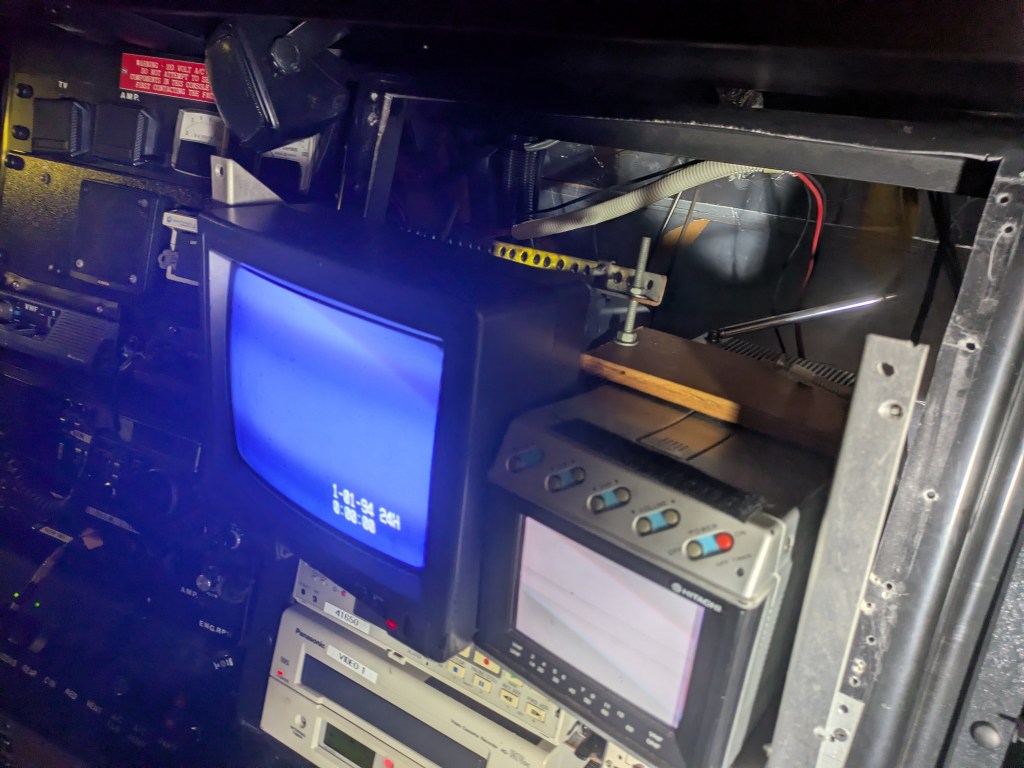
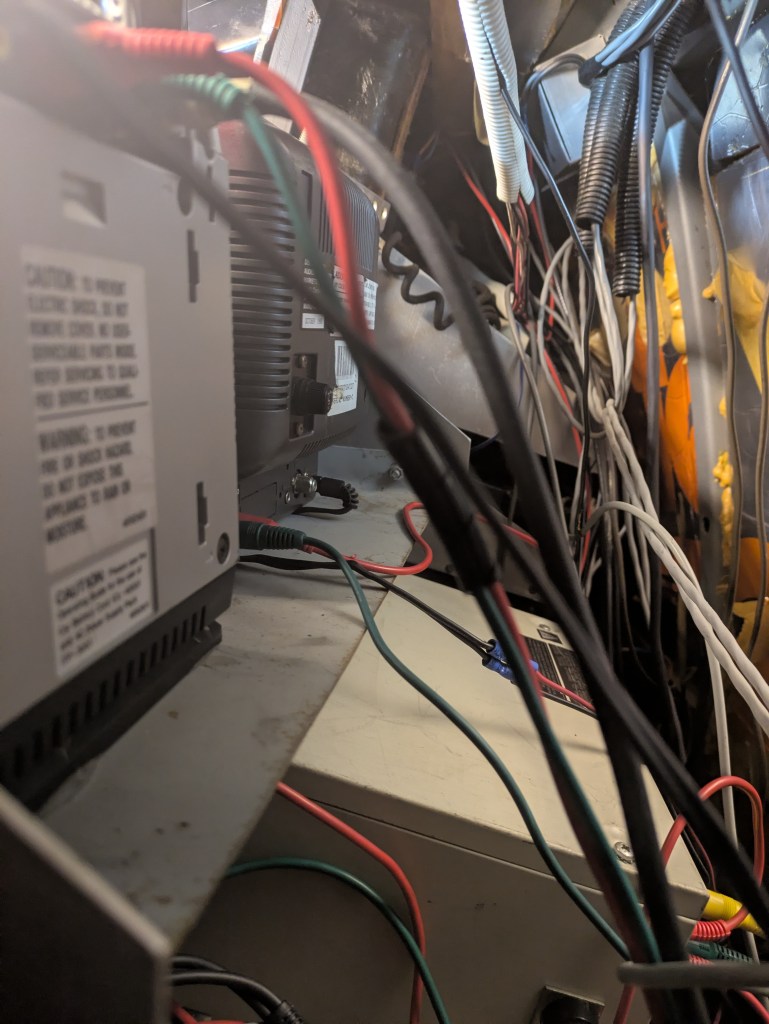
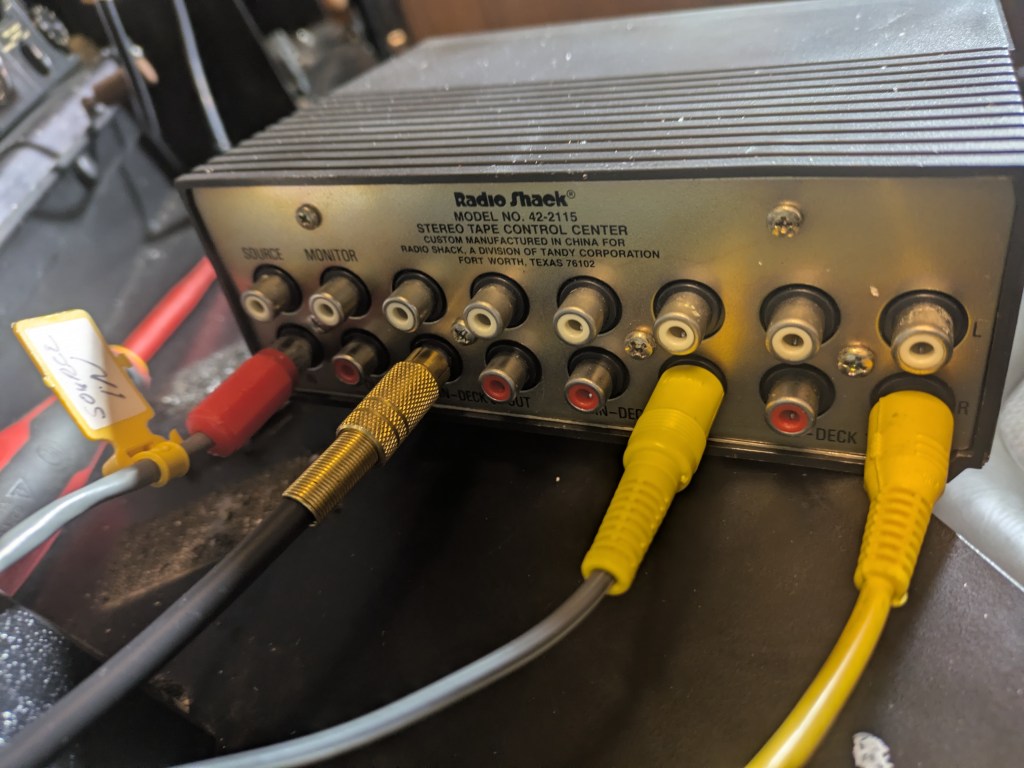
The following is the beginning of a map of where the various audio and video inputs/outputs go.
I. Video Routing Matrix
Controlled by the RadioShack 42-2115 Switcher
Switcher Port Direction Connected To Source Input IN Periscope Camera Deck 3 Input IN Auxiliary Wire (poked out front of stack) Deck 1 Output OUT Burle PTZ Controller (Video In) Deck 2 Output OUT VCR 2 (Video In)
II. Audio Routing Matrix
Controlled by the Archer Switcher
Switcher Port Direction Connected To Input 2 IN VHF Radio 2 (“Audio from VHF 2” wire) Input 3 IN Shure Mixer (Outside Ambient Mics) Input 4 IN VCR 1 (Audio Out Feed) Output Channel A OUT Marantz Tape Deck 2 (Line In) Output Channel B OUT VCR 2 (Audio In)
III. Dedicated Monitor & Master Loops
Hardwired for direct verification (does not go through switchers)
Source Device Connection Type Destination VCR 1 Audio & Video Out Large CRT Monitor (Master View) VCR 2 Audio & Video Out Hitachi CRT Monitor (Secondary View) Burle PTZ Video Out VCR 1 (Video In)
IV. Isolated/Direct Audio Wires
Manual connections found during the forensic teardown
Device Wire Color Status / Connection VCR 1 Grey Runs from VCR 1 Audio In toward the Radio Stack, unknown destination. Tape Deck 1 Green Disconnected (Not plugged into anything) Since the last tech update, VCR2 seems to have stopped functioning. This isn’t unexpected, due to the sheer scope of this project we expected some setbacks.
- Case File 010: The Gold Standard — Quantico & the Science of Surveillance
As the mechanical restoration of the 351 Windsor continues, a deeper dive into the archives reveals that this van was more than a vehicle; it was a mobile laboratory for a department that helped set the national standard for undercover operations. The Hillsborough County Sheriff’s Office (HCSO) appears to have been a pioneer in integrating federal training with psychological research to protect the men and women of the Vice Squad.
The Quantico Connection: Training for “The Deep Cover”
During the service life of this van, internet archives indicates the HCSO may have been a frequent contributor to and beneficiary of the FBI National Academy and the FBI Law Enforcement Bulletin, amongst other studies and training programs. The agency’s commitment to federal-level standards meant their surveillance platforms had to be over-engineered to meet “best practice” protocols.
- Standardized Surveillance: The FBI has long emphasized that the “Command and Control” vehicle must be a “sterile environment” to prevent detection—a principle reflected in the “Air Quality” disguise of our van.
- Source: FBI Law Enforcement Bulletin (Vol. 65, No. 2) notes the critical importance of specialized training for undercover support personnel to mitigate the risks inherent in “deep cover” stings.

The “Stressors” Study: The Human Cost of the Stakeout
While we’ve been examining the unique A/C and the silent stabilizers, we now understand these weren’t just luxuries—they were tactical requirements identified by psychological research. While publications from the era have proven to be difficult to obtain, internet archives indicate the HCSO has historically been cited in studies regarding the unique pressures of the Vice Unit.
- Hyper-Vigilance and Environment: Research on undercover officers often highlights the “sensory deprivation” of sitting in a windowless van as a primary stressor. The transition from the “boredom” of a 12-hour stakeout to the “high-intensity” of a bust creates a physiological spike that is difficult to manage.
- The Findings: In the study “Undercover Policing: A Review of the Psychological Issues” (Farkas, 1986) and subsequent updates in the 90s, researchers found that environmental controls (like the A/C and specialized seating found in front of our Seatron rack) were essential to maintaining the “operational readiness” of a surveillance team.
- HCSO’s Role: The HCSO has been a model for “Undercover Support Systems,” ensuring that the officers in the van (the “ears and eyes”) are as protected as the detectives on the street.
The FBI “Stress in Undercover Work” Report
The FBI’s own research into Undercover Stressors (U.S. Dept of Justice) specifically lists “Equipment Failure” as a top-tier stressor for undercover units. If the microphone cuts out or the video feed goes snowy during a deal, the stress levels of the support team in the van skyrocket because they can no longer ensure the safety of the undercover operative.
“The failure of electronic surveillance equipment during a critical phase of an operation is not merely a technical inconvenience; it is a life-threatening event for the undercover officer and a source of profound psychological trauma for the support team.” — FBI Behavioral Science Unit Archive.
The Legacy in the Driveway
This context changes how we look at the silent microphones and the snowy PTZ camera. To the HCSO Vice Squad 527, those weren’t just “broken parts”—they were a breach in the safety net.
By restoring these systems to their 1990s peak, we are preserving the exact environment that the FBI and HCSO identified as the “Gold Standard” for protecting their officers’ minds and bodies during their mission.
- Case File 009: Echoes of the Vice Squad
While Case File 008 focused on the “what” of this van, Case File 009 is about the “who.”
Behind every switch on the Seatron board and every second of tape on those VCRs were the men and women of the Hillsborough County Sheriff’s Office Vice Squad. Specifically, this van was believed to be the mobile headquarters for Squad 527—a group tasked with some of the most dangerous undercover work in the area.
The Ghosts in the Machine
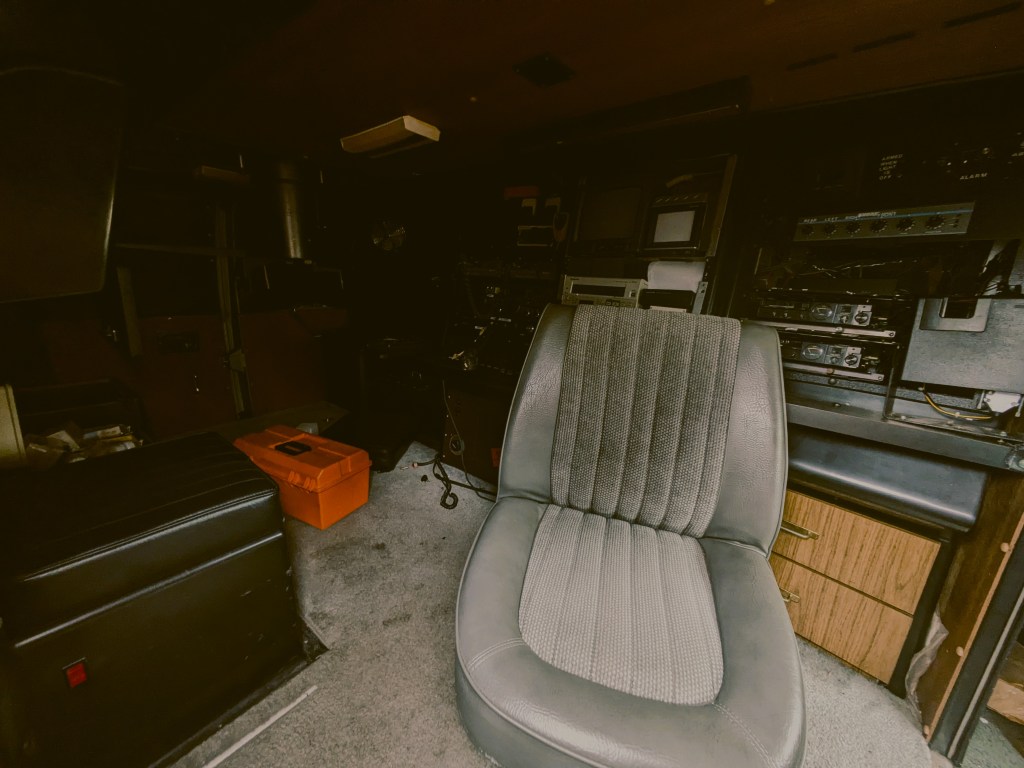
Looking at the wear patterns on the interior—the scuffs on the monitoring desk and the specific way the microphones are positioned—you start to get a sense of the tactical reality for veterans like the Sergeants, Corporals, and Detectives who ran these operations.
During the peak years of this van’s service, HCSO Vice wasn’t just doing “buy-busts.” They were dismantling organized conspiracies and running long-term stings that required detectives to sit in the back of this windowless “Air Quality” van for hours or days at a time.
Professionalism Under Pressure
The men and women of Squad 527 operated in a pre-digital world where “real-time” meant what you could see through the PTZ camera and hear through the four-point mic array.
- The Stakes: If the surveillance gear failed, an undercover detective’s life was at risk.
- The Discipline: The pristine condition of the van and the neatly organized equipment isn’t an accident. It’s the mark of a unit that knew their equipment was their only lifeline when things went sideways in a Tampa parking lot or a rural warehouse.
The “Unseen” Detectives
We often think of undercover work through the lens of Hollywood, but the reality was much quieter. It was about the Sergeant in the back of this van, sweating in the Florida humidity (relying on that A/C pump we found), eyes glued to the Hitachi CRT, waiting for the exact moment to signal the take-down teams.
The news archives from this era are filled with the results of their work, with headlines like “Detectives put sting into escort services”, “Pool hall owner charged as bookie”, and “Club owner, dancers jailed”. The same few names repeatedly appear in the margins of these cases—the leaders who ensured the technology and the tactics were flawless.
The Purpose of the Restoration
Restoring this van isn’t just about making an old Ford run again. It’s about preserving a piece of HCSO history. When we eventually get that right stabilizer working and the PTZ camera clear again, we aren’t just fixing a “spy van”—we are honoring the workspace of the detectives who sat in the dark so the rest of Hillsborough County didn’t have to.
- Case File 008: The Mission Briefing (Status Report)
We have officially moved from the “Discovery” phase into “Active Restoration.” After completing a full forensic inventory of the surveillance suite and performing the first mechanical audits of the 351 Windsor, we now have a clear technical picture of the Hillsborough Vice Van.
Before we move into the “Electrical Ghost” hunt, we are pausing to document the current status of the mission. Here is what we’ve learned over the last seven Case Files.
I. The Surveillance Suite (Electronics)
Status: The “heart” of the spy rack is alive. By bypassing the dead battery banks and using the wheel well shore-power inlet to feed the on-board inverter, we successfully powered up the entire equipment stack.
- The Successes: The ICOM R-7000 receiver, Marantz PMD decks, CRT monitors, and Panasonic VCRs all have power. One VCR has a tape stuck in the transport.
- The Challenges: While the units have power, the signal is compromised. The camera feed is poor, and only the Front Mic of the four-point array is currently active.
II. Tactical Infrastructure & Power
Status: Functional / Original The custom Seatron switchboard is in good condition. There is no visible oxidation on the equipment, which is a testament to how the van was stored.
- Systems Check: All fans and environmental pumps are operational. The Left Stabilizer deployed perfectly, while the Right Stabilizer remains unresponsive—likely a seized actuator.
- The Grid: Both the starter and house batteries were non-recoverable. We are currently operating entirely on shore power via the inverter/charger for all internal/equipment testing.
III. The Mechanical Heart (351 Windsor)
Status: Solid / Awaiting Fuel Pressure The engine is the biggest victory of the project so far. With only 27,000 miles, it remains in its original factory configuration.
- The Combustion Audit: In our last update, we learned the engine is healthy. It fired immediately on starting fluid and ran strong with no ticking or knocking.
- The Mystery: Despite the healthy block, the fuel system is currently “Silent.” The pumps are not priming when the key is cycled to the ON position.
The “Diagnostic Wall”
The project is now focused on the intersection of the mechanical and the tactical. We have confirmed the van can run and the gear can power up. Now, we have to find out what is keeping all the individual components from working.
We are currently investigating whether the fuel system failure is:
- Mechanical: Seized pumps after 15 years of dormancy.
- Electrical: A standard relay or fuse failure.
- Security Interlock: A “kill switch” integrated into the AutoPage alarm or the surveillance rack, designed to prevent the vehicle from being moved during a sting operation.
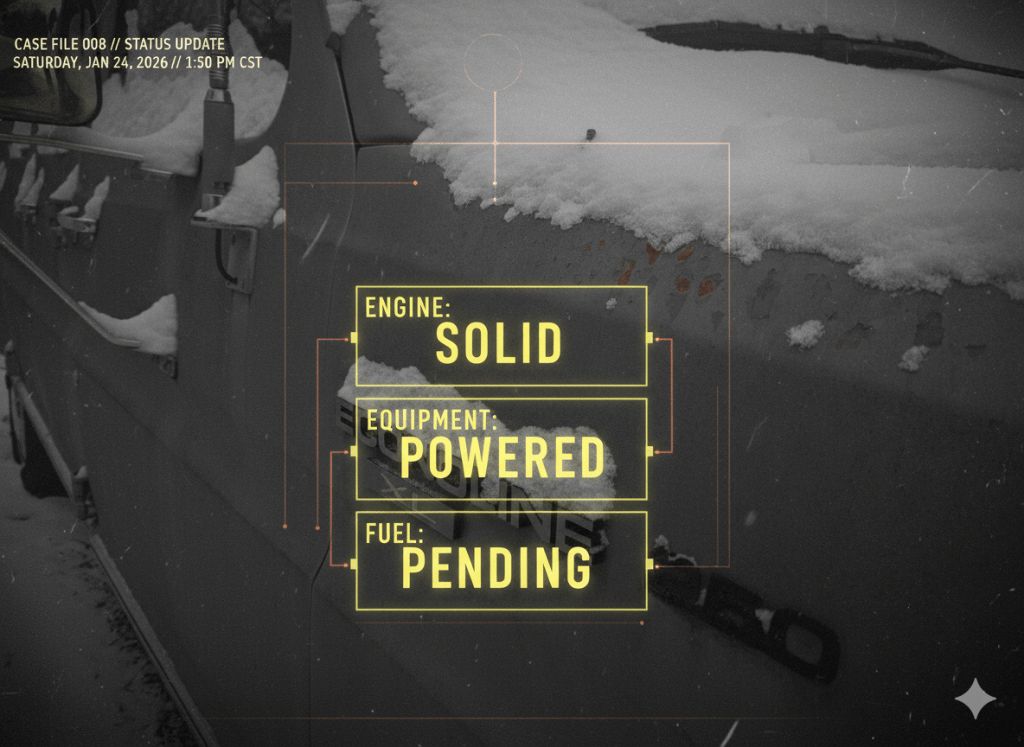
- Case File 007: The Combustion Audit
In Case File 006, we hit a diagnostic wall: a silent fuel system. The engine would crank, but without the pumps priming, we were stuck. To move forward, we needed to know if the “heart” of this van was worth the effort of chasing a complex electrical ghost.
We decided to bypass the fuel delivery system entirely to perform a direct combustion audit.
The Starting Fluid Test
To determine if the 351 Windsor had the spark and compression to actually run, we introduced starting fluid directly into the intake. This is the ultimate “pass/fail” test for a vehicle that has been dormant for 15 years.
- The Result: The engine fired immediately.
- The Sound: It didn’t just stumble; it ran strong. Crucially, there was no ticking, no knocking, and no internal mechanical noise.
- The Verdict: The engine died as soon as the starting fluid was consumed, but the audit was a success. We have confirmed that the engine internals are solid. The low mileage on the odometer is backed up by the mechanical health of the block. This van is officially worth every hour of repair ahead.
Shifting to Electrical Forensics
With the engine’s health confirmed, our focus moves from the mechanical to the electrical. We know the 351 Windsor can run; now we have to find out why the van won’t let it.
The mystery of the “Silent Prime” is our new priority. We are moving into a systematic Voltage Audit to find where the signal is being dropped:
- Pump Continuity: We are heading under the chassis to the frame-rail pump. We need to see if it receives a 12V pulse when the key is cycled to the “ON” position.
- The Logic Trace: If there is zero voltage at the pumps, we work backward through the circuit: the Fuel Pump Relay, the Inertia Switch, and the AutoPage 4242 Alarm system.
- The Interlock Theory: Given the van’s history, a security interlock or a “kill switch” integrated into the surveillance rack remains a high-probability suspect for the fuel system’s inactivity.
The Path Ahead
Hearing this van roar to life—even for just a few seconds—changes the entire energy of the restoration. We aren’t just cleaning up a relic; we are bringing a high-performance surveillance tool back to the street.
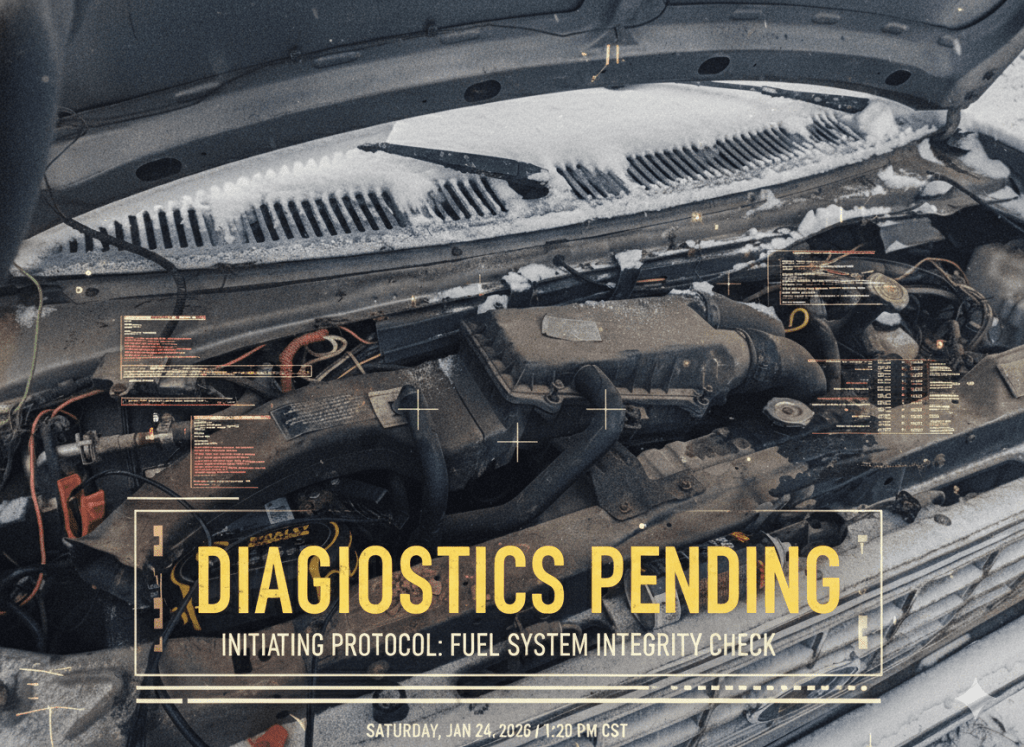
- Case File 006: The 351 Windsor
We’ve proven the “Air Quality” gear works, but a surveillance van that can’t move is just a stationary target. Today, we stepped out of the darkroom and into the engine bay to see if the Ford 351 Windsor V8 is ready to rejoin the force after 15 years in the Tennessee humidity.
The 27,000-Mile Original Engine
Opening the hood reveals an incredibly well-preserved 351 Windsor. Everything is exactly where the Ford factory—and the Seatron converters—left it.
- The Condition: Aside from a significant accumulation of dust, you would never know this vehicle hadn’t been in use. The air filter is in great condition, and significantly, the battery had been disconnected before the van was put into storage. This intentional step indicates the vehicle wasn’t just parked, it was stored.
- The Fluids: While the engine looks clean, the fluids show the toll of time. The oil on the dipstick is black, and both the coolant and brake fluid levels are low. These will be our first areas of mechanical investigation once we establish that the engine runs.
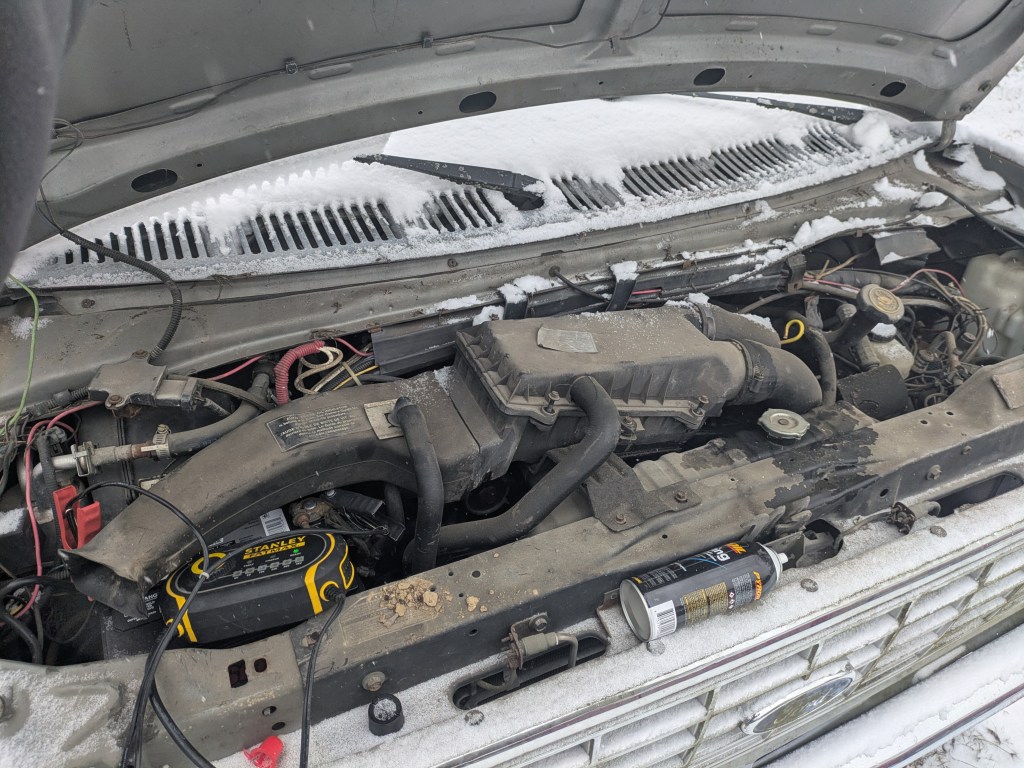
The Fuel System Strategy
The van has been sitting since 2011 with very little fuel left in the tank. Rather than dropping the tank immediately, we are opting for a more direct test of the existing infrastructure.
- The Plan: We are adding several gallons of fresh gasoline to the tank to fortify whatever remains.
- The Goal: Once the fresh fuel is added, we will cycle the ignition to see if the original fuel pump can prime the system and build adequate fuel pressure at the rail. This will tell us immediately if the pump and lines are still functional.
The “Cold Start” Protocol
Before introducing fuel, we followed a methodical process to ensure the engine was physically capable of turning:
- The Battery: With the original battery disconnected and dead, we installed a fresh heavy-duty battery for the testing phase.
- We connected a battery charger/maintainer to the new battery and powered from a separate shore-power source so we don’t destroy the new battery during testing.
- The “Dry” Crank: We tripped the inertia switch to crank the engine without firing it. The starter engaged strongly, and the engine turned over with a steady, rhythmic cadence.
The Moment of Truth
With the fresh fuel added and the battery connected, we reached the final step of the mechanical audit. In a fuel-injected Ford of this era, turning the key to the “ON” position should be met with a distinct, two-second hum of the fuel pumps priming the lines.
We turned the key, and we were met with silence.
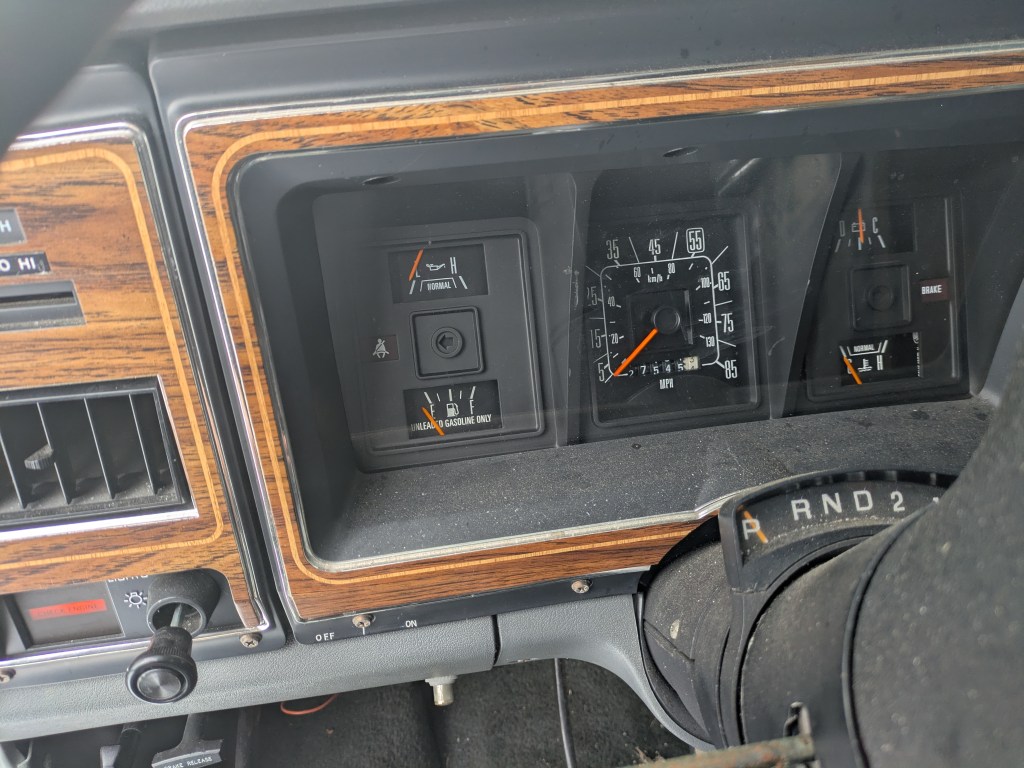
The Diagnostic Wall
The engine cranks with strength, but without fuel pressure, it will not fire. We are now in a diagnostic standoff. Because this is a specialized surveillance vehicle, the “Standard Ford” troubleshooting guide only goes so far. We are currently investigating three potential points of failure:
- The Dual-Pump System: We have to determine if the low-pressure lift pump inside the fuel tank has seized, or if the high-pressure pump mounted on the frame rail is the culprit after 15 years of sitting.
- Electrical Continuity: We are checking for the basics—blown fuses or a seized fuel pump relay. Given how well-preserved the engine bay is, we’re looking for a clean electrical failure rather than wiring damage.
- The Alarm Interlock: This is the wildcard. The AutoPage 4242 alarm system is integrated into the van’s vitals. It is possible that a security interlock or a “kill switch” is preventing the fuel pump relay from triggering.
Next Steps: Chasing the Signal
The 351 Windsor is ready to run, but until we solve the mystery of the silent prime, it remains a 27,000-mile display piece.
- Case File 005: The First Pulse
After a decade and a half of silence, the “Hillsborough Files” van has officially been brought back to life. Following our strict power-up protocol—isolating the electronics and feeding the system through the shore power inverter—we began flipping breakers.
The result? The Vice Van is officially “live,” but like any 35-year-old veteran, it has some battle scars that need attention.
The Electronics Audit: Successes and Snags
- The Radio Stack: Every radio in the rack—from the ICOM R-7000 to the Midland units—powered up successfully. The displays are crisp, though we haven’t yet put them to the test for reception or transmit usability.
- The Evidence Decks: Both Marantz PMD audio decks and both Panasonic VCRs have power. However, “Video 1” has a tape stuck in the transport—a literal piece of history frozen in the machine. We haven’t loaded tapes into the Marantz decks yet, awaiting a full cleaning.
- The Monitoring Station: Both the Panasonic and Hitachi CRT monitors fired right up. No “magic smoke,” no humming—just that classic 80s static.
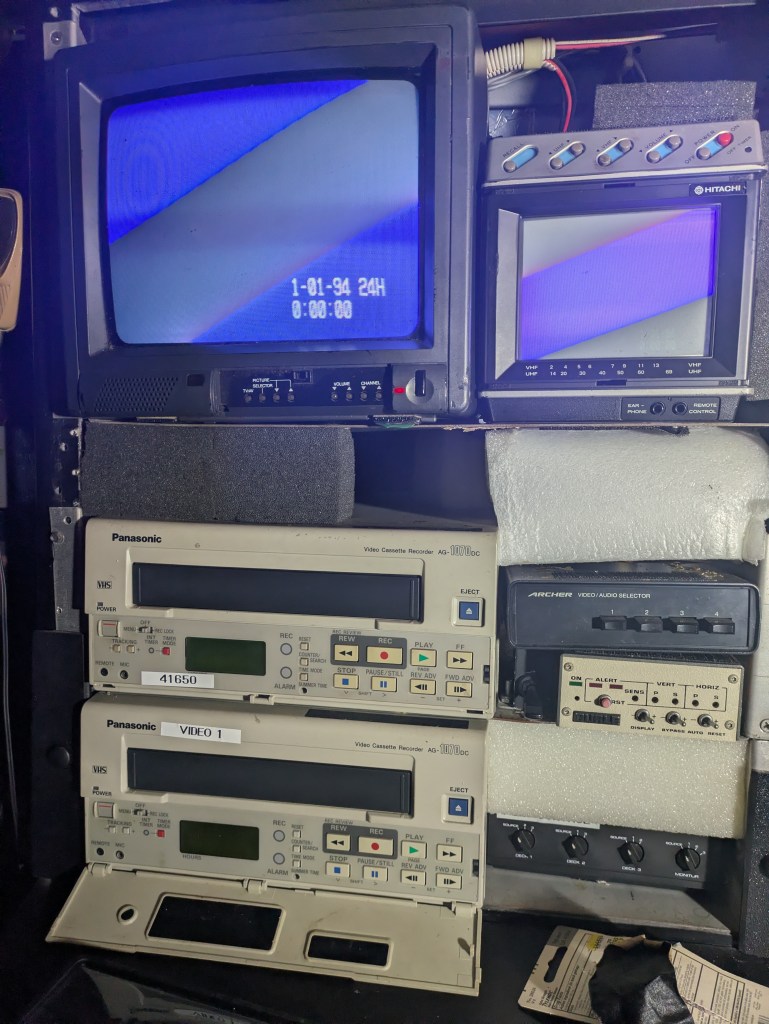
The “Eye” and the “Ears”
This is where the forensic work begins:
- Video Quality: The PTZ camera is receiving power, but the feed on the monitors is poor. This confirms our suspicion about the signal wiring. Between the periscope-mounted housing and the rack, there is interference or a degraded connection that is “snowing out” the image.
- The Four-Point Array: Testing the Shure mixer revealed that the Front Mic is crystal clear. However, the Back, Left, and Right mics are currently silent. We’ll investigate whether it’s the mics themselves or the wiring leads running through the van’s walls.
- The AutoPage 4242: The alarm light is cycling on and off sporadically. We haven’t quite “cracked the code” on its logic yet, but the brain of the system is definitely alive.
The Mechanical Infrastructure
The Seatron switchboard proved its worth today:
- Life Support: All the fans and pumps for the environmental systems are functional. The “Air Quality” cover story can once again move air.
- The Stabilizers: We have a split result. The Left Stabilizer deployed perfectly, but the Right is loud and doesn’t fully activate. This is likely a seized actuator or a power issue—a mechanical hurdle for a later day.
- Power System: The most important victory? The Inverter and Charger are fully functional, successfully bridging the shore power to the 12V DC bus.
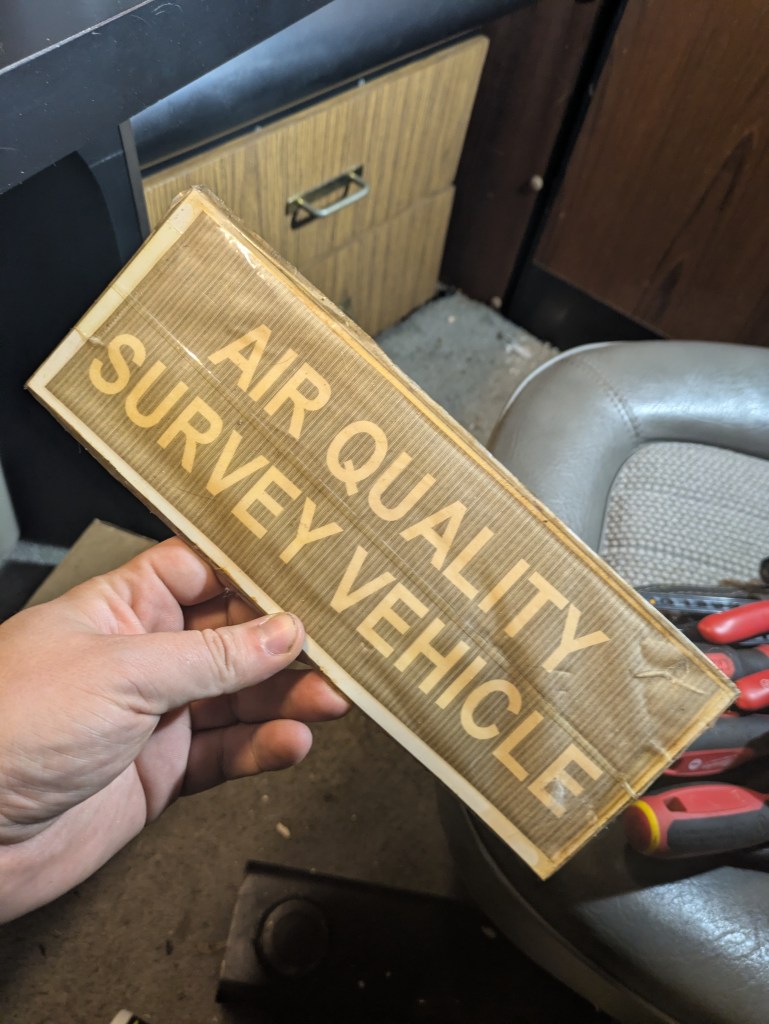
- Case File 004: The Power Grid Audit
Before we can test much of the equipment, we have to verify the “heart” of the operation: the Seatron Power Grid. This van wasn’t powered by a simple cigarette lighter plug; it features a massive, integrated electrical system designed to run a small office’s worth of electronics for hours in total silence.
The Seatron Switchboard: Professional Integration
The center of this audit is the custom Seatron Switchboard. Unlike the dry-rotted radio cords, these heavy-duty toggles have held up remarkably well.
- The Stabilizer System: The “STABILIZER” toggle is a known quality—it operates the system designed to keep the vehicle perfectly still. In a surveillance environment, this prevented the “tell-tale” rocking of the van’s suspension when operators moved in the back, which would have given away their position to anyone watching the exterior.
- Environmental Controls: The “A/C PUMP” and “VENT” switches were the life-support for the detectives. These devices rarely go bad from lack of use, barring any physical damage or corrosion.
The GE Gauges: Pristine Condition
The two large General Electric D-C meters (Volts and Amperes) are in surprisingly good shape.
- Current Status: There is no visible oxidation on the gauges or the faceplates. They appear as clean as the day they were installed.
- The Goal: Despite the clean exterior, we are checking the wiring behind the panels to ensure there’s no obvious damage.
The Power Distribution Box & The “Biohazard”
Down near the floor sits the main Power Distribution/Inverter box.
- The “Biohazard” Magnet: A piece of dark squad humor left on the face of the unit.
- The Battery Compartment: We’ve located the auxiliary battery compartment in a hidden compartment under the floor, and as suspected the batteries are not usable.
That is a critical piece of the van’s “stealth” infrastructure. It explains how the van could remain active for days in a stationary position without needing to run the engine.
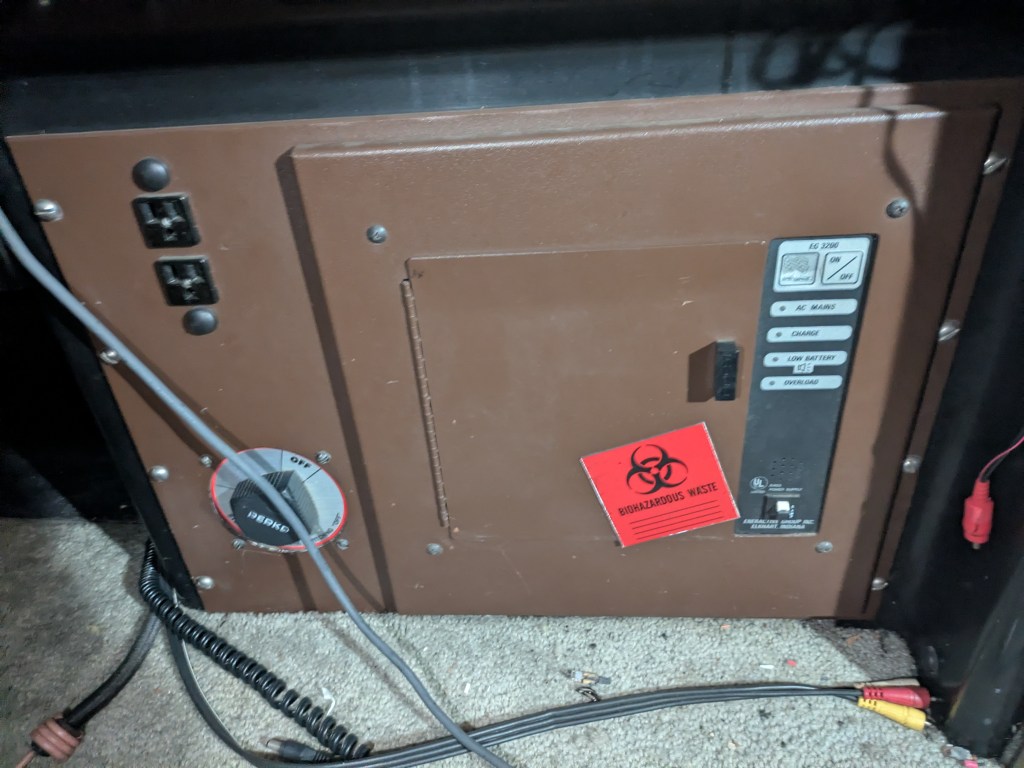
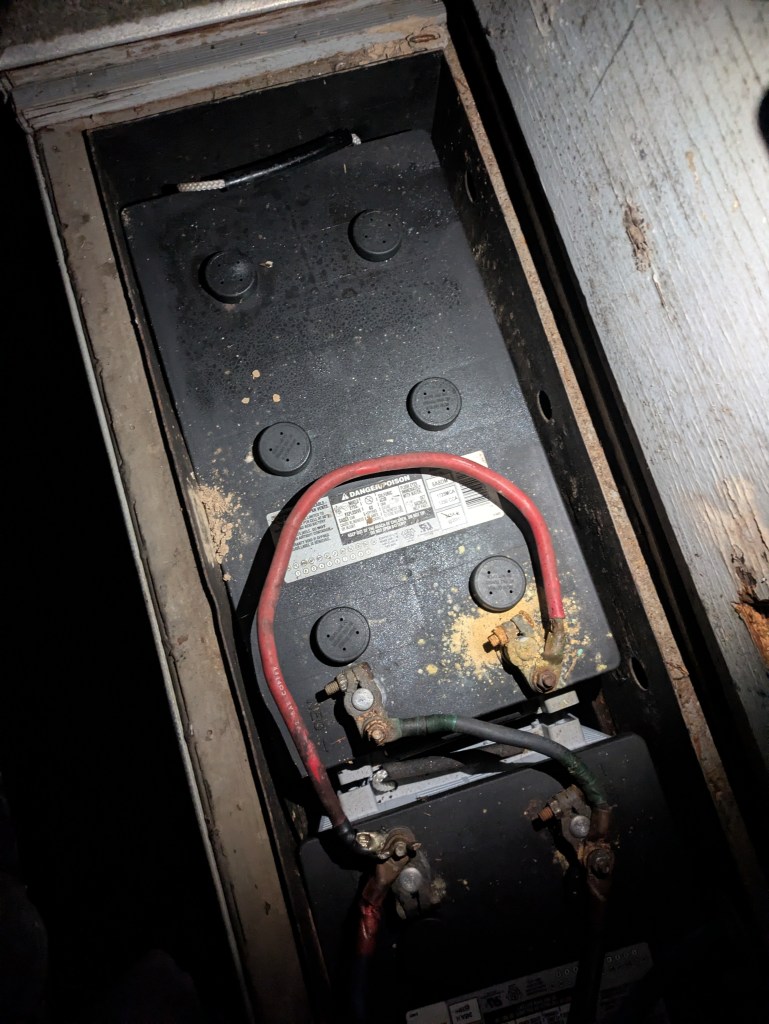
The External Life-Line: Shore Power
One of the most tactical features of the Seatron conversion is hidden in plain sight. Tucked away inside the driver-side rear wheelwell is a recessed AC power inlet.
- Stealth Charging: This allowed the squad to run a heavy-duty extension cord to a “safe house” or a nearby building. To a passerby, it looks like a mundane service cord for a utility van, but inside, it was providing the 110V AC “Shore Power” needed to keep the racks running and the auxiliary batteries topped off indefinitely.
- The Inverter/Charger Link: This external port feeds directly into the main power distribution box. It allowed the detectives to use the on-board monitors and radios without worrying about the “Amperes” gauge dropping into the red during a multi-day stakeout.
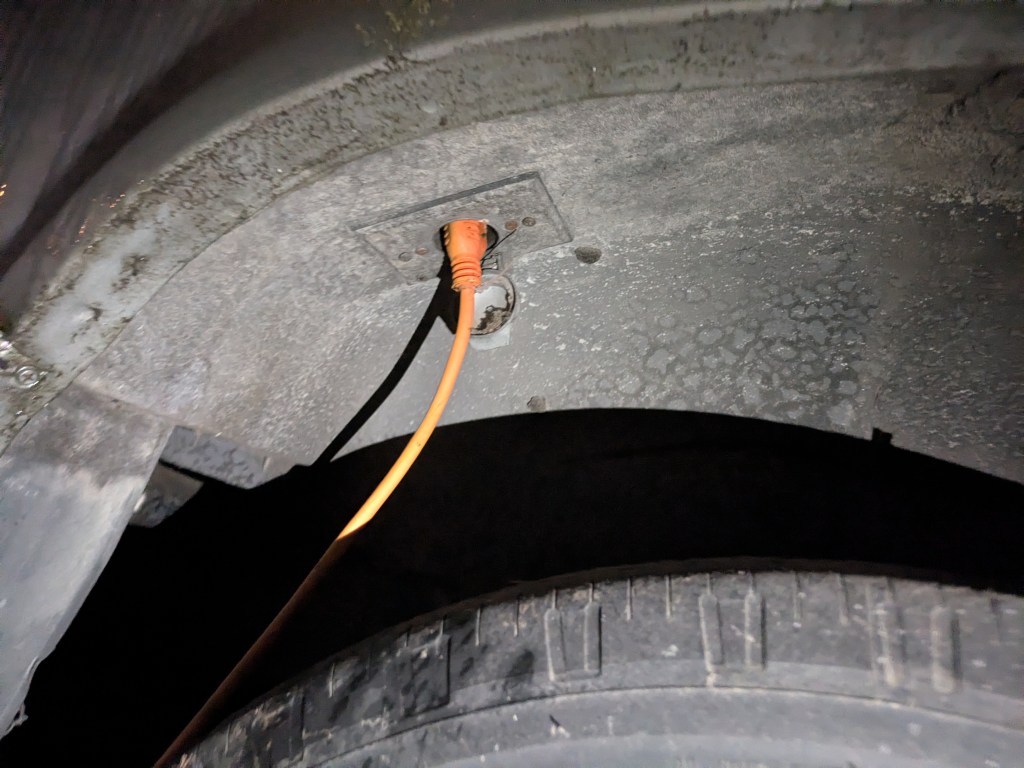
The Power-Up Protocol: Methodical Restoration
We aren’t just hooking up a jump pack and hoping for the best. After 15 years, a “shotgun” approach could lead to a catastrophic short. The strategy is a controlled, bottom-up activation:
- Isolation: Every circuit breaker on the main panel is being flipped to the OFF position. This isolates the sensitive 1980s electronics—the ICOM, the Marantz decks, and the CRTs—from the initial surge.
- The Battery Audit: Initial testing of both the Van (Starter) battery and the House (Auxiliary) battery bank has confirmed what we expected: both are dead and non-recoverable. The van battery will be replaced and connected to a separate battery maintainer, while the house battery will be bypassed during initial testing.
- Shore Power Activation: We will introduce 110V AC through the wheelwell inlet to power up the inverter/charger unit. This will provide a stable DC bus for the rest of the testing.
- Incremental Testing: With the inverter live, we will flip the circuit breakers one at a time. We will be monitoring for shorts and watching the GE Analog Amperes gauge for any sudden, unexpected current draws that indicate a wiring failure.
- Case File 003: The Master Inventory Audit
Restoring a vehicle like the “Vice Van” is as much an archeological dig as it is a mechanical project. Before we can start soldering or turning wrenches, we have to know exactly what we have.
Below is the complete equipment manifest of The Vice Van as it sits today. This represents the pinnacle of 1989 surveillance technology—hardware that built cases and recorded history.
Category Component Model / Identifier Status / Observation Radio/RF Communications Receiver ICOM IC-R7000 The “Master Scanner.” Faceplate is clean; dial feels smooth. Radio/RF VHF/UHF Transceiver Midland Syn-Tech (x2) Labeled for local agency monitoring. Brittle coiled cords. Radio/RF Handheld-to-Base Converter MA-COM Unit Converts handheld radios into low-power base stations. Radio/RF Handheld-to-Base Converter Motorola Unit Integrated converter for handheld-to-antenna signal boosting. Audio Tape Recording Deck Marantz PMD Series (x2) Labeled “Audio 1” & “Audio 2.” 1/4″ and Mic inputs. Audio Audio Mixer Shure M267 5-Channel. Used for balancing covert mic feeds. Video Industrial VCR Panasonic AG-1070DC (x2) 12V DC powered. One marked with maintenance tag “41650.” Video Video Selector Archer Audio/Video Routing hub for monitors and recording decks. Monitoring Primary Monitor Panasonic CRT Mounted in the main rack; 1994 timestamp on last use. Monitoring Secondary Monitor Hitachi CRT Smaller auxiliary monitor for multi-cam viewing. Control PTZ Controller White Joystick Box Remotely operates the roof-mounted periscope camera. Electrical Power Switchboard Seatron Custom Panel Toggles for A/C, Vent, Heat, and Stabilizers. Electrical Analog Gauges General Electric D-C Large Volts and Amperes meters for battery health. Security Alarm Interface AutoPage 4242 Alarm interface box for securing the van and its contents. Technical Breakdown by System
1. Signal Interception (Radio/RF)
This was the van’s “ears.” The goal was to monitor every relevant frequency in the Hillsborough/Tampa area.
- The ICOM IC-R7000: This is a wideband communications receiver. Unlike a consumer scanner, this unit can pick up signals from 25MHz to 2000MHz. It could have been used to find “pirate” frequencies or unlisted tactical channels used by suspects.
- The Midland Syn-Techs: These are rugged, EPROM programmable mobile radios. These were the “workhorses” dedicated to the primary dispatch and tactical channels for the Sheriff’s Office.
- The Converters (MA-COM & Motorola): These units allowed detectives to take their standard-issue handheld radios and “dock” them. This instantly connected the handhelds to higher-gain antennas and the van’s power supply, turning a portable radio into a powerful base station with superior range.
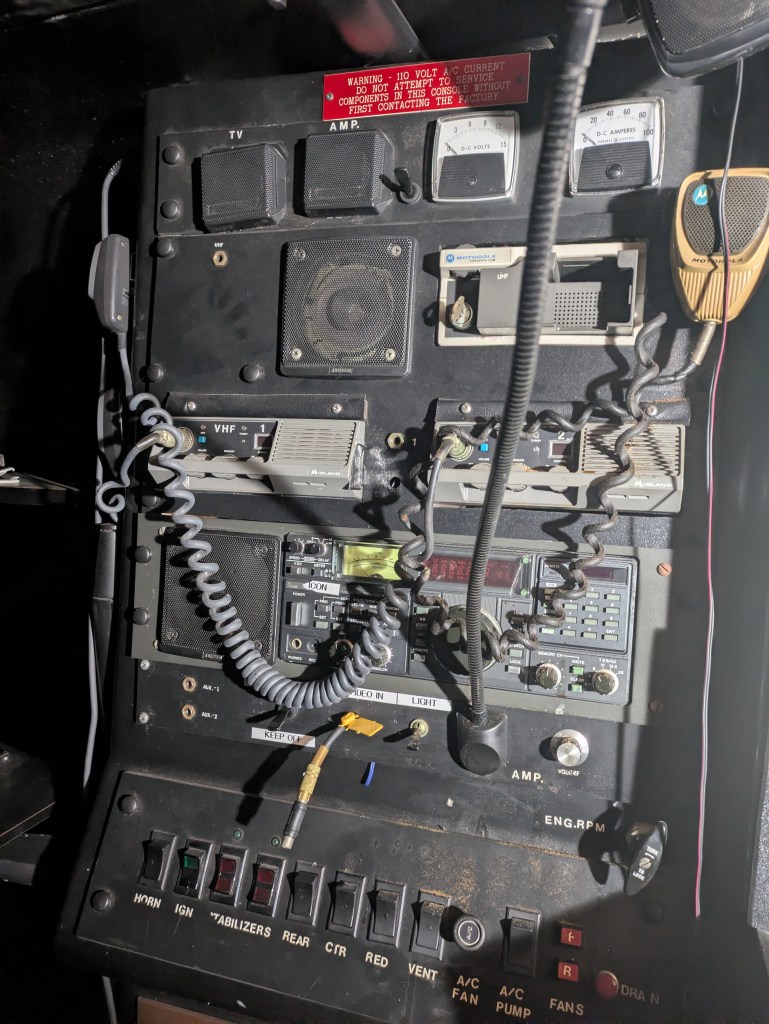
2. Evidence Capture (Audio & Video)
Everything heard or seen had to be recorded to be admissible in court.
- Marantz PMD Series: These are legendary in the field for their “Direct Drive” systems and high-fidelity recording. They feature built-in limiters to prevent loud noises (like a door kicking in) from distorting the tape, ensuring every word of a whispered conversation was caught.
- Shure M267 Mixer: This 5-channel mixer acted as the ears of the operation. It was specifically wired to a four-microphone array—one hidden on each side of the van (Front, Back, Left, and Right). The detectives could adjust the gain on each individual mic to isolate a conversation happening on the sidewalk (Right) while cutting out traffic noise from the street (Left). This spatial mixing ensured that no matter where a deal was going down, the audio was centered and clear for the recording.
- Panasonic AG-1070DC VCRs: These are industrial 12-volt DC units. Unlike home VCRs, these were designed to run off battery power and survive the vibrations of a moving vehicle. They provided the visual proof of who met whom and when.
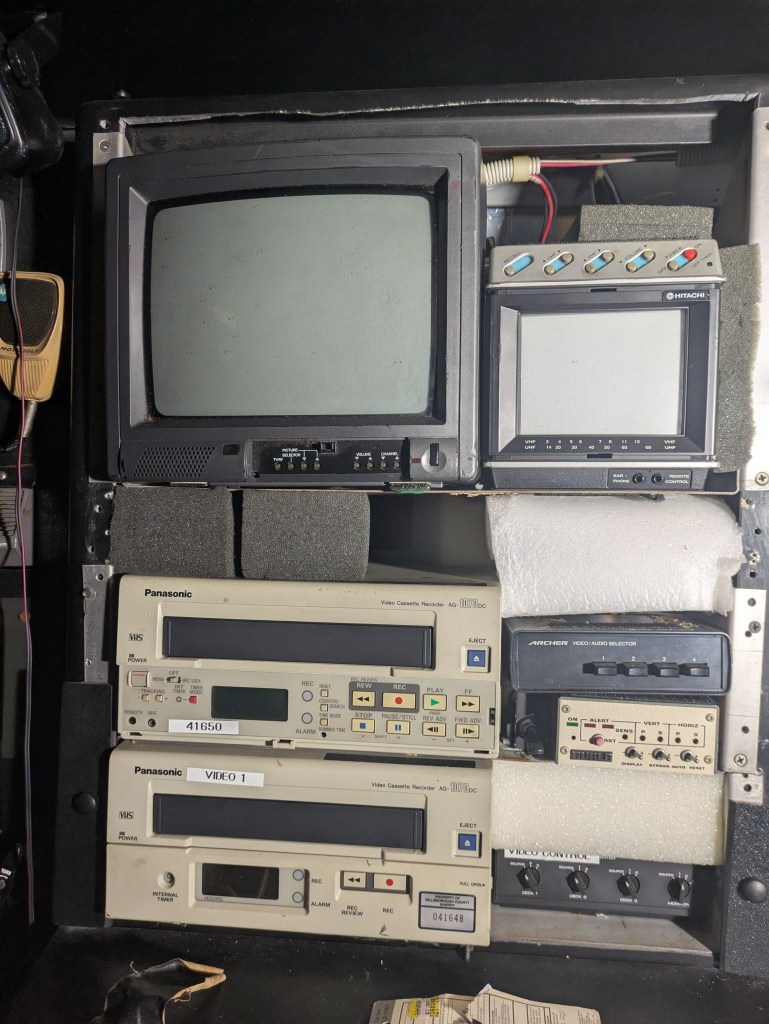
3. Observation & Control (Monitoring)
This allowed the “Vice Squad 527” team to stay out of sight while maintaining total situational awareness.
- CRT Monitor Array (Panasonic & Hitachi): Before the era of flat screens, these heavy-duty CRT monitors provided the only way to see what the cameras were seeing.
- The Motion Detector: This joystick box is the interface for a high-tech motion detector alarm. In a modern system, motion detection is handled by software; in 1994, this was the “brain” that did it manually via analog signal analysis
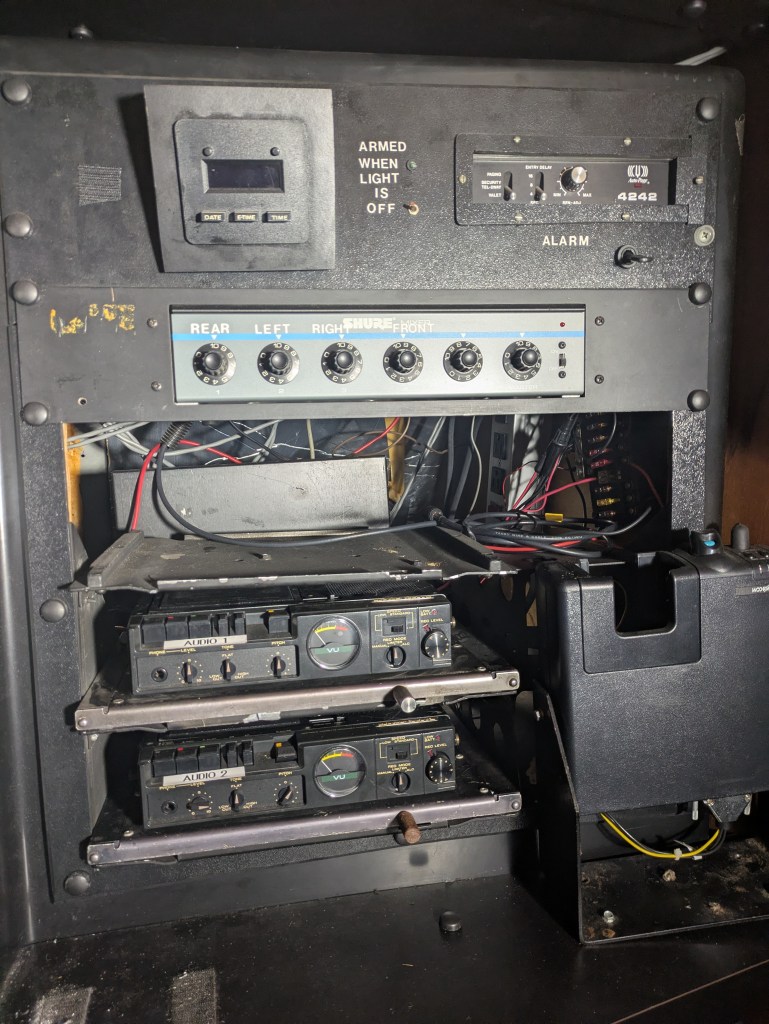
4. Tactical Infrastructure (Electrical & Security)
This is the “life support” that kept the detectives from being caught or overheating.
- The Seatron Switchboard: A custom-built power distribution panel. The “Stabilizer” switch is a key detail—it operated jacks to keep the van’s suspension from moving when the operators shifted their weight, which would prevent the “tell-tale” rocking that gives away a stakeout van.
- GE Analog Gauges: These provided a real-time “health check” of the auxiliary battery bank. In a high-drain environment with multiple CRTs and radios running, monitoring the batteries was critical to ensure the van didn’t die in the middle of a sting.
- AutoPage 4242: A high-end 80s security system. Beyond just a car alarm, this likely protected the rear equipment doors and the “periscope” camera to prevent tampering if the van was left unattended.
The Uncatalogued Cache: Beyond the Rack
While the primary equipment is bolted into the racks, the rear of the van serves as a graveyard for loose tactical gear that was likely “tossed in” when the unit was finally decommissioned.
We’ve discovered boxes containing an assortment of loose cameras and high-zoom lenses, ranging from standard surveillance glass to specialized lenses.
Mixed among the hardware is a tangle of professional headphones and auxiliary speakers used for multi-operator monitoring, alongside a “rat’s nest” of proprietary wiring looms and connectors that have yet to be traced.
It’s a literal puzzle of 1980s tech that will take weeks of sorting to fully document.
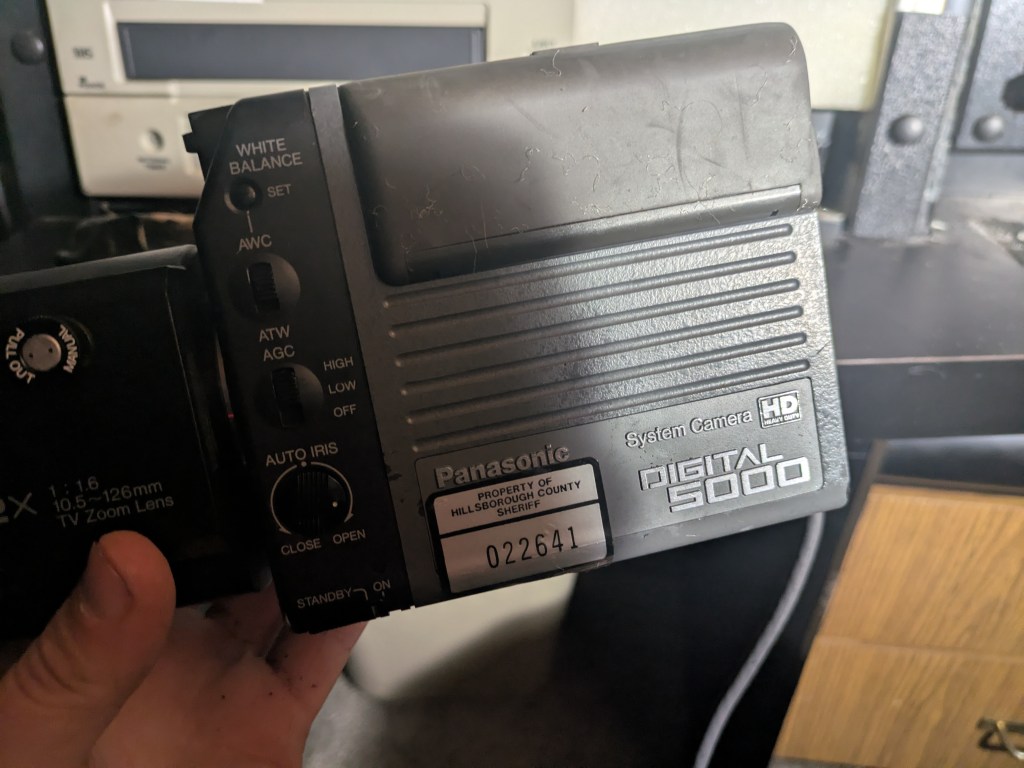
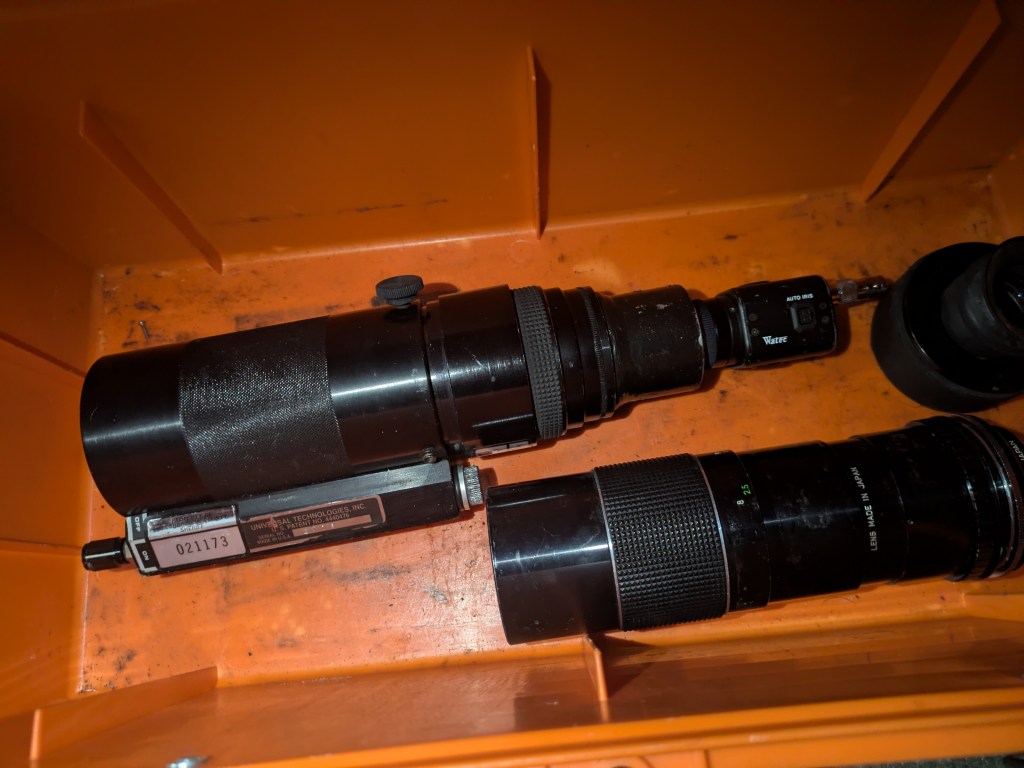
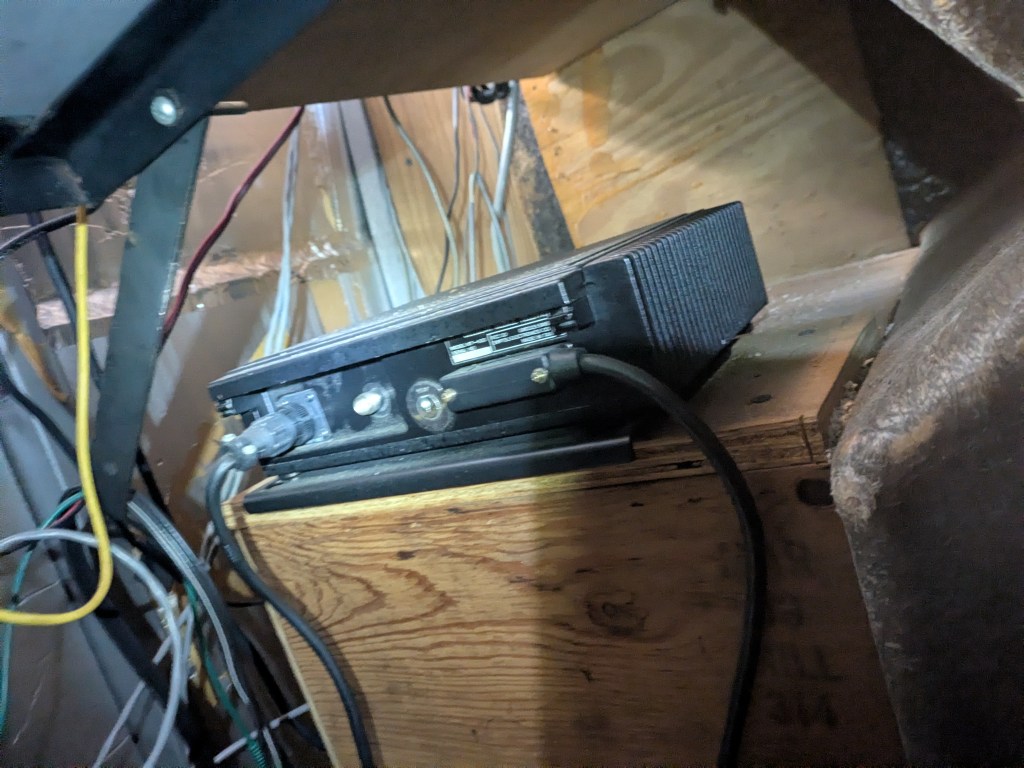
- Case File 002: The Analog Arsenal
While the exterior of the van was designed to be ignored, the interior was built to be an elite listening post. Stepping through the side doors, you leave the present day and enter a high-stakes workspace from 1989. This isn’t just a collection of old radios; it’s a fully integrated evidence-gathering machine.
The Surveillance Rack
The core of the van is a floor-to-ceiling equipment rack. This was the “brain” where signals were intercepted, mixed, and recorded to tape.
- The Audio Hub: Two Marantz PMD series cassette decks (labeled Audio 1 and Audio 2) and a Shure M267 mixer. These weren’t for music; they were chosen for their ability to capture clear voice recordings that would hold up in a courtroom.
- The Frequency Watch: An ICOM IC-R7000 communications receiver sits as the centerpiece. This wideband scanner allowed the Vice Squad to monitor almost any frequency in the Hillsborough area.
- The Monitoring Station: Two CRT monitors—one Panasonic and one smaller unit—provided the eyes for the operation.
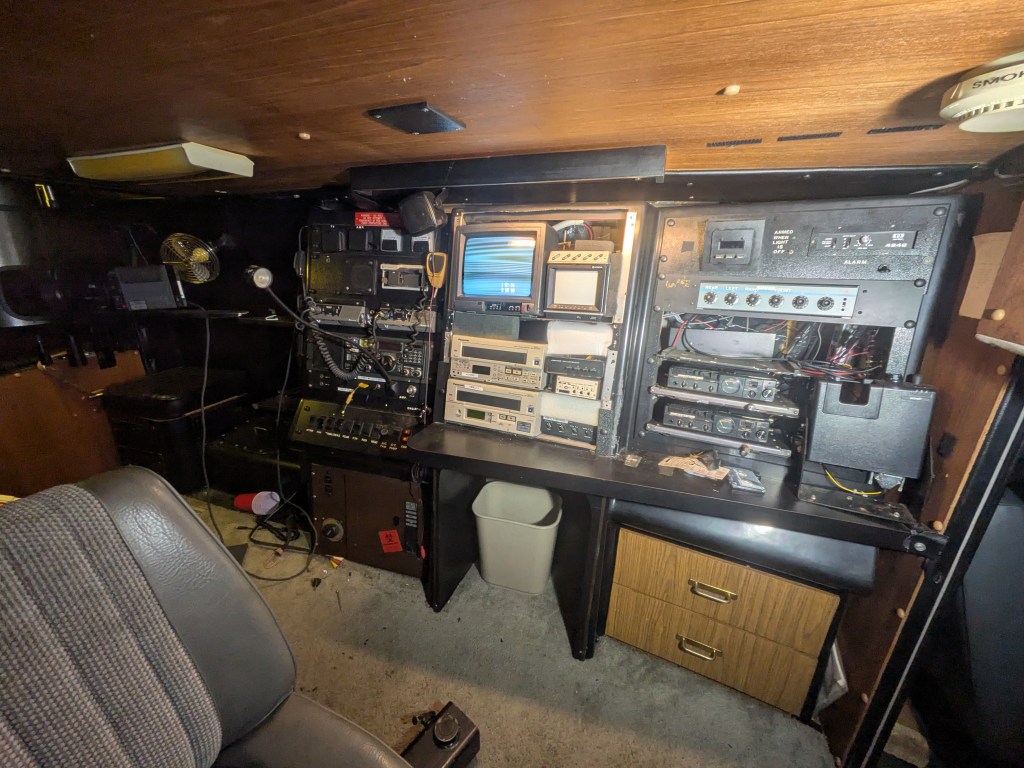
The Control Interface
On the desk sits a specialized piece of kit: a white PTZ (Pan-Tilt-Zoom) controller. This joystick allowed the operator to remotely aim the roof-mounted camera with surgical precision, all while sitting comfortably in the back of the van.
Next to it is the Seatron Switchboard. This custom panel manages the van’s “hidden” life, with toggles for:
- Stabilizers: Used to keep the van from rocking and tipping off the surveillance team.
- Environmental (A/C, Vent, Heat): Essential for surviving long Florida stakeouts.
- Power Monitoring: Two large, analog General Electric D-C meters for Volts and Amperes.
The Toll of 15 Years
The “Time Capsule” effect only goes skin deep. A closer look reveals the damage of the “15-year slumber”:
- The Brittle Cords: The coiled microphone cables for the Midland and Motorola radios are physically failing. The rubber jackets have dry-rotted and cracked; they are now so brittle that they snap if you try to stretch them.
- The Frequency Cheat Sheet: Taped to the wall is a hand-typed list of frequencies for Tampa PD and Hillsborough County. It’s a literal map of the airwaves as they existed 35 years ago.
- The Power Distribution Box: Located near the floor, the main power unit still sports a Biohazard magnet—a piece of dark squad humor left behind by the previous operators.
Coming Soon: The Inventory Audit
This overview only scratches the surface. To truly understand the capability of this van, we have to look at the equipment not as individual pieces, but as a total system. In our next update, we will be releasing the Master Inventory Audit—a full technical breakdown of every single piece of 1980s surveillance tech still bolted into these racks.
We are currently cataloging every device, including:
- The Receivers: ICOM IC-R7000, multiple Midland 70-155 units, and the Motorola Radius setups.
- The Recording Stack: Dual Marantz PMD series decks and the Panasonic AG-1070DC VCRs.
- The Processing Gear: The Shure M267 Mixer, the Archer Video/Audio Selector, and the Am-Par 4242 Alarm interface.
- The Optics: The PTZ remote system and the Hitachi/Panasonic/ monitor array.
- The Power Grid: The Seatron Switchboard and the massive GE analog monitoring gauges.
We’ll be looking behind the faceplates to see what’s just waiting for the right voltage to come back to life.
- Case File 001: The 27k-Mile Time Capsule
The paperwork for this 1989 Ford Econoline told one story: a high-mileage government surplus vehicle with 275,000 miles on the clock. But upon physical inspection, the odometer revealed a clerical error. This van has only traveled 27,545.4 miles since it was delivered to the Hillsborough County Sheriff’s Office 35 years ago.

This discrepancy changes the entire nature of the project. This isn’t a worn-out workhorse; it is a mechanically preserved survivor. Because it was custom-manufactured by Seatron International Inc. specifically for surveillance work, it spent its life stationary—idling in the shadows while its racks of analog gear did the heavy lifting.
The Provenance
The van’s origin is verified by its original Ford Warranty Identification Card and the Seatron manufacturer’s plate, confirming a delivery date of May 22, 1989. While it eventually moved from Hillsborough County, Florida to the 15th Judicial District Drug Task Force in Tennessee, the interior remains exactly as it was outfitted for the Vice Squad in the late 80s.
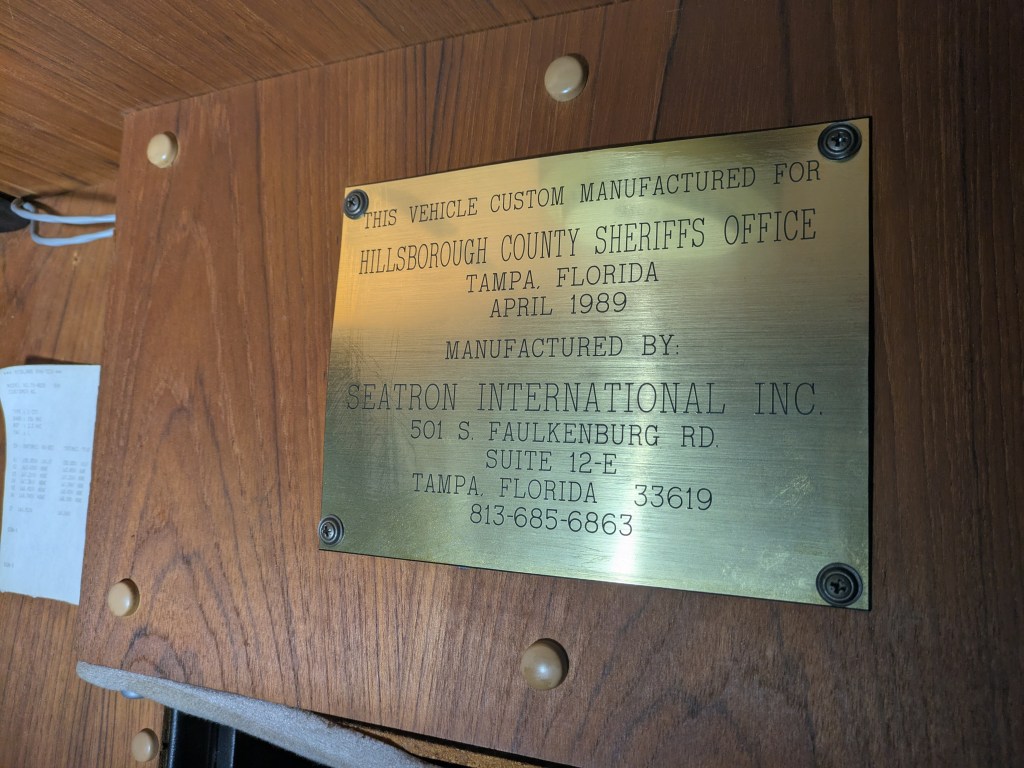
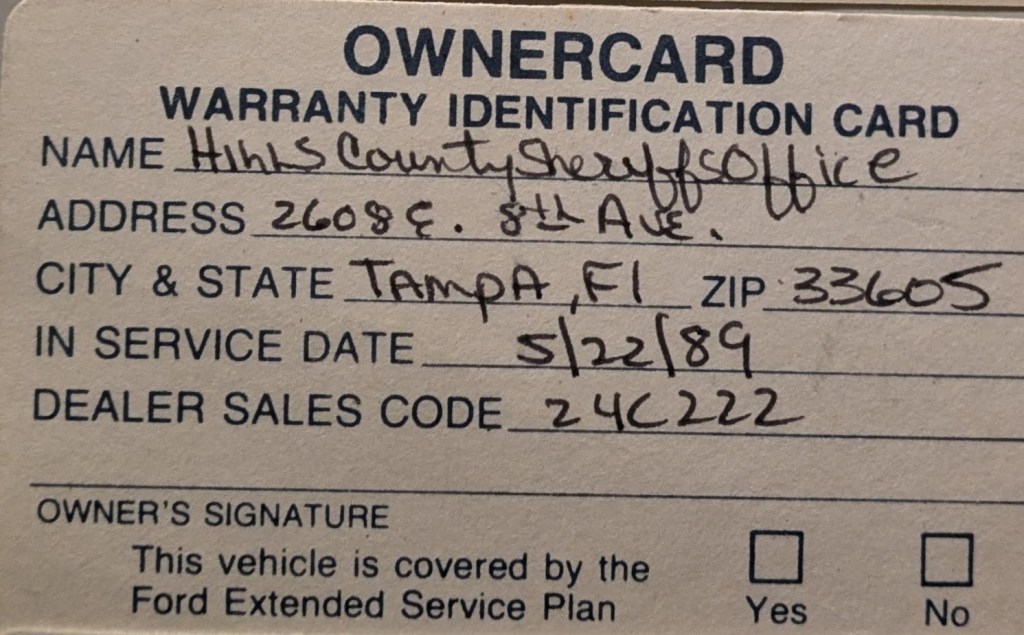
The mission for The Vice Van: Hillsborough Files is to document the technical preservation of this unit. We aren’t just fixing an old Ford; we are auditing a rolling laboratory of 20th-century surveillance.
The Recovery
I found the van on a government surplus website, listed by the 15th Judicial District Drug Task Force in Hartsville, Tennessee. It had been sitting untouched in storage since approximately 2011, and it looked every bit the part.
When I arrived for pickup, the silver paint on the hood and roof was buried under a decade of grime and heavy surface rust. The tires were flat-spotted and dry-rotted beyond trust. Because I had no intention of risking a 27,000-mile engine by firing it up with 15-year-old gasoline and brittle seals, the “first move” was handled by a rollback tow truck.
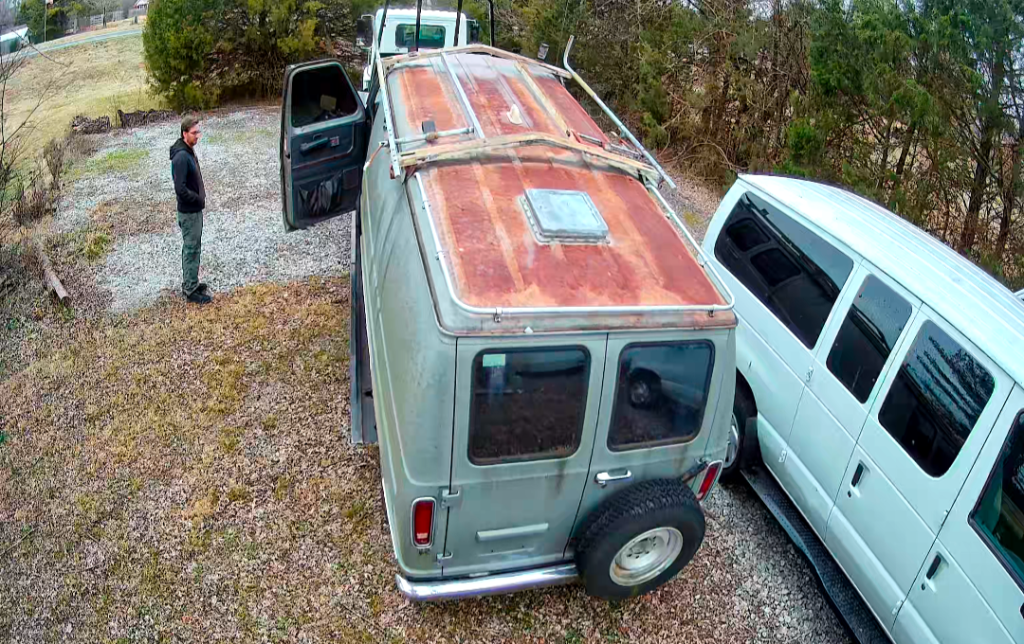
I noted during early on that the exterior is weathered and rough, but at a second glance it’s in remarkable condition with a straight body and solid frame. Suffice it to say, this is a 6,000-pound mystery box that hasn’t seen the road in a generation.
The Inspection
As soon as I opened the heavy side doors, the contrast was jarring. The “storage” had acted as a time-capsule seal. While the outside suffered in the Tennessee elements, the interior remained a pristine 1989 workplace. Aside from some dust and a few leaked batteries in the storage compartments, the Marantz decks, ICOM scanners, and “Vice Squad” paperwork were exactly where they were left when the unit was decommissioned.
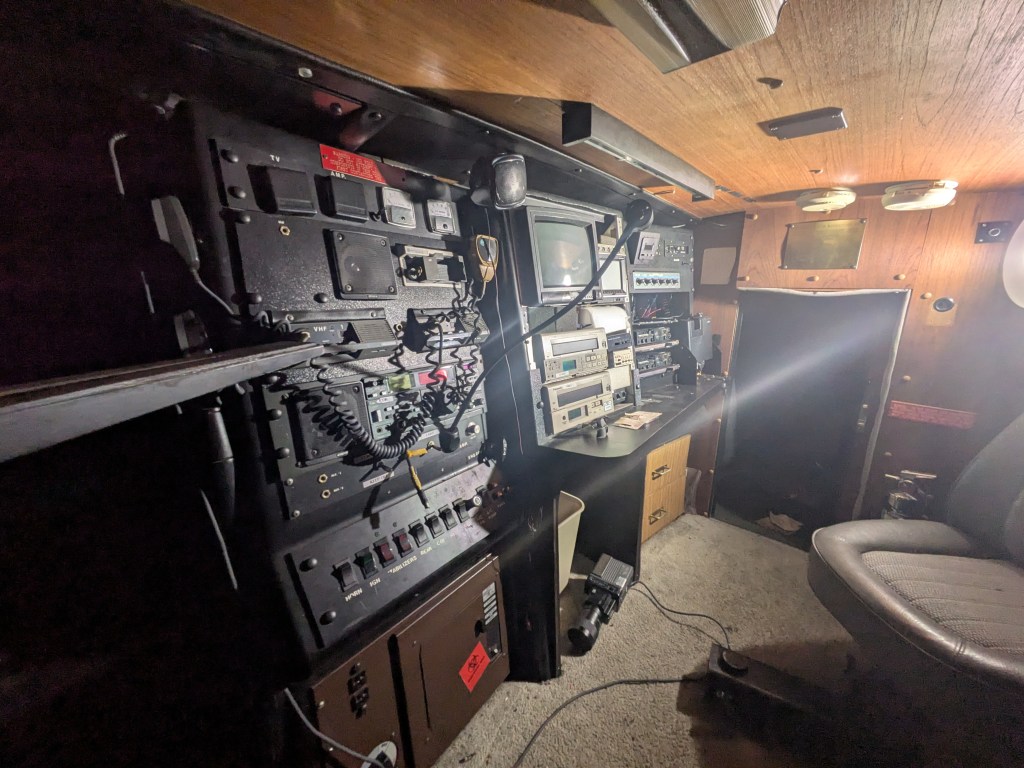
The Toll of Time: Surface vs. Substance
While the interior looks like a 1989 time capsule, a closer look reveals the damage of fifteen years of dormancy. The environment has been particularly hard on the plastics and rubber.
Many of the coiled microphone cables and audio patch cords have become extremely brittle. The outer jackets are dry-rotted and cracking, exposing the shielding underneath. In some cases, the insulation is so compromised that the wires stiffen into whatever shape they were last left in, snapping if you try to straighten them.
It’s a reminder that “preserved” doesn’t mean “functional.” Every signal path, from the ICOM antennas to the Marantz input jacks, will need to be meticulously inspected and likely re-terminated or replaced before we can have a working surveillance rack again.
The Human Element: Squad 527
Perhaps the most sobering find isn’t the high-end Marantz gear or the low-mileage engine, but a simple, faded contact list left behind, lost in a storage pocket. It’s a roster for Vice Squad 527, listing the names and home numbers of the Sergeants, Corporals, and Detectives who operated out of these blue captain’s chairs.
Seeing a list of names, with unit numbers and pager IDs, is a reminder that for thousands of hours, this cramped, windowless box was a center of operations. These men and women sat here in the Florida heat, listening to the very Marantz decks I’m now trying to repair, watching the same CRT monitors that now sit dark in my driveway.
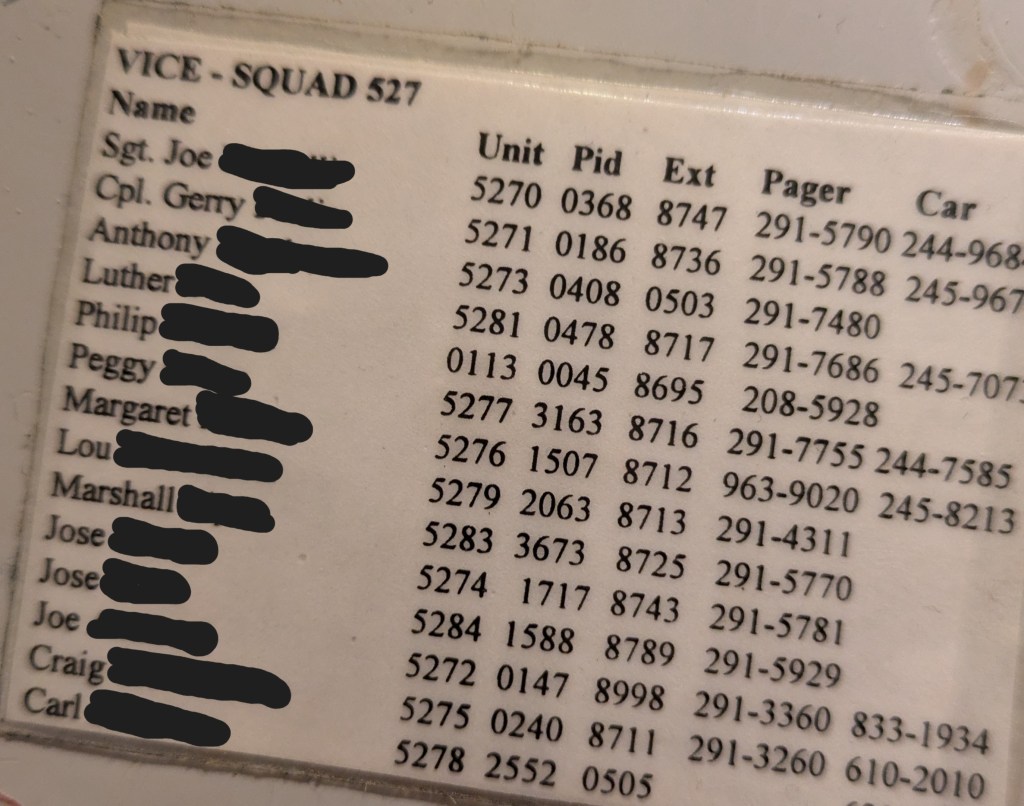
They left behind more than just gear; they left behind a “Brief Relief” urinal bag, an instant cold pack, tylenol, and coffee stains. It’s a workspace frozen in time, right down to the dry-rotted microphone cords hanging like cobwebs off the rack and the decades expired soft drinks.
This project isn’t just about making an old Ford run again. It’s about preserving the tools and the environment of the people who worked in the shadows of The Vice Van.
-
Subscribe
Subscribed
Have a WordPress.com account? Log in now.

